

Who is Andy Burnham and what is he about? The PM-in-waiting gave a speech last week setting out his ideas about devolution, and has made some other interventions setting out his stall.
Labour do have one big, consistent idea: raise tax and spend more. Burnham will do that for sure.
But beyond that it is very, very thin. Maybe there is a brilliant secret plan under preparation, but so far, the ideas he has set out fall into three categories:
incredibly familiar / already happening
hazy or meaningless
far too small to solve big problems - often problems the government is creating.
Let’s have a quick tour. Below, Burnham’s words are in bold italics, and my thoughts on them are in plain text.
* * * * * * *
“On reindustrialisation, we will support every region to set clear and credible industrial ambitions and provide the support to achieve them, encouraging more cross-UK partnership between places with complementary industrial clusters”
Ah, good old clusters. Lots of Prime Ministers have said very similar things. In fact, Starmer was saying similar things about “firing up our industrial heartlands” not long ago. But the truth is that we are rapidly de-industrialising, because of government energy policy.
The manufacturers trade body Make UK say: “Britain faces deindustrialisation unless manufacturers get relief from high energy prices.” In fact, it’s already happening: Ineos Grangemouth ethanol plant, Sabic's plant in Wilton, Teesside, CF Fertilisers in Ince, and numerous ceramics firms have all closed - blaming Britain’s uniquely high energy prices. As Sir Jim Ratcliffe pointed out after the Grangemouth closure. “De-industrialising Britain achieves nothing for the environment. It merely shifts production and emissions elsewhere” If Burnham was at all serious about this then his first move would be to sack net zero zealot Ed Miliband - instead he is apparently thinking of making him Chancellor.
I am probably about as sympathetic as they come to the ideas that a) we should re-industrialise and b) work hard to get poorer places growing faster. And net zero is just one of the obstacles. But everything Burnham has said so far makes me think this is heading towards yet more high-flown rhetoric, more fiddly, bureaucratic schemes and more eventual disappointment.
* * * * *
“We will make sure that all eligible public contracts are subject to proper social value weighting. And we will do that to make sure British based companies are in a better position to win those contracts…”
Public contracts already have social value weighting - there is literally primary legislation (The Public Services (Social Value) Act 2012) promoting it - and lots more besides. In fact there is so much emphasis on “social value” that this can become a problem - for example, British businesses got locked out of bidding for a MOD satellite contract precisely because they could not comply with “social value” red tape on things like Climate Change and Modern Slavery. In reality it would be better to hack back some of the proliferation of woke side-objectives that add cost to procurement and lock out smaller businesses from bidding.
* * * * *
“The days of a school system configured entirely around the university route will be brought to an end”
Another very familiar trope - again, Starmer said very similar things not long ago and announced a load of fiddly and inconsequential changes. For example, the government press release breathlessly promised: “a joined-up post-18 education system, with a unified regulator and funding model for level 4+ courses… FE colleges will gain new awarding powers, and the Lifelong Learning Entitlement will ensure parity in student finance across higher level study FE and HE – opening up opportunities for more learners, including through modular courses tailored to priority skills.”
Fine, but meanwhile back in reality, the government has actually been hacking back apprenticeships in various ways (defunding higher apprenticeships and management apprenticeships), while continuing the endless expansion of low value university courses and student debt.
In fact an increasing number of universities require no qualifications to apply - but so far Labour have been opposing Conservative plans to bring in number controls on poor university courses. I will take Burnham’s rhetoric on ‘ending the university obsession’ more seriously when he drops Labour’s opposition to exactly that.
* * * * *
“On utilities, we will ensure all parts of the UK are able to take greater public control of essential services like water, housing, energy and transport. Learning from the model that has transformed our bus networks here in Greater Manchester. We will set out ten year plans to bring down the cost of these essentials to individuals, families and businesses”
What is “public control”? Public ownership would be astronomically expensive - billions to buy up these utilities. If it is just control then all these utilities are already regulated. If you want to force down energy bills via regulation then fine, but taxpayers will need to fund that - and the experience of 2022 shows how very expensive that can be. So what exactly is going to change here? I detect no sign of a clear plan here.
* * * * *
“Number 10 North will oversee the biggest council house building programme since the post-war period.”
This sounds like a huge spending commitment. Maybe it will be. If so, it’s not obvious that this would be the right priority: The Hills Report (2007), published under the last Labour government, found that even after controlling for a lot of different factors, people in social housing were less likely to be in work than equivalently disadvantaged people in the private rented sector. We already have one of the highest proportions of social housing of any European country. Would this be a better use of taxpayers’ money than some of his other priorities?
But I think this is actually just going to turn out to be a rhetorical sleight of hand, moving money between two definitions - from funding housing associations to funding councils to build. Over the last decade only about 14% of what people call “council housing” has been built by actual councils - the rest is housing associations. That’s because the Housing Associations are able to build at a much lower unit cost, so in the allocation of funding by councils and central government they tend to win out.
Burnham could rig the competition so that more of the money is reserved for councils. Then he would be able to say (misleadingly) that we had “record council house building”. But in reality, he would end up with fewer affordable homes overall, because the cost per house would be higher.
Burnham has also been interested in a different definitional switcheroo - from “affordable rent” (20% cheaper than market rates) to “social rent” (40-50% cheaper). He could then boast of “more social housing”. But again, the real-world downside would be far fewer homes (just six “social” versus ten “affordable” for the same money) and the only upside would be to deepen discounts which are often enormous already: for a 3 bed social property in Westminster or Kensington the subsidy is worth £33,000-34,000 a year.
So with this one it is too early to say. It’s either very expensive - or involves some bad policy choices to stand up misleading political rhetoric.
* * * * *
“we will reform business rates to support pubs and high street businesses.”
Burnham is already a walking away from a clear promise made during his by-election campaign. On 5 June he promised: “We would ensure that all pubs in a constituency like this would have a 20 per cent cut in their business rates, typically worth about £5,000 a year.” That 20% cut seems to have disappeared already, replaced by vague talk about “reform”. In reality Labour has hammered these high street businesses with higher business rates, higher National Insurance and more regulation.
They cut Retail, Hospitality and Leisure business rate relief from 75% to 40%, then to zero. Then, after a furious reaction, they introduced a sticking plaster concession, but that only applies to pubs. Things like shops, cafes, restaurants, nightclubs, hotels, theatres, cinemas and clubs don’t get it - only 5% of hospitality businesses even get the sticking plaster.
Overall, OBR have estimated that revenue from business rates will rise by 10 per cent in 2026-27. And these businesses are hit by all the other Labour tax hikes too - overall, in 2028 taxes will be £105 billion higher under Labour plans than previous Conservative plans (up 8%). So this is yet more rhetoric, papering over broken promises.
* * * * *
“we will never get the growth up to the level Britain needs unless every single postcode in the land is set up to contribute to it. This country hasn’t thought in that way before, but with the Makerfield test at the heart of decision making, it will do from now on.”
What exactly is this Makerfield “test”? Is it just a statement that you want poorer places to grow faster? Well, so did loads of other Prime Ministers.
My worry is not just that that Burnham is trying to respond to huge challenges with fiddly micro announcements - but that macro policies will continue to push in the other direction.
An example: Labour’s biggest fiscal move to date has been the £24 billion increase in National Insurance, the great majority of which feeds through into lower wages. Because they cut the threshold rather than, say, raising the rate, Labour’s increase was laser-targeted on low income working people. They cut the threshold from £9,100 a year to £5,000 a year.
The OBR say 76% of the change is passed through into lower wages. So someone on £13,000 loses £500. Someone on £9,000 loses 5% of their income. This is a regressive policy because poorer people are taking much bigger losses as a share of their income (the green line below).
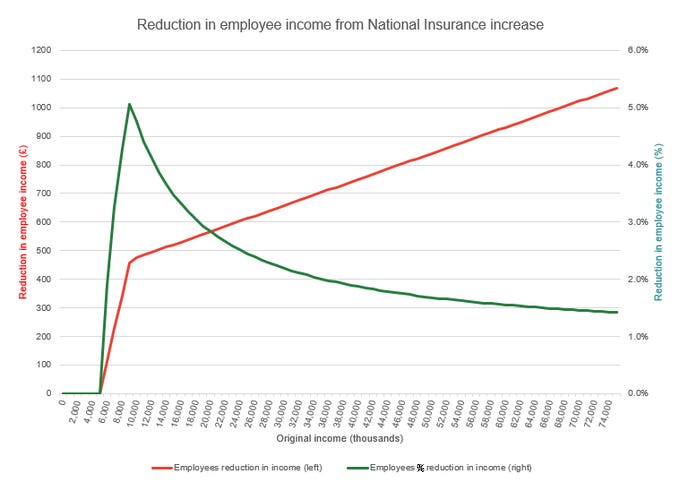
And if you hit poor people, you hit poorer places too. People in Makerfield will be losing more of their income than people in London from this policy.
So this massive, tens-of-billions policy obviously fails the “Makerfield test” - but will Burnham get rid of it? At one point he was critical of it. On 5 June he said: “I have said that I thought the weight of the burden on employers’ National Insurance wasn’t the right decision.”
But now he seems to have fallen silent. Even Rachel Reeves now admits there is a “valid argument” this tax increase was a mistake. No kidding. But there is no plan to fix it, because they want to do lots more spending.
Conclusion
I could go on and on. My worry for Burnham is that despite the soaring rhetoric, nothing he is saying makes me think he has ideas on the scale needed to deliver real change.
For example, I am more interested than many in how we can make poorer places grow faster. But to change trends that have often been going on or over a century you need a bazooka - not a peashooter. For example, you need to think about how we can move some of the vast sums we spend on welfare in poor places from paying the bills of social failure to investing in the future.
Likewise, if you want to make housing affordable again you need to change a lot of things - not just fiddle with different definitions or build a few more council houses. And if you want to “reindustrialise” or “save the high street”, you need to tear up, not repeat, the policies of the Starmer government.
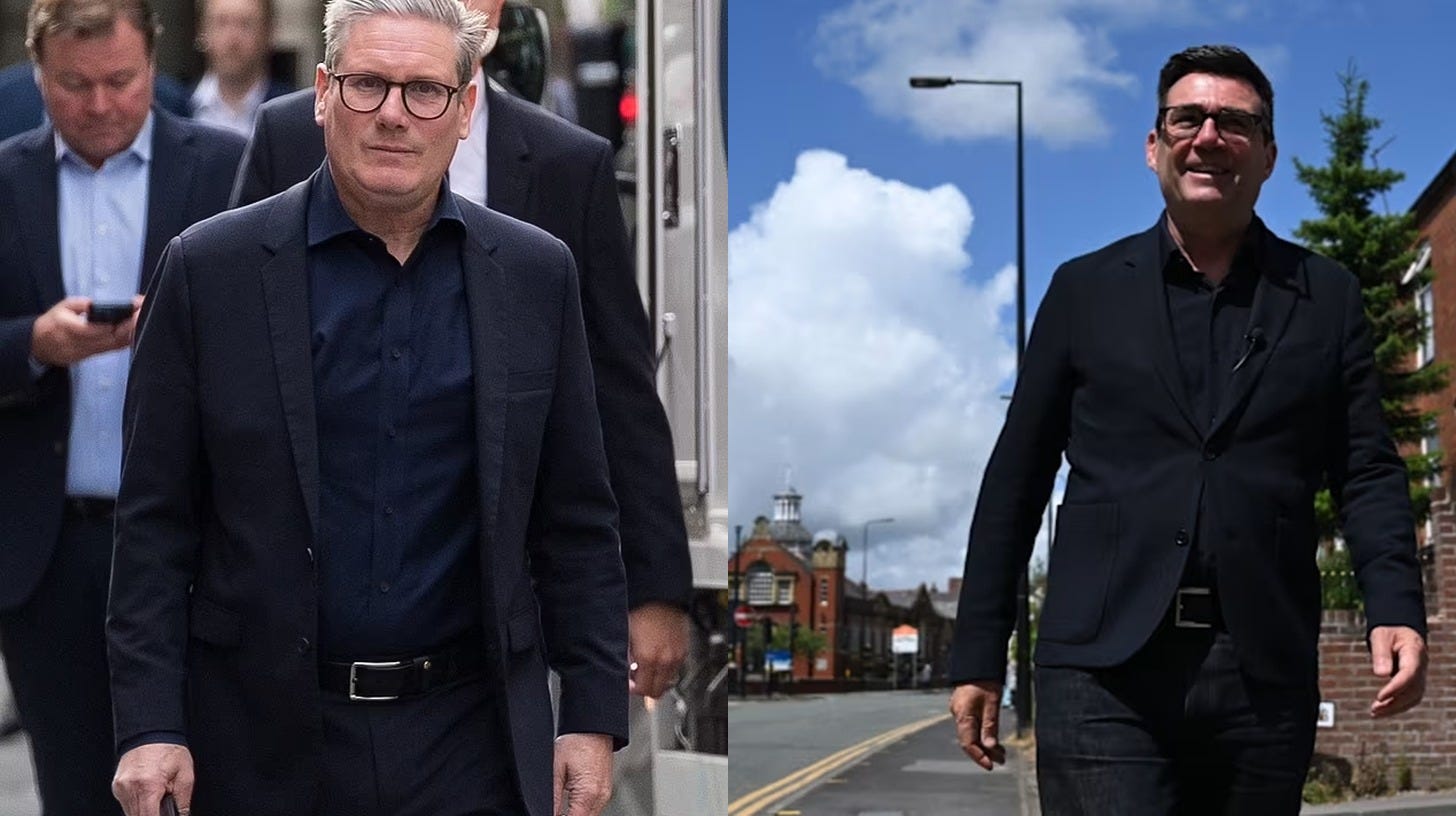
I hope I am wrong. But as things stand, I worry we are just going from one middle aged guy in a dark shirt to another, and the country will carry on declining.
"Head North"(2024), which Burnham co-wrote with Steve Rotheram, has gem-after-gem of inadvertent self-revelation. It's surprising the MSM has not gone to such a key primary source. Critiqued today for ConHome.
In short, Burnham's policy page is no more than "This page intentionally left blank."
If he doesn't get rid of Net Zero the whole country will get poorer, not just aleady poor places.