

Andy Burnham inherits a lot of problems and unresolved issues from the Starmer government. Here is a quick tour through just some of them.
The Defence Investment Plan
The final act in Starmer’s fall was the Defence Investment Plan, with a gaping hole in the plan for funding it. This included:
- £4.7 billion “to be funded at Budget 2026”.
- £4 billion of capital cuts in NHS, education, roads etc (these departments admit they have no idea1 how to find this.)
- £2.4bn allocated to “more efficient procurement” (polite language for “unfunded”).
- £1.1bn allocated to unknown “MOD asset sales” (what are they selling?)
But the supermassive black hole at the heart of the DIP is just the start. We have promised NATO that we will be spending 3.5% GDP by 2035. But Andy Burnham has declined to commit to his new Chancellor John Healey’s demand to increase defence spending to 3% of GDP by 2030.
So quite apart from funding the unfunded DIP, there is a big unresolved difference of views about hitting the NATO target. Given the appointment of Ed Miliband has gone down very badly in the US, there is every chance the UK is pressed by NATO allies to move faster on this, and the Chancellor is on the record saying we must. Who will back down?
Early release of prisoners and sex offenders
In September, part of Labour’s Sentencing Act 2026 will come into force, meaning that killers, rapists and sex offenders will qualify for early release. 700 offenders are due to be released in this first wave, with 5,000 expected to be released early in total.
Victims have begun to receive letters from the government telling them their abusers or attackers are set to be freed under the scheme.
Last time this happened, there were numerous examples of offenders re-committing within hours of being let out of prison early.
Burnham has briefed the Times that he is exploring how to tighten the early release scheme to prevent child sex offenders from walking free.
Will he intervene to prevent sexual offenders being released in the first wave in September? Will he prevent violent offenders being released early as well? Time is ticking away….
Northern Ireland veterans and the Troubles Bill
The Government is attempting to repeal the Northern Ireland Legacy Act and replace it with a Troubles Bill.
Al Carns, in his resignation letter, described their bill as “unfit for purpose,” saying it “risks failing the very veterans it claims to protect”, while Paul Young, a spokesman for the Northern Ireland Veterans Movement, has called on Burnham to drop the bill.
Does he intend to drop the legislation? Or will he carry forward the legislation and open the door for vexatious claims against our veterans? Even though Al Carns says it is failing our veterans?
Chagos
The Diego Garcia bill, which would have ratified the Chagos surrender, was not reintroduced at the last King’s Speech.
However, it has been reported that Jonathan Powell is set to maintain his role as National Security Adviser, and that Burnham is considering completing the Chagos surrender.
Will he commit to dropping the Chagos surrender? If not, where does he intend to find the £35bn to pay for the use of what is currently sovereign British territory? With the Starmer government forced to drop the crazy plan after the US withdrew support, will Burnham really push on with this?
SEND legislation
Council spending on support for special educational needs has tripled over the last decade, reaching £14.8bn in 2025/26. One in five students now receive SEND support.
The statutory override that has allowed councils’ spiralling SEND deficits to be kept off their balance sheets was extended at the last budget to 2027-28, with the Treasury committing to absorb 90% of historic deficits built up by March 2026.
The government’s white paper on SEND reform proposed an increase in spending out to 2029, followed by a reduction which mysteriously kicks in just after the next election. But Phillipson was always very hazy on what legislation would bring about these future savings. Amazingly, the government has refused to answer multiple FOI requests on what these forecasts are based on:
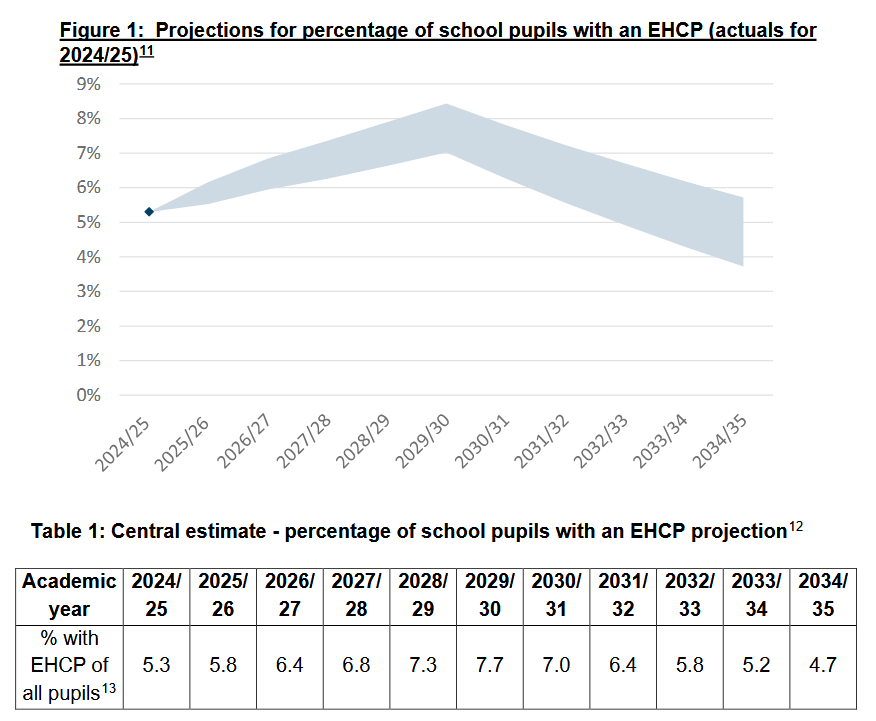
But as the fiscal forecast rolls forward if the government wants to keep banking those future savings they will have to come forward with the legislation to deliver them.
In an interview with PoliticsHome, Burnham called ECHPs “part of the problem, in that [they add] much greater fragmentation to an already fragmented landscape” and called for a “whole school, not individual child funding model”.
Will Burnham stick with Phillipson’s plan? Now you mention it, what even was Phillipson’s plan?
Will he extend the statutory override again? The OBR has projected that cumulative deficits will reach around £14bn by the time the override expires. How does he expect to pay for this?
Puberty blockers
In February, the “Pathways” clinical trial for puberty blockers was paused over MHRA safety and ethics concerns. A modified protocol has been agreed and is scheduled to commence on 1st August 2026. Children as young as 11 will still be eligible. We will be in a situation where the government is banning the sale of energy drinks to the under 16s but allowing the use of experimental drugs which may cause irreversible damage to 11 year olds.
Burnham was one of 253 MPs who mysteriously “missed” the vote on a Conservative motion to halt the trial.
Will he allow it to continue?
Benefits bill
The number of claimants on Universal Credit with no requirement to work has increased by 1.5 million since Labour took office, and total spending on health and disability-related benefits is forecast to rise to £100 billion by 2030.
Sir Stephen Timms has said “The current rate of welfare spending is not a concern” but voters disagree. Working age benefit spending in Great Britain was £139.7 bn in 2024/5, and will rise to £178 bn by 2030/31. So the bill per person will be over £2,500 a year, or for a family of four that is over £10,000 a year. For context that is about 9 times what we currently spend on the police in England and Wales (£20bn) or nearly 3 times what we spend on schools in England (£65bn)
Several welfare rebels have already called on Burnham to rule out using welfare cuts to fill the £4.7bn black hole left by Sir Keir’s defence spending plan, and in an interview with LBC, he ruled out what he described as “crude cuts to benefit levels that then just put people who are struggling in even worse poverty, and that often creates the backlash, and understandably so.”
Does he have any plan to address the ballooning of health and disability related benefits?
Will he accept Kemi’s offer of support from Conservative MPs to get future welfare reforms through parliament?
If not, (in the now infamous words of Pat McFadden) who will he tax in order to pay for the benefits of others?
NEETS
Since the election youth unemployment in the UK has surged to levels above the eurozone for the first time in many years. This is a very bad result, but no great surprise: the government has massively tightened employment regulation with the employment bill, massively hiked tax in a way that targets low wage workers, and tried to bring about their pledge to align minimum wage rates for 18 year olds with those for the most experienced workers.
There are now more than one million young people not in education, employment or training (NEET), and this is expected to rise to 1.25 million by the end of the decade. The crisis is costing the country £125 billion a year, which is more than the government spends on education.
Burnham has talked about ending an education system that is “overly focused on the university route,” and has promised a guarantee of a work placement or apprenticeship for every 16- to 18-year-old who wants one.
When might we see proposals for what this might look like? Who will be paying for it?
Student loans
In April, the Government announced that Plan 2 student loans will be capped at 6% in the next academic year.
Since then, it’s been reported that 4.4 million graduates with these loans are now in more debt than they were when they started making repayments.
Does he agree with Conservative proposals to abolish real interest rates for Plan 2 student loans? If not, what is his alternative to stop graduate debt from snowballing?
Pensioners being dragged into income tax
Rachel Reeves confirmed in last year’s budget that the current bands of income tax will remain in place until April 3031. Forecasts suggest 9.3 million pensioners could be dragged into paying income tax by 2030 if no changes are made. The Starmer government promised this would be dealt with but has said nothing further.
The OBR has predicted that the Treasury will raise £100m from the new payers over the next five years.
In an interview with the i paper, Burnham said that this was an issue that the next government needs to look at.
How does he intend to protect pensioners? Will he raise he raise the threshold of income tax?
If so, which other taxes will he raise to make up the difference?
Sudanese and Eritrean refugee scheme
Shabana Mahmood has announced plans for a “named sponsorship” route for refugees. It has been suggested that those offered refuge will be those from countries most in need, such as Sudan and Eritrea. The government hopes that it will reduce the huge numbers arriving on the small boats if the nationalities arriving illegally can just come legally. This is a very expensive and dangerous way to try and massage the figures – and there is a good chance it won’t work anyway.
Similar schemes have brought significant numbers. Homes for Ukraine and the Ukraine Family Scheme have brought over 127,000 Ukrainians to Britain since 2022.
Is Burnham committed to these proposals? What will he set the cap at, and how will he enforce it?
Is he also committed to the Labour manifesto pledge of closing down all asylum hotels? If so, where does he propose to house all of these migrants? Will the government continue to just shift people into expensive suburban accommodation rather than stopping the boats?
ILR
In November, the Home Secretary announced a series of welcome reforms to ILR, which include adopting proposals to extending the qualifying period, and removing the right to benefits for those with ILR. She has said that these changes will take effect this autumn.
More than 100 Labour MPs have already signed a letter to the Home Secretary opposing the changes, including new Communities Secretary Angela Rayner who called the plans “un-British”.
Briefings have suggested that Burnham is considering watering down these plans.
Will these reforms still go ahead this Autumn? Will he take up Kemi’s offer to lend Conservative votes to pass the legislation in full?
Social media changes
Last month, the Government published a Media Green Paper consulting on proposals which would force social media firms to give greater ‘prominence’ to certain state-sanctioned ‘trusted’ news outlets of the government’s choosing.
Burnham’s close ally, Lucy Powell, has gone further, saying she wants the Representation of the People Bill amended to extend broadcaster-style “purdah” rules to social media during election periods. The Bill is due its final Commons stages on the 14th of July.
Does he agree with this illiberal social media crackdown?
HS2
In an interview with the i paper, Burnham confirmed he wants to bring back the northern leg of HS2. The Manchester leg was due to cost £36bn at the time it was cancelled.
Is he serious about reviving the northern leg of HS2? If so, how will it be funded? Does he intend to cancel other regional transport in order to pay for it?
Council bankruptcy
Debt among local authorities in Britain hit a record £154.6bn at the end of the last financial year, with 25 councils reaching arrears of at least £1 billion.
Eight different councils have issued section 114 notices since 2018.
How does he intend to defuse this ticking time bomb in the public finances?
Oil and gas
Labour introduced a temporary ban on new drilling licences in the North Sea last year and has since pledged to make the move permanent with the ironically names “Energy Independence Bill”
In May, the Government endorsed a legal opinion from the ICJ that would make states responsible for “damage” caused to the world’s climate from their carbon emissions. The former Lord Chief Justice has wanted that all North Sea drilling could be ruled an illegal act as a result.
So far the government are briefing that they plan to keep to this plan. But Labour has has been divided over the issue, with some trade unions and MPs urging Burnham to demonstrate his support for the future of the oil and gas industry. Under Labour, we buy half the gas we use from Norway. Last year, Norway’s Labour Government drilled 49 wells in the North Sea. Ours drilled zero. We are also importing fuel from Russia, while refusing to use our own north sea. With billions of tax revenues also available, will Burham really stick to this national-interest-sacrificing position?
Rape gang inquiry
In December, after first fighting an inquiry then trying to sabotage it, the Government was finally shamed into launching an Independent Inquiry into Grooming Gangs, after Baroness Casey’s report uncovered a litany of institutional cover-ups, gaps in data collection and repeated failures to act on previous recommendations.
Will Burnham commit to implement the recommendations of the independent inquiry in full? Will he ensure it looks at all examples, rather than just cherry picking a few places?
The fiscal black hole and tax increases
The black hole in the DIP is on top of the £9 billion of completely unspecified “efficiencies” Reeves had already scheduled in the last two years of the forecast in a desperate attempt to make her numbers “add up”. Compared to the last Conservative Budget, spending in 2028/29 alone will be £152 billion higher (that’s 11% more than planned in that year under the Conservatives).
Burnham has suggested he wants to spend more on many things – and he will have to fill in holes left by Starmer and Reeves. He has said he won’t raise the main taxes – so which taxes will he raise? And will the OBR actually score further measures to soak the middle classes? Recent cuts to CGT were actually scored as a saving because the rate was already too high, and the proportion of people paying inheritance tax is already scheduled to increase to record levels. Is there really scope to squeeze even harder?
And finally…
As Prime Minister, Burnham will also inherit a series of longer-term commitments Labour promised in their manifesto. These include: “6,500 more teachers” (when there are 2,322 fewer teachers) and “1.5 million new homes” (when starts are falling and no-one thinks the target will be hit).
And there is also a whole host of other bills promised in Starmer’s outgoing King’s Speech but not yet introduced to Parliament:
Commercial Payments Bill
Clean Water Bill
Competition Reform Bill
Regulating for Growth Bill
Highways (Financing) Bill
Overnight Visitor Levy Bill
Commonhold and Leasehold Reform Bill
Education for All Bill
Remediation Bill
Draft Ticket Tout Ban Bill
Police Reform Bill
Digital Access to Services Bill
Removal of Peerages Bill
Draft Taxi and Private Hire Vehicle Bill
Sovereign Grant Bill
Energy Independence Bill
Nuclear Regulation Bill
National Security Bill
European Partnership Bill
Does he intend to introduce any of these? Or will he let them fall by the wayside and focus on his own agenda instead?
Conclusions
It has been remarkable to see how quickly the tensions within the Labour Party have risen. On day one in the job former Chief Secretary Darren Jones made it clear that the PM was lying when he claimed he could find funding from cancelling the (unfunded) ID cards programme - and there have been plenty of ministers briefing against one another. And that’s before they face any of these difficult decisions. Good luck everyone!
Thanks Neil. An objectively described and extremely daunting list. Just one small comment - I do think it’s misleading to describe the Chagos cost as £35bn. That’s over 100 years! He doesn’t need to find funds for that yet.
«Andy Burnham inherits a lot of problems and unresolved issues from the Starmer government.»
And a lot if not most of those issues were inherited from the previous 14 years of Conservative government.
Which points to the biggest advantage of Reform UK and Greens: thei record of government is empty so voters cannot blame them.
«Here is a quick tour through just some of them.»
Ah but most are just "ordinary administration". The Conservatives and New Labour have not lost 60-80% of their voters because of failing at "ordinary administration".
«And that’s before they face any of these difficult decisions. Good luck everyone!»
The real issue the government and the political class face is this one and none of the political parties is remotely addressing this (but the "deep state" have looked at it):
https://old.reddit.com/r/sysadminjobs/comments/1gltmn3/systems_administrator_salary/
"I work as a sysadmin in a small financial organization in one of the economically deprived countries in Africa. Work is good and not too demanding but the only problem is the pay. I am a fairy experienced professional, I have about 2 years experience in systems administration and bachelor's degree in Computer Science. I get around $172 a month after subtracting employee taxes [probably $200 before taxes]. Life here is not very expensive, living costs like rent, food and transport cost around $114 a month. It leaves me with just over $50 to spare. This is what most people are getting when they start off in any IT career by the way( sysadmin, developers etc...)."
An important "detail" of this quote is the global market wage of $200/month for a skilled STEM graduate with some experience; that means that the wages of 90-95% of UK workers are grossly unsustainable in the global labour market.
But the most important "detail" of the quote above is "living costs like rent, food and transport cost around $114 a month" because if the same were true in the UK then UK worker wages could be competitive with those of the global labour market.
So the big problem that all UK governments have failed to overtly address is that property prices and business profits depend on a large mass of buyers whose purchasing power from wages is grossly unsustainable, and property and business business owners are the core constituencies of all major parties.
The Conservatives lost 60-80% of their voters because in 2022 property prices largely flattened putting their "Middle England" voters in the situation where the vast majority of their capital is yielding zero, and New Labour lost 60-80% of their voters in part because their core voters are also "Middle England" voters and some others of their voters are starting to feel more and more the harsh competition from global labor market workers.