

The government’s long awaited (and massively overdue) plan on special needs education (SEND) is out. Alongside it is a schools White Paper. But the big focus is SEND.
As most readers of this blog will know, spending on SEND has gone up pretty dramatically over recent years, including under the Conservative government, following the Children and Families Act 2014.
The goal of the SEND plan is to start to bring that spending under control.
That is not at all a bad thing to do in principle, but the question is how to do this in such a way that children who really do need extra support don’t lose out - and that we don’t just create more problems further down the line.
I’ve seen this first hand. One of our two children has benefitted from some help with a really wonderful SENCO and it has been hugely valuable. And there are other people who are much more needy than us.
Saving money… but only in the next Parliament
The core of how the plan will save money is that the government will amend the law to restrict access to Education, Health and Care plans (EHCPs), which set out what extra help children with special needs are entitled to. Only the “most complex needs” will get education, health and care plans (EHCPs) by 2035. But the difficult measures to restrict EHCPs don’t start until 2029, coincidentally the year of the next General Election. Funny that.
Things will get more expensive till then.
The DfE estimates that the percentage of pupils with an EHCP will continue to rise initially - from 5.3 per cent in 2024-25 to 7.7 per cent in 2029-30 - before dropping to 4.7 per cent by 2034-35.
They have published a document supposedly setting out how they arrived at these numbers. But there is no methodology I can see. The document does say that “by 2035, 15-20% of pupils will have an Individual Support Plan” and that the proportion of pupils in special schools will fall from 2.5% to 2.2% over the next Parliament. But it is not at all clear how they have arrived at any of these numbers, or how much money this is intended to save.
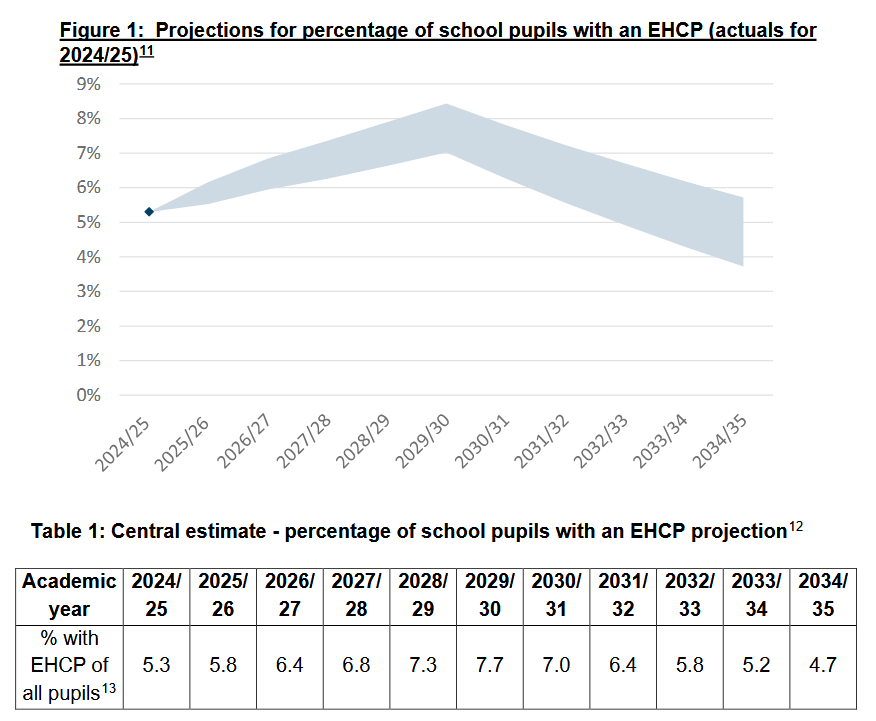
What’s clear is that all the action in terms of saving money is being pushed into the next parliament. The nice stuff is now, the hard stuff after the election.
This raises a massive question about the DFE’s finances before then. Regular readers will remember that Rachel Reeves left DFE holding the baby for £6 billion of funding pressures which are to be transferred from local authorities to the DFE.
As the OBR has noted:
“the Government has announced that from 2028-29 the cost of SEND provision will be fully absorbed within the existing RDEL envelope. The Government has not set out any specific plans on how this pressure, which we estimate at £6 billion in 2028-29, would be accommodated within the existing RDEL envelope. If it were fully funded within the Department for Education’s £69 billion RDEL core schools budget in 2028-29, this would imply a 4.9 per cent real fall in mainstream school spending per pupil rather than the 0.5 per cent real increase planned by Government.” (OBR EFO Nov 2025, p122)
We now know the government isn’t really planning to save money by 2028-29.
The DFE are going to get £3.5 billion extra in 28/29, reopening their Spending Review settlement - but that is offset by the existing £6 billion pressure they previously got. So there is a £2.5 billion funding gap.
DFE could hope that spending on more mainstream provision for send now might reduce LA pressures, but that is a bit of a punt.
So where is the money coming from? We shall have to see how the numbers stack up.
A blank cheque?
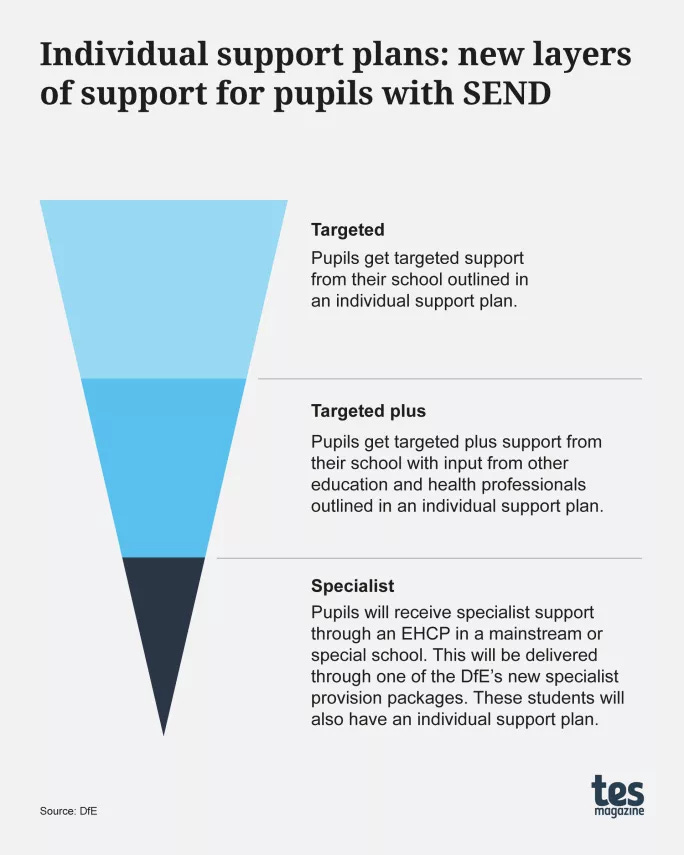
The government says that there will be individual support plans (ISPs) covering a broader group than EHCPs. The goal here is to control spending by shifting numbers from EHCPs to ISPs. But how much will be available to fund these ISPs? We won’t find out until 2028 or 2029, after the legislation is passed.
Government is planning to create “approximately” seven different packages of support. It says that some will be mapped on to familiar descriptions of complex SEND, while others will support a group of children with different or no diagnosis but who require similar support. But these specialist provision packages - and the funding bands associated - will only be published by 2028.
A key detail is the funding cap on all these packages - if the caps are set too low, it will simply be impossible to fund the work that is supposed to be done. The DfE had already announced that independent special schools will be subject to national price bands, in a government clampdown on “spiralling” fees. If these are set too low it will simply destroy independent special schools which are looking after some of the most severely disabled children. But TES reports that we won’t see these funding rates until 2029 (potentially after the next election). The National Association of Special Schools has made this point about a blank cheque:
banded funding and capped prices will be in place for all special school and specialist college placements. In the absence of any sense of how these categories will be constructed, nor of the funding that will be attached to them, schools and families are given a headline message that will leave them anxious about whether special schools will be able to afford to provide the support that they know is transformative for children.
As well as driving down the number of pupils with an EHCP, the other way the reforms will saving money is to water down the EHCP.
If parents feel they have been unfairly denied an EHCP, they will still be able to appeal to a tribunal. But unlike under the current system, the tribunal will not be allowed to demand that local authorities send a child to a particular school, giving councils far more control over where SEND children are educated. This will probably save money - but the politics of this will be very hard after 2029: parents won’t get the support they want or may be offered something far away from home.
Those receiving the most specialist support will be entitled to an EHCP. But the way these are issued will also change - and in a way that is not clear at the moment. A child’s provision will be agreed before an EHCP is issued. This provision will be based on a “statutory entitlement” outlined in what the government are calling a “specialist provision package”. The council will then issue an EHCP, while the school will issue a more detailed IPS. So what exactly is the EHCP actually doing in this new system? I heard one Labour MP say today that children don’t always get the support promised in an EHCP. Okay, but won’t that be more likely to happen if their legal weight is watered down? Isn’t that in fact… the point of what the government is doing?
The basic issue is this: the government is going to ask MPs to vote for a completely new system, but almost all of the important details of it will only be agreed after that legislation is passed. So we are being asked to sign a blank cheque.
More to do for schools
The white paper proposes a new system of tiered support. Individual schools will be asked to do quite a lot more themselves.
The teaching unions have said the resources the government are offering to do all this work within schools is not enough. The NEU say:
“it is too small. It only equates to a part-time teaching assistant for the average primary school and two teaching assistants for average secondary schools. This is not enough to make schools more inclusive.“
The NASUWT teaching union says:
“this new funding is barely a drop in the bucket of the investment necessary to drive real improvement in schools.”
Some heads are making the same point. Katie Barry, headteacher at St George’s Church of England Community Primary School in Lincolnshire, tells Tes that “the move away from EHCPs towards school-led plans raises my concerns about potential increased pressure on already stretched mainstream schools”.
This new proposed system does seem to be loading a lot more work and bureaucracy onto individual schools. Will they actually be able to cope?
In addition the government have a plan to reassess the need for extra help when children transition from primary to secondary and to sixth form - this sounds reasonable in principle, but the danger is that it creates a lot of friction and cost for no real savings - in many cases parents will be re-fighting battles for support that they have just been through, and that the process costs more than it saves.
The schools white paper
The schools white paper is full of micro-announcements and new targets - some of which are fine. There is a plan to change the funding formula which I will have to come back to.
There are a couple of things in there that are concerning though. There is a big push for “inclusion” rather than suspension or expulsion of children who don’t misbehave - there is so much ideology pushing in this direction already, and I worry that it means more disruption and danger to kids and teachers doing the right thing.
Questions we need answers to
What does this plan mean for mainstream school funding, and what’s happening with the rest (the other £2.5bn) of the £6 billion pressure?
How are MPs supposed to reassure themselves they aren’t signing a blank cheque, given the lack of detail on what will replace the current system, and what funding rates will be?
Why are funding rates only being set out in 2029?
Why is the government able to give quite precise numbers on how many children will have an EHCP in future, but not any real methodology on how it arrived at these numbers?
Are teaching unions and heads wrong to say that the resources aren’t enough for mainstream schools to do all the extra work that is proposed?
Further reading
TES: How is Labour planning to reform SEND?
TES: Schools White Paper: the sector reacts
Schools Week: Schools white paper: What is happening to EHCPs under SEND reforms?
NASS: NASS warns SEND reforms erode rights and let costs dictate
Guardian: Fewer children in England to get EHCPs by 2035 under Send overhaul.
There is a major flaw in the policy. Every generation has the essential duty to reproduce and nurture the next generation to take over the reins and rule. Every year, a small proportion of children are born extremely talented and should become our leaders. They too have a variety problems which need support. It's in the nation's best interests that they are given the highest priority.
What is the source for the EHCP projections?