

Why taxes will go up again
Andy Burnham has declared that there is “room for movement on tax”. Will Burnham really put up taxes yet again this autumn? You might think that having broken their promises and increased national insurance, increased income tax, and raised tax to record levels, that Labour might be done. Nope.
Why?
The bottom line is that Labour have spent a lot more. Compared to the last Conservative Budget, spending in 2028/29 alone will be £152 billion higher (that’s 11% more than planned in that year under the Conservatives). Taxes will be £105 billion higher (up 8%) and borrowing will be £47 billion higher (more than double previous plans). The increase in spending wasn’t one big jump: spending keeps ratcheting upward:
You can only borrow so much. Burnham has made some very unwise comments about not “being in hock to the bond markets” which have spooked markets, but in reality, any attempt to just borrow and borrow endlessly will blow up. And Burnham won’t cut spending, so more tax it is.
Those figures above don’t recognise the full mess either. Keir Starmer has left him at least £5 billion to find for the defence plan, on top of the £9 billion of completely unspecified “efficiencies” Reeves had already scheduled in the last two years of the forecast in a desperate attempt to make her numbers “add up”.1
Labour had already built up various pressures for more spending – for example, they said they would deal with the fact that poor pensioners are being dragged into paying income tax by the frozen tax threshold, but so far haven’t come up with a solution.
In addition, Burnham also has a long list of commitments which he has floated at one time or another. In his speech on 29th June he promised “the biggest council house building programme since the post-war period” and “greater public control of essential services like water, housing, energy and transport.” He has also been wobbly on Indefinite Leave to Remain - but concessions to the Labour backbenches would jack up the welfare bill. During the Makerfield by-election he promised a business rate cut, saying that “all pubs in a constituency like this would have a 20 per cent cut in their business rates.”
And all that’s before you deal with any fiscal impact from the Iran crisis.
Gulp.
Normally, Prime Ministers try to get their disappointments in early, and Burnham may well try to grab the extra tax while he is still in his honeymoon.
No wonder the tax speculation is already well underway. There are several leading contenders. There are still months to go but here are the runners and riders so far.
Possible tax increases
Burnham says he won’t raise Income Tax, or VAT, or hike National Insurance further. But there is room for movement elsewhere.
It’s interesting to look at who is advising Burnham. Miatta Fahnbulleh is said to be “running policy” along with Josh Simons, who made way for him in Makerfield.
Miatta has previously called for a breathtakingly large number of different tax increases, so that doesn’t help us narrow down much.
Simons was part of the Labour growth group - their work has been less crude but argues for a shift of the tax burden onto capital and property and that seems more likely.
Here are the taxes that have already become the focus of particular speculation:
Increasing Capital Gains Tax
This has been floated in numerous places. Reeves’ first Budget already sharply raised CGT, with the lower rate increased from 10% to 18%, and the higher rate from 20% to 24%. This is one of the changes that has sent investors running for the exit. But many in Labour they want to hike it further.
The Labour Growth Group argue we should raise an extra £14 billion from CGT.
In May former health secretary Wes Streeting set out plans for a co called “wealth tax” that would equalise CGT with income tax.
More ominously on Sunday key Burnham aide Louise Haigh said that CGT rates “should be brought closer to income tax rates” (the UK’s top rate is 45%).
The macro problem with that is, as I argued before, that Labour are already building their plans on getting tens of billions more from large investor types, while simultaneously doing everything they can to drive them away.
And one additional specific problem with this is that the Treasury and OBR may be reluctant to score any meaningful extra money once dynamic effects are considered. When the Conservative government cut CGT on property from 28% to 24% in Spring 2024, the OBR scored it as raising revenue not costing it, because it would lead to more transactions.
Hikes in Inheritance tax
Burnham has nodded in the direction of inheritance tax already. He said: “It is urgent, the need to fix social care, and I personally would look at all of the kinds of implications of that in relation to inheritance tax and care changes and everything. I wouldn’t flinch from it”. (The Guardian, 4 June 2026, link).
A problem with this is that Labour are already on course to have huge numbers paying. Rachel Reeves has frozen the nil rate threshold out to 20312 and brought in more things like pensions. Soon, nearly one in ten people who die will be subject to it - that’s twice the average over the last couple of decades.
Is this tenable? Previously when the number of people paying has grown it has become very unpopular and governments have been forced to take action. In 2007 Labour introduced the transferable nil-rate band, effectively doubling the tax-free threshold to £600,000. Once numbers paying started to rise again in summer 2015 George Osborne introduced the Residence Nil Rate Band. Is it really plausible to have even more people paying than already planned?
CGT on top of IHT
Rachel Reeves applied inheritance tax not just to family farms and family businesses but unused defined contribution pension pots. Burnham could go one further and end the practice of rebasing CGT liabilities on death.
The Labour Growth Group, which Josh Simons is part of, have argued that: “The uplift at death that lets substantial gains escape tax altogether should be removed.”
The IFS think this exemption is worth about £1.5 billion a year. If Burnham wants a “wealth tax” this might be attractive. It has academic sympathisers too - thought probably only if done as a wider reform rather than revenue grab. For example, the IFS argue that “Uplift (or ‘forgiveness’) of CGT at death should be ended. It creates a very big incentive for people to hold on to assets well past the point at which it is efficient for them to do so.”
On the other hand, the argument against this is obvious: you would have double taxation, paying not just inheritance tax on death but CGT too, with the same assets taxed twice over and the share of people’s family assets taxed away rising to crazy, punitive rates - potentially 64% of the value above the threshold. You could get that figure down though. The original CenTax report which the Labour Growth Group are pointing to suggests “giving the inheritor a deduction against CGT (on a subsequent disposal) in respect of the IHT already paid on the asset.” So Burnham could set the combined rate at whatever level he chose - very high but perhaps not 64%. To be honest, the sheer complexity of this might be attractive to Burnham: a policy that is hard to explain is harder to attack.
Land/ property value tax
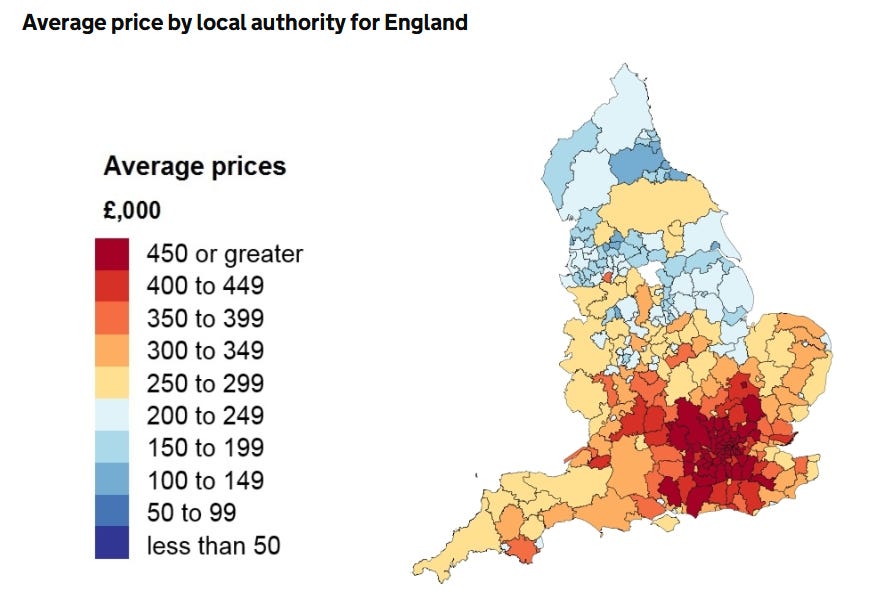
Burnham criticised the current council tax system and called for a land tax. In his leadership launch speech he said: “It’s a highly regressive tax, and I think it’s not justifiable based on those 1991 valuations. I see a big case for land and property and business taxation to be changed”
Specifically, he signed up to support the ‘Fairer Share, The Proportional Property Tax’ campaign. The proposed tax is a ‘flat rate of 0.48 per cent on the current value of your property’. In the version the “Fairer Share” campaign advocates, the government would use this money to scrap Council Tax and Stamp Duty, and the whole thing would even out. But Burnham needs tax revenues, and it is particularly hard to see him copying Kemi Badenoch’s commitment to abolish Stamp Duty. So he might focus on just the property tax element: the takeaway part without the give-back part.
A 0.48 per cent annual property tax would raise about £44 billion3. Council taxes across the UK raise about £50 billion. So Burnham could do the property tax bit, cut council tax a lot (perhaps abolish it for lower bands) and still raise some money overall.
The argument against this is that you would have a massive and very visible new tax on people, potentially on top of Council Tax. The proposal is basically the old domestic “Rates”. Though no-one now remembers it now (because of the Poll Tax disaster) the old “Rates” were very unpopular. In particular they hit older people who wanted to stay put in areas that had become more expensive over time4. Even a shift from council tax to rates would create huge redistribution, with some really massive losers in areas with expensive property. This would be a sort of “core vote” strategy, except that it would also wallop the seats Labour hold in London.
Bank tax.
An early spat has erupted between different Burnham backers over the prospect of further taxes on financial services. Paul Nowak, General Secretary of the TUC, has said that Burnham could raise £9 billion over four years by re-introducing a bank surcharge. But Lord (Jim) O’Neill said: “We can’t just keep avoiding what are seen as difficult choices and having backdoor ways of raising taxes. And we certainly shouldn’t raise them on business”.
With this one the downside is obvious: the UK financial service industry is already struggling under the weight of tax and regulation. Look at the lack of new IPOs, with fundraising falling to its lowest level in 30 years, and just five companies listing in the first half of 2025. So doing something that puts us at a further disadvantage compared to competitors would potentially be bad for jobs and so bad for tax revenues.
Nonetheless, the speculation is already hitting confidence. The FT quoted a senior Banker saying, “The City is holding its breath. It feels very likely they will raise taxes on banks — just look at the direction of travel on spending.”
Conclusions
I have already met a couple of people who are changing their plans because of this tax speculation. Either trying to dispose of assets before a CGT hike, or thinking about where to locate business.
Burnham needs to realise that tax speculation is itself damaging - as Reeves’ experience last year showed. The UK economy is really limping along already, and youth unemployment has gone from being lower than the eurozone to higher under Labour.
I obviously think that we need to cut spending and cut tax and get the economy moving.
But if Burnham is going to raise our taxes even more (please don’t) then he should make up his mind fast and end the damaging speculation. But what are the chances of that? Anyone’s guess…
Budget 2025, Policy Decisions Table, line 37, “RDEL: Go further on efficiencies and savings”
If instead of being frozen at £325,000 since 2009 it had been uprated it would be worth £588,000 in 2031 - so no surprise lots more people are going to be paying.
As estimated by Savills, the total value of all homes across the UK is £9.18 trillion. A 0.48 per cent tax on this comes to £44 billion.
I know Northern Ireland is still on the Rates, but the charges are much lower. Band D in England is about £2,400, the average NI home pays about £1,200 - and no one gets a water bill either.
If they want to raise CGT, they should bring back indexation, otherwise it mainly becomes a tax on Government inefficiency
I long for the days of Chancellor Nigel Lawson who promised to get rid of one tax every budget and kept his promise.