

Yesterday the government published the final funding allocations for local authorities following its overhaul of local government finance. The settlement covers the next three years from 2026-27 to 2028-29. There’s an overview of the whole thing here.
The government has been conducting and consulting on what it calls the“Fair Funding Review 2.0” to overhaul outdated needs assessments using up-to-date data — including deprivation, population projections, and cost variations in service delivery. It replaces formulas that sometimes used decades-old data. So far so good.
But of course “fairness” is subjective - and you may not be surprised to learn that under Labour’s new funding formula and funding settlement, councils in Labour-run urban areas (e.g., Manchester, Birmingham, London boroughs) are receiving significantly more grant funding.
The way Labour have cheated this is very crude.
Last year Labour overlaid the old formula with what it repeatedly described as “one-off Recovery Grant”.
This was a bung to Labour’s urban heartlands and was supposed to be abolished after the new “fair” funding formula came in.
But despite torturing to formula to get the outcome they wanted, Labour ministers have not still been able to make it spit it out the outcome they want.
So that supposedly “one-off” grant to their mates has now been made permanent. The biggest winners from it are Birmingham, Leeds, Liverpool, Manchester, Bradford and Sheffield.
As the Institute for Fiscal Studies has pointed out,
“It is difficult to see a principled basis for these decisions other than to achieve an overall allocation more in line with the government’s subjective judgement. Government should avoid such formula bypasses becoming a habit.”
As well as a new formula, government is “resetting” the business rates retention system.
The last Conservative government introduced an arrangement where if councils agreed to growth and building in their area, they kept a share of the upside in terms of the extra business rates.
Why? In a purely “needs-based” system of the kind that Labour tends to favour, councils suffer no downside if they do things which are anti growth - the formula will compensate them for being poorer. And they get no upside if they allow building, which often unpopular locally - because the formula will punish them.
Under the “reset” Labour have whipped away the gains councils were getting from business rates retention. As the document puts it euphemistically, the new system will “better align funding with need across the country.”
All above-baseline growth in business rates revenues, which councils have been able to retain since 2013–14, will be redistributed away.
As well as business rate retention, there was a similar formula element for approving new homes called the “New Homes Bonus” which is also being phased out. I think this is a mistake.
This is bad for districts that have seen growth, and bad for incentives, but also unfair.
The shire district I live in is currently run by a Lib-Lab-Green coalition, but has also been Conservative. I recall one planning application for a large logistics shed.
The meeting had to be held in an aircraft hangar because so many people wanted to come. Councillors of all parties got screamed at… then yelled at in the car park afterwards… then had to do the whole thing again a few months later because of a technicality, and get screamed at again.
It was a pretty rough experience. And it now turns out they won’t even get any upside for their trouble.
Meanwhile councils that bugger up growth (say by demanding absurd levels of council housing on all developments) will be rewarded with more cash because they make themselves poorer. Not for the first time, Starmer’s government has revealed itself to be uninterested in incentives.
Winners and losers
What’s the upshot of all these complex changes?
First, here are all the councils with lower tier responsibilities only.
Lower tier councils typically account for a small share of the spending in their area but a lot of the stuff people actually notice most: rubbish collection, recycling, Council Tax collection, housing, planning applications, leisure, parks etc. They are taking a massive beating. Some are really going to struggle1.
Now, let’s have a look at all the councils with lower tier responsibilities - both unitary (single tier) councils and the lower tier. You can see the difference between the urban and rural areas pretty starkly. A lot of those things that people really notice are going to be tough to deliver in the shires.
Last but not least, hear are all the councils with upper tier responsibilities - unitaries and county councils where they exist.
These are the councils that do social care, so this is where the bigger money is. They also do transport and have coordinating functions for education, libraries etc.
At this level the distribution is more even, but you can still see that urban-rural gap. Thought the settlement is higher, the growth of pressures from social care will likely mean that it doesn’t feel like a land of milk and honey for councils.
The measure used in the maps above is “core spending power”, which includes an assumption that the council will be increasing council tax at the maximum permitted rate. In most of the shires almost all of the growth is coming from council tax, rather than a government grant.
As the County Council Network have pointed out:
“many of our councils will see their government grant cut and the simple fact remains that county taxpayers, the length and breadth of this country, will foot the bill for these reforms. At least 90% of CCN member councils’ much-vaunted increase in total ‘core spending power’ will come from presumed council tax rises of 5%, we estimate.
“It is abundantly clear that recent changes to the original government proposals have disproportionately benefitted London and metropolitan boroughs at the expense of all county and rural areas. The continuation of the Recovery Grant and the removal of ‘remoteness’ from almost the whole funding formula will mean hundreds of millions of more funding will be diverted from rural to urban areas over the next three years. These last-minute changes, implemented against the available evidence, raises serious questions over whether ministers are unfairly cherry picking which councils benefit from extra funding.
“Overall, the three-year settlement outlined today will be extremely challenging and will leave many of member councils facing a substantial funding shortfall over the course of this parliament. It is simply unrealistic to expect them to provide vital care services while receiving deep reductions in government grant and more councils may now have to apply for exceptional financial support.”
The District Councils Network say
“The measures set out in The Fair Funding Review 2.0 will also punish the councils most successful at housebuilding and at growing their local economy, despite these being Government priorities. The reforms end the bonus paid to councils when new homes are built – despite councils’ extra costs from providing infrastructure and services to new residents – and they take away the extra business rates received by councils for boosting their local economy.
The impact of the changes is likely to be felt by millions of people in the form of cuts to services including housing, waste collection, town centre regeneration and parks. Councils are also likely to scale back services which prevent illness or social problems including leisure centres and homelessness prevention, impacting on other parts of the public sector.
This is happening at a time of local government reorganisation, which will lead to upheaval and lead to financial risk for councils and services.”
The Institute for Fiscal Studies have a useful analysis here.
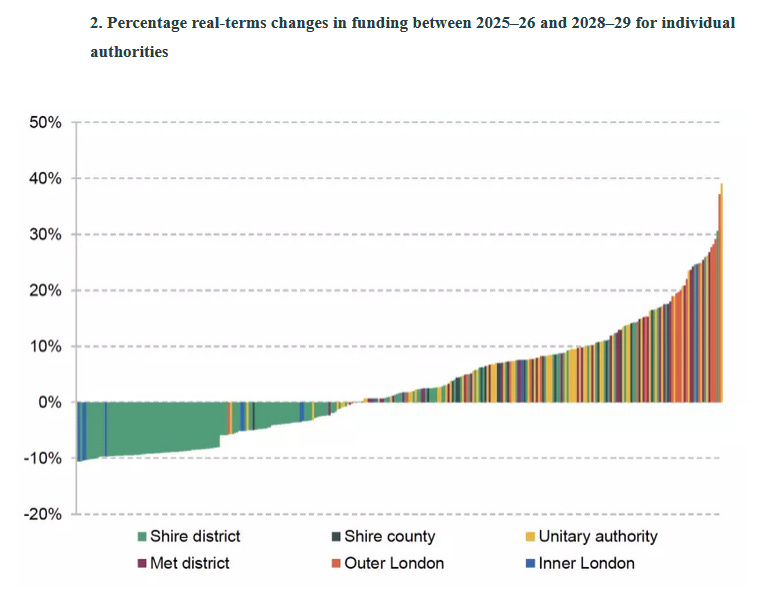
This chart shows how shire districts in green on the left are taking a pounding while urban areas on the right gain.
Conclusions
The government have made their choices, and residents will feel the effects.
I worry that they have trashed incentives in a way that is unfair and will be bad for growth.
They have nakedly overridden the idea of funding being based on a formula, in order to help their Labour mates.
I also think that some shire districts are going to really struggle, and while they are a smaller share of funding in two tier areas, they deliver many of the things people notice most.
Labour want to abolish all these councils and have a single tier everywhere (“unitarisation” in the jargon). But is not at all clear how quickly that process will go or whether it will be done in this parliament.
Neil O’Brien presents this as neutral analysis, but it overlooks the central empirical finding of the last decade: Conservative governments redesigned local government funding in ways that consistently advantaged Conservative-leaning areas.
Independent analysis by the Institute for Fiscal Studies shows that the most deprived councils lost far more funding per household than affluent ones, even after accounting for need. At the same time, ministers shifted money from transparent, needs-based grants to politically discretionary bidding pots, and pushed councils towards council tax — a move that structurally favours wealthier areas.
O’Brien’s argument rests on the claim that Labour councils were inefficient and unresponsive to local needs. But this narrative sidesteps a more straightforward explanation: the funding system itself was redesigned in ways whose distributional effects were obvious and repeatedly flagged by the IFS, NAO, and local government associations at the time.
There may be no memo saying “reward our voters”, but the design choices, discretion and outcomes all point in the same direction. To describe this pattern as merely technical reform is selective reading of a settlement whose political consequences were clear from the outset.
This is not about abstract incentives. It is about whether local government funding is allocated by need or by political convenience — and on that test, the recent Conservative record speaks for itself.
Thank you for this analysis, Neil. Am I right in thinking that the (paltry) rural services grant has also been abolished, which was there to recognise that the costs of providing services eg waste collection, is much higher in rural areas?
Here in Essex the government cancelled the A12 upgrade despite huge amount of money having been spent on preliminary works and have just cancelled a new primary school to serve a new development. Hard not to draw the conclusion they are just funnelling money to areas which traditionally support Labour.