

The 1996 Education Act requires schools to be politically neutral. But we see lots of examples where schools are clearly not, and nothing is done. Why not?
Most teachers manage their way through the minefield of teaching contested issues. But there are too many examples where things are going wrong. Let’s run through some.
Here’s a social media post from Blue Coat School, Coventry. The school is clearly taking sides in a party political issue. Apparently the law doesn’t align with their “school values”.
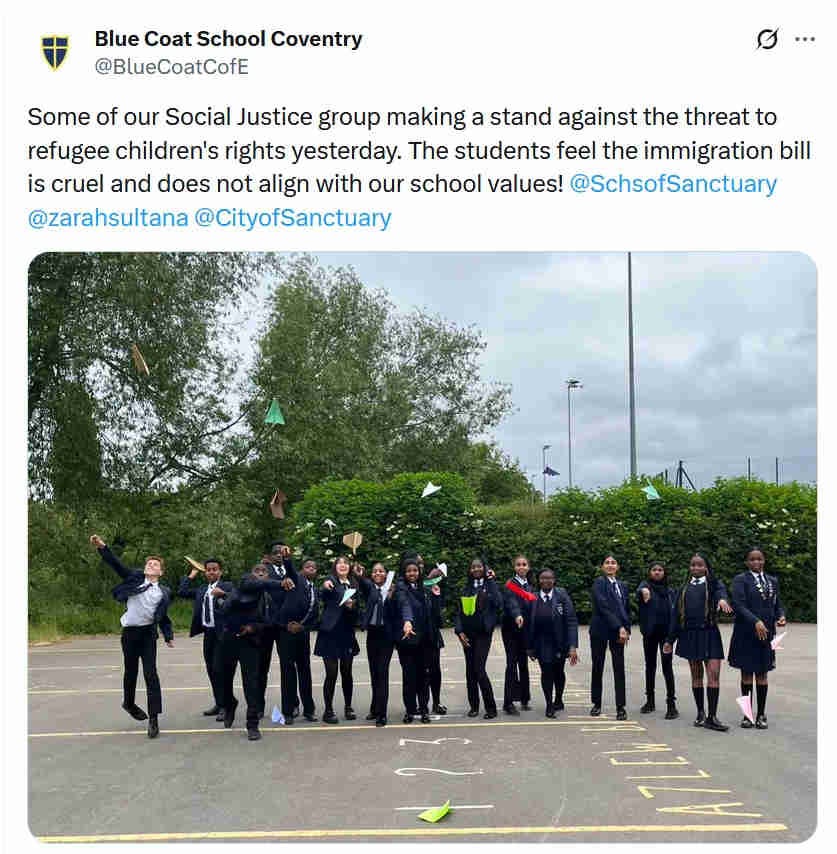
We are told that the “students feel” this is a bad piece of legislation - as if the teachers have played no role in arranging this stunt.
Imagine a school posting a picture of pupils protesting about the Starmer government’s handling of the small boats crisis. “Enough is enough, say pupils in Year 9 - Britain’s generosity is being exploited”. People would go berserk.
Another example: a visit by a Jewish MP to a school in their constituency was cancelled, after a demo by pro-Palestinian campaigners. Damien Egan was set to visit Bristol Brunel Academy in September, but the school became aware that protests were planned by members of staff and the National Education Union (NEU).
The Bristol branch of the NEU said the cancellation of the visit by Egan, who is vice chair of Labour Friends of Israel, was “a win for safeguarding, solidarity, and for the power of the NEU trade union staff group, parents, and campaigners standing together.” They said the cancellation was “a clear message” that politicians who support Israel’s actions in Gaza “are not welcome in our schools”.
This issue came to the surface again when extraordinary footage emerged of pupils at Connaught School for Girls in Waltham Forest confronting their striking teachers. The SWP-backed teachers are bedecked with Palestine flags and keffiyeh. The children would just like them to get back to work, and hold up signs saying things like TEACH THEM NOT PALESTINE”, “LET US LEARN”, and “NICE DAY FOR A STRIKE? NOT REALLY”). The last I thought particularly charming. They really are being more grown up than the teachers.
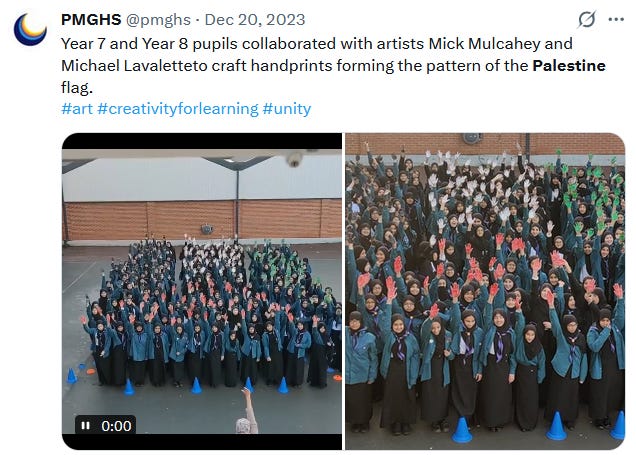
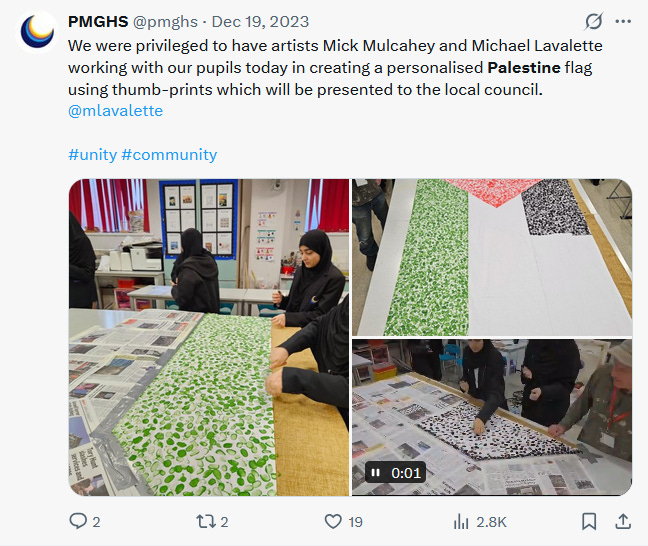
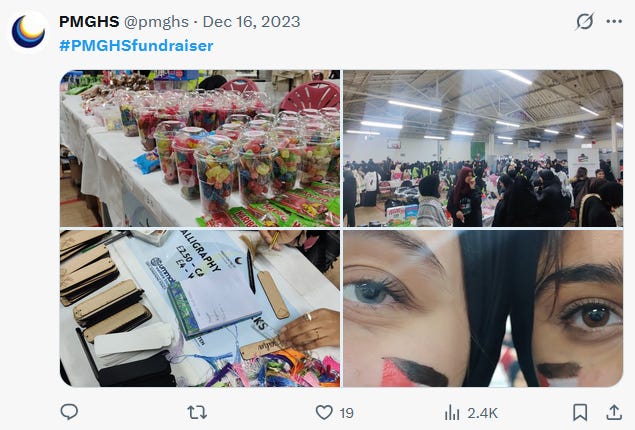
The problem is often just that pupils are only given one side of the story. Here are pupils from Preston Muslim Girls High School (a state school). The school had them making Palestine flags to give to the local council and painting flags on their faces. Are they really getting both sides of the story here? Well, the “artists” they are working with in the examples below are on the extreme left - part of “Your Party” and standing for election on the basis of “Gaza Genocide”. So probably not.
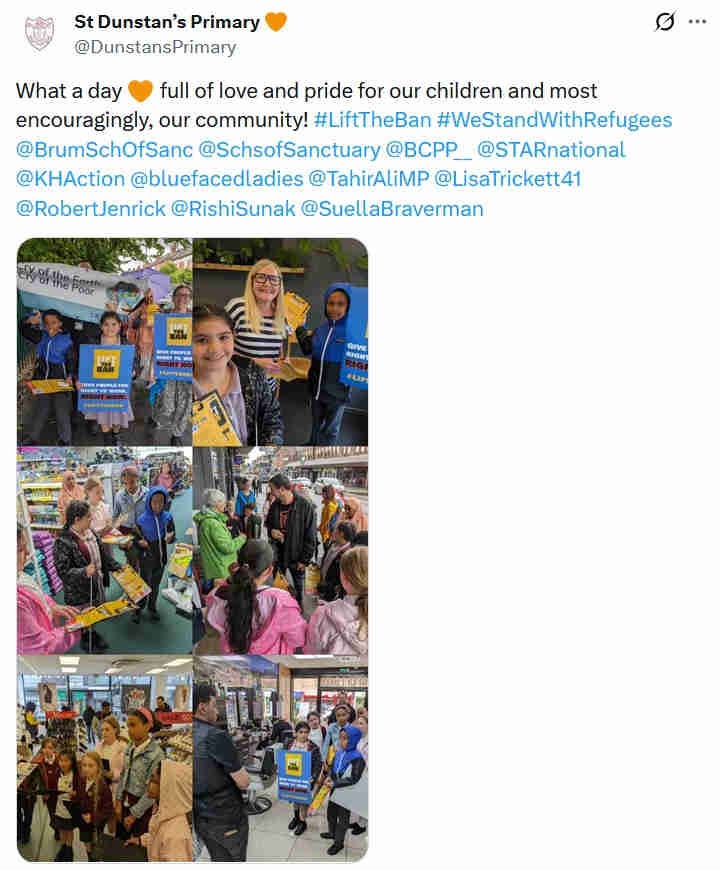
Another example: at St Dunstan’s Primary, teachers got their children to support the “lift the ban” campaign to let asylum seekers work.
The reason governments (of all colours) have not done this is because it would act as a powerful pull factor, and attract more economic migrants to come and pose as asylum seekers. You don’t have to agree with me on this, but it is not “political neutrality” for the school to be pushing a policy which is off to the left of the Labour party.
What and how
Bias takes the form of both what is and isn’t discussed, and also how it is taught.
James Esses points out examples of both.
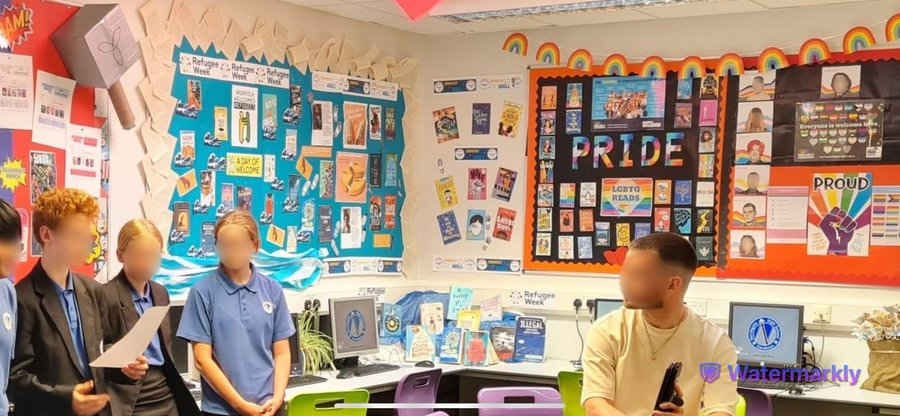
What is and isn’t covered. Take Northgate High School. Classrooms filled with ‘refugee’ and ‘pride’ displays. These include: ‘Norfolk Welcomes Refugees’, ‘LGBTQ Reads’, and flags representing various gender identities. The favoured causes of the left are well covered here - but the overall effect is one sided. This is common.
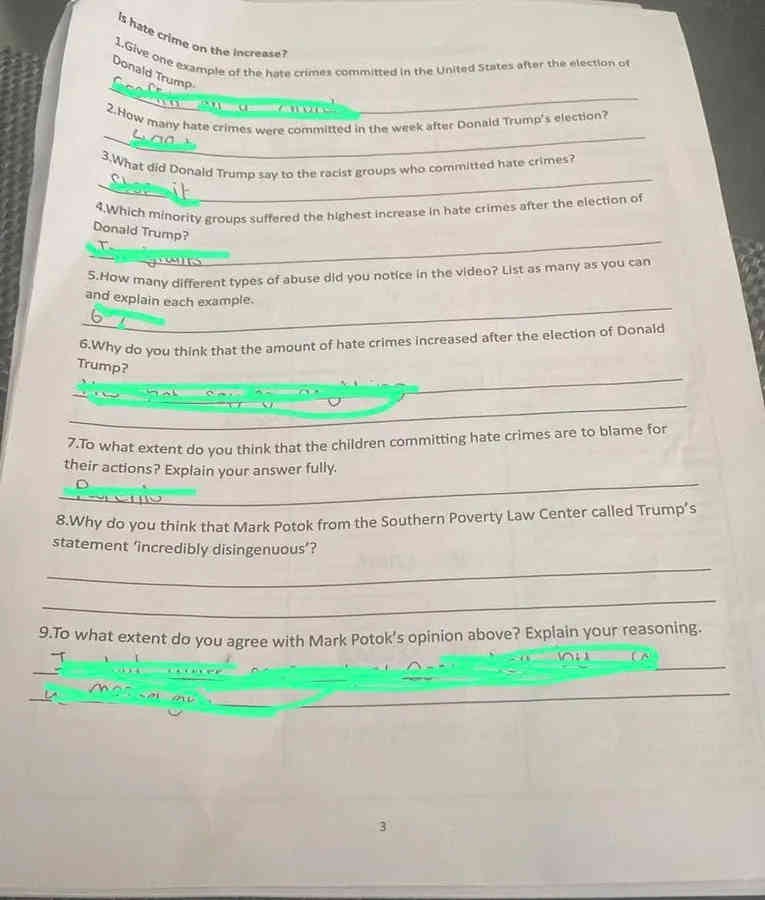
How it is taught. As part of ‘iGen Day’ (identity generation) at Honley High School, (near where I grew up) 14 year olds were set an exercise on ‘hate crimes’. They were asked: “Why do you think that the amount of hate crimes increased after the election of Donald Trump?” and a battery of similarly one-sided questions. I hold no brief for Trump at all, but this isn’t neutral.
Or take St Barnabas Primary School, where they are still using the terrible left-wing “boxes and fences” picture to try and teach Year 1 kids about equity and fairness - a totally slanted introduction to these issues.
Protest
There have been too many examples of where schools have either released pupils from school to go to political protests - or organised them to go.
The issue hit the headlines during the 2023 Gaza protests - there were kids in school uniform at the protests.
But climate is another area where some schools have found it hard to distinguish between the uncontentious and the political. There was a rash of climate protests in 2019 in the run up to the General Election. In fact, in my constituency in Market Harborough, there were several.
During one of them, one of the primary schools walked children round to the protest in the middle of the day to have a picture with Extinction Rebellion banners. Secondary school children came along too - one of the schools even produced a banner with their logo on. This is not political neutrality.
Campaigners present these things as being spontaneously “organised by the children” but in reality eight year-olds do not “spontaneously organise” themselves to go on protests during the school day, and the kids are regurgitating what they have been told by teachers.

Not neutral on culture
Too many schools also practice asymmetric multiculturalism. Bilton School held a “culture day” dedicated to “recognising and celebrating the rich cultural diversity within our school community”. They told parents: “We encourage students to consider wearing attire that reflects their nationality or family heritage”.
But after a 12 year-old girl turned up in a Union Jack dress and said she wanted to talk about being British, the school sent her home early. The school later offer offered "unreserved apologies."
“Culture day” is a disastrous, balkanising concept which should be stamped out.
Norwood Primary School in Eastleigh scrapped its annual Easter celebration and service to “respect diverse religious beliefs”. The head teacher told parents that: “By not holding specific religious celebrations, we aim to create a more inclusive atmosphere that honours and respects the beliefs of all our children and their families”.
“We understand that this change may be disappointing for some, especially those who have cherished these traditions over the years. However, we believe that this decision aligns with our values of inclusivity and respect for diversity.”
She added, however, that the school would celebrate Refugee Week in June, as the school works towards becoming a “School of Sanctuary”.
Schools of Sanctuary is a political pro-immigration campaign - more than 1,000 schools have signed up to make children into what it calls “ethically informed change-makers”. Joining such a campaign is a clear violation of the 1996 Act.
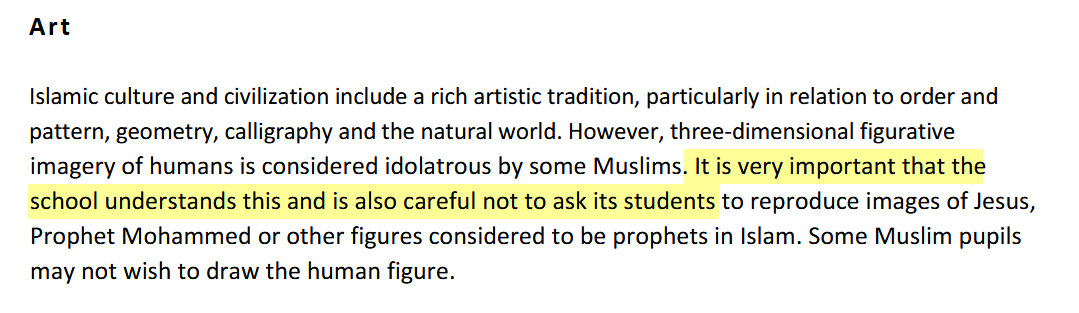
There has been controversy recently about advice to local schools from Calderdale Council, and in particular their guidance that a school should not ask “its students” (not even just Muslim students) to draw Jesus or Mohammed:
Not neutral on trans and gender
I’m not going to repeat it all here - but I wrote about these issues before and too many schools are way, way, off being neutral.
Why things go wrong
Let’s now turn on to why these failures of neutrality happen. I think there are three main reasons: failure to train the workforce, campaigners pushing against neutrality, and a lack of mechanisms to enforce neutrality.
a) Managing your own biases is something you have to learn
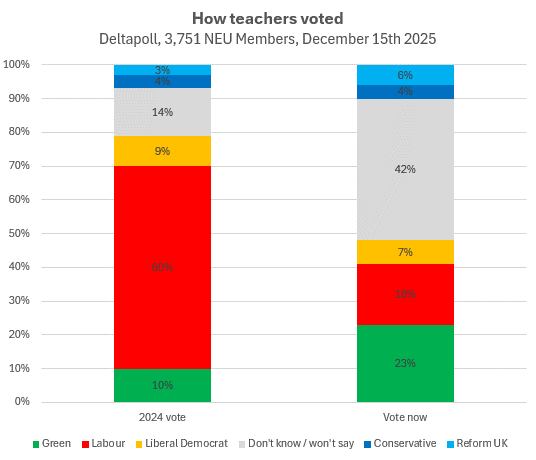
First, the teaching workforce is quite left wing - only 7% voted Conservative or Reform at the last election, less than a fifth as many as the general public. Since the election teachers have become disappointed by Labour, but even back in December (long before their recent surge) the Green Party was the top choice among teachers.
A recent poll by Arch 10 found that people in education (across schools and universities) were much less likely to think Britain’s role in the world has been positive than the general public, and (in contrast with the public) they on balance agree rather than disagree that “symbols of patriotism can be offensive and should not be promoted in public institutions.”
People can set aside their personal politics. But most people do not naturally understand how to present things in a truly neutral way. We all constantly apply our own biases to everything. To present political and social issues in a neutral way requires great skill and much greater knowledge than most people have.
So when a complete non-specialist (say a physics teacher) finds themselves teaching PHSE or civics, or doing an assembly on trans, or conflict or whatever, there is every chance they will fail to do this neutrally.
One factor compounding the problem is the incorrect belief of much of the contemporary left that their political views are in fact “not politics, just kindness and politeness”.
Many new teachers (at school in the 2010s, at university after 2020) will never have been in a milieu in which there are multiple views on immigration or trans. The views of the left on these issues are in the minority nationally, but there is no reason young teachers will automatically understand that there even is another view. And at present they are not taught how to be neutral.
B) There are a lot of people pushing for a less neutral approach
There are plenty of people who want to push schools away from being neutral - campaigners who argue that the school system should be explicitly aimed at promoting one or more strands of ‘social justice’, and encouraging changes to that end.
The main teacher union, the NEU, is aggressively left wing and is led by the ultra left. NEU Leader Daniel Kebede said at a Socialist Workers Party’s Marxism conference (!) that teacher strikes were about “taking back control of an education system from a brutally racist state”. Teachers have been told by the NEU that they need to bring the “Palestine Struggle” into schools.
Another example is the Runnymede Trust, which exerts considerable influence in schools and in teacher training through its ‘Lit in Colour’ joint initiative with Penguin Books to diversify the English Literature curriculum and spend much more class time discussing race and racism, (and now also through a partnership with Penguin and AQA to make English Literature GCSEs and A levels more “inclusive”.)
The Runnymede response to the recent Curriculum & Assessment Review stated that “we are concerned that the report does not address the urgent need to develop anti-racist literacy in schools” and “we remain committed to focusing on education as a key site through which we [Runnymede] progress racial justice”.
As I noted in my earlier piece on sex education, there are numerous activist campaign groups trying to push sex and gender education in a direction away from what most parents would regard as neutral or even acceptable.
Even the government believes that schools should be vehicles for social justice, rather than politically neutral places. The government’s recent “Curriculum and Assessment Review” has a section headed “a commitment to social justice” describing how it has applied a social justice ‘lens’. This is unsurprising as it was chaired by Professor Becky Francis, all of whose published work has been in the field of “social justice” in education.
Following the review, the government is re-writing the national curriculum. Working groups have submitted their proposals for each subject, it will be published in spring 2027, and then be taught from September 2028.
The government’s response says, amongst other things, that: “we will look for the earliest opportunity to make citizenship a new statutory requirement for key stages 1 and 2”.
So primary teachers will be spending less time on the three Rs, and more time on potentially contentious social issues. Without action, this is likely to increase the risk of politicised or biased content.
c) The lack of a mechanisms to enforce neutrality
None of these issues are new. The first high profile case was that of William Tyndale Primary School in Islington in the early 1970s, where “progressive” leaders showed indifference to parents’ interests even as their school broke down. This case contributed to Callaghan’s “Secret Garden” speech in 1976, which asserted the legitimacy of some control of an activity absorbing such a large slice of the national budget.
Despite this long history, impartiality has made too little progress. It is not mentioned at all in the initial teacher education standards: there is no expectation that trainee teachers should be taught what impartiality should mean in their professional context, and where the challenges are likely to arise.
The political neutrality requirements of the 1996 Education Act were not followed up by action or the creation of any enforcement mechanism because of the result of the election the next year. So the law just sits there, with no clear mechanism for its enforcement.
Guidance set out in 2022 was good - but doesn’t seem to have percolated into the consciousness of schools. Unless there is proper enforcement of the law, many (busy) schools and teachers will focus elsewhere.
Getting back to neutrality: how to do it
So… there are lots of things we need to do to unwind all this mess.
Here are some starters for ten:
Teacher training should include political neutrality - teachers need to know both what neutrality is, and how to deliver it. We need to recognise that this is something that needs to be taught, not simply required.
The 1996 Act needs enforcement mechanisms. The political neutrality requirements of the 1996 Education Act come with no enforcement mechanism for the DFE, either for trusts, schools or individual teachers. That means the law is not enforced - which means no-one ever learns any lessons.
Ofsted needs an explicit remit (and resourcing) to consider the issue at inspection. At present Ofsted has little chance of detecting curriculum matters that a school wishes to conceal, let alone more subtle impartiality failures. There is also no time or space for difficult conversations of the kind that can help school leaders understand that they have wrongly strayed into political partiality, even if with good intentions.
The regulatory frameworks for teachers need to include greater requirements for political neutrality. At the moment the Secretary of State can only refer teachers to the Teaching Regulation Agency on the basis of a referral, and it is not clear how the TRA would make judgements even if teachers were referred over political bias.
Teachers need a really clear set of examples of what is not neutral, and things they must not do. We’re not in search of perfection here. But too many schools just have no idea where the line is, and find themselves way on the wrong side of it. The 2022 guidance will need updating, but ultimately enforcing of the law and communicating it when you do is what will provide examples to teachers and schools of what isn’t acceptable. We should be clear that joining a campaign like “schools of sanctuary” is a breach of the law.
The Public Sector Equality Duty created a wide channel for the politicisation of schools under the guise of ‘promoting respect for protected characteristics’ - aided also by organisations such as Stonewall advising that it was good practice to ‘go beyond the law’. We need to undo this, and schools should also be explicitly precluded from ‘going beyond the law’ on contested matters.
The Equality Act “positive action” provisions have so diminished the long-standing principle that the law should treat all citizens equally, that many in schools feel they can or even must favour minorities. As Kemi Badenoch has argued, the principle of equality before the law needs to be strongly reasserted, and the Equality Act needs a total overhaul - we can keep sensible things like the elements from the Disability Discrimination Act 1995, but much of what Labour added needs to be deleted.
Parents and children of British-born children and immigrants need to hear positives about Britain and about the future: a narrative about the past that gives credit for all that is good as well as a proportionate assessment of mistakes and wrongs. Telling children that they are part of a systematically oppressed minority, whose life chances were largely removed even before they were born is self-defeating. It encourages victimhood, grievance - and, perversely, a sense of powerlessness and second-class status. This is particularly sad given that Britain has a fairly strong record here compared with many other countries…
We will likely need to overhaul parts of the curriculum, change specifications etc. Until we see the curriculum consultation drafts that are due to be published come out we won’t know exactly what will need to change, but there are lots of reasons to be concerned about the current government’s direction of travel.
I’m sure there are more - but what do you think?
My children's primary school have done an international evening for some years. Fine. But this year they have said that kids can come to school in non uniform and instead wear clothing that reflects their culture or religion etc.
I made some similar arguments to the above and added that rather than focusing on how we are different they should focus on what we have in common, but they weren't for budging, so I have notified the school that my children won't be attending that day.
It's all so tiresome.
Another depressing read - not your fault, Neil, as this is another clear, well evidenced piece. But it does illustrate what any right wing government is up against. The use of primary school children by schools or teachers to try and further left wing goals is especially appalling.