

Last month, the Economist ran a piece which investigated the rate at which foreign nationals are convicted of sexual offences compared with Britons. That they did so at all shows how far the debate has moved in confronting some uncomfortable truths.
Their research looked at Ministry of Justice data for cautions and convictions in England and Wales, split by offenders’ nationality between 2010 and 2024, information originally obtained via Freedom of Information requests by the Migration Observatory. Averaging population estimates for Afghans over 2020 to 2022, it found that ‘Afghans are convicted of sex crimes at seven times the British rate’. It concluded, reassuringly, that ‘it is hardly an epidemic’. (Note log scale below)
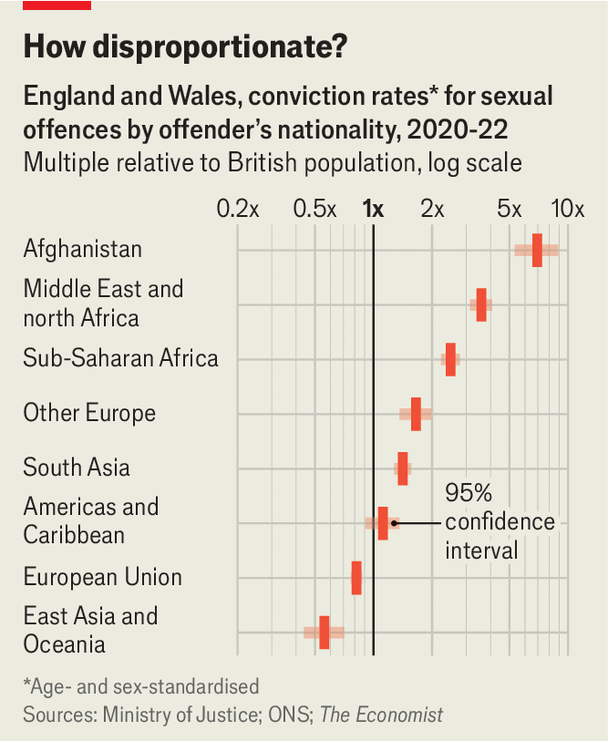
The story was intended to be a rebuttal of similar analysis from the Centre for Migration Control, which estimated that Afghan migrants are 22 times more likely to be convicted of rape than somebody born in this country.
Other estimates are available, depending on different methods used, and different estimates about the population size of migrant groups.
But these are currently all informal estimates and cover very large groups. The government is refusing to publish the data it holds. Some people still refuse to believe there are any problems here because of the lack of official data. So let’s use one bit of official data they will release to underline that there is indeed a problem here.
The 1st of January quirk
Home Office guidance on the circumstances by which dates of birth may be changed, notes that “Officials will only amend a date of birth on a Home Office issued document in one of the following circumstances: recording error; finding by a court or tribunal; fraud; new evidence or information was not previously available.”
For the first three of these, guidance states that officials are able to ‘correct a birth date’ where there is clear evidence that the birth date was ‘incorrectly recorded’ or ‘different to the one recorded by the Secretary of State or the Registrar General’. For the last of these, ‘new evidence or information was not previously available’, guidance notes that where an individual is unable to provide satisfactory evidence of their birth date, such as where ‘an undocumented migrant has claimed asylum’, officials may ‘allocate a date of birth’.
Other guidance, by HM Passport Office, notes that ‘UKVI will issue the certificate with a day and month of birth of 1 January together with a year of birth, if they are unable to establish a correct day and month of birth for the customer’.


The upshot is that many of those who have entered our country illegally, without documentation, appear to end up with the 1st of January as their recorded date of birth. That date then follows them through official records, including police records.
Here are some recent examples of police reports:
24th August 2026 - Abdul Shinwari, an Afghan man of no fixed abode charged with the rape of a 17-year-old girl near Piccadilly Gardens. Recorded birth date of (01/01/2002) by Greater Manchester Police.
28th April 2026 - Mohammed Shakavan, an Iraqi national charged with the attempted rape of a child and sexual activity with a child. Recorded birth date of (01/01/1984) by Greater Manchester Police.
28th July 2026 - Both Douk Deng, a failed asylum seeker from South Sudan charged (and later jailed) after bringing a hammer, a hatchet and a kitchen knife to a school in Heywood, Greater Manchester. Recorded birth date of (1/1/2005) by Greater Manchester Police.
18th September 2026 - Sulaiman Tajzai, an Afghan asylum seeker, jailed for life after fatally stabbing a man in Westminster. Recorded birth date of (01.01.08) by the Met Police.
28th April 2022 - Curtis Balbas, a Kurdish Iraqi jailed for life after pleading guilty to the kidnap and murder. Recorded birth date of (01/01/92) by Greater Manchester Police.1
Unhappy birthday
I asked each police force for the number of people a) arrested and b) charged, for all offences and for sexual offences, with the birth date 1st of January, vs 2nd of January.
Here is what I got back so far:
Across the 25 police forces that have responded to questions about arrests and charges, there were 2.7 times as many arrests of people with a recorded date of birth of 1st January as of people born on 2nd January (6,426 compared with 2,372), in the most recent year available.
This is a pretty staggering difference already, but becomes even more stark when we look at birth rates. According to the ONS, between the years 1995-2025, there have been 47,309 live births on the 1st of January, and 52,333 live births on the 2nd of January.
This means we are starting with a ratio of about 0.9 births on 1st January for every one on 2nd January. On births alone, we would expect slightly fewer people with a 1st January date of birth, not more.
Adjusting for the difference in births between the two dates raises the gap in arrests to around three times.
There were also 2.4 times as many charges (2,090 compared with 871) in the same period, or about 2.7 times once adjusted for births.
Across the 19 forces that provided figures for sexual offences, there were 3.7 times as many arrests for sexual offences of people with a 1st January date of birth (474 compared with 129). Charges for sexual offences were nearly twice as high (108 compared with 55, across 18 forces), though these numbers are small.
For some forces, the difference is even larger. The Metropolitan Police, the country’s largest force, recorded 1,899 arrests of people with a 1st January date of birth, compared with 424 for 2nd January, about four and a half times as many. For sexual offences it was 155 compared with 34.

Time to open the books
Whilst this may seem a bit of a silly exercise - and unlikely to prove anything conclusively, this little bit of official data does add to a growing body of evidence pointing to the fact that some migrant groups are over-represented in crime, particularly for sexual offences.
The frustrating thing is that whilst we are left speculating over the order of magnitude by which some of these groups are more likely to offend, the government holds all the data and is refusing to publish it despite being told to.
In June, the Information Commissioner’s Office, the organisation responsible for enforcing the Government’s disclosure obligations, ordered the Ministry of Justice to release conviction data for England and Wales for 2018 to 2024, by nationality and offence.
But the MoJ continues to refuse - and has appealed this decision to the tribunal.
Other countries are able to have a far more sensible conversation about the facts of immigration by making this data available. In Denmark, for example, the government routinely publishes crime figures by country of origin every year.
We must retain sight of the fact that each of these numbers is a real case, involving real victims who have suffered serious harm.
It is about time the government opened the books so we can have an honest conversation about these uncomfortable truths.
Abdul Shinwari and Mohammed Shakavan have been charged but not convicted, and both are presumed innocent. They are included only to show how police records give their date of birth. No suggestion is made about their guilt.
All racehorses born in the northern hemisphere have 1 January as the date of birth, in the southern hemisphere it is 1 August.
But doesn't 1st January being the assigned default mean there's many more people in total with 1st January as their birth date?
So this could well just be a population size difference? Surely you would need to know the number of people currently living in the country with recorded birthdays on the 1st vs other days to see if the rate of offences is different? Your live births stats don't work because no one migrating into the country will be in them.