

As Paul Simon sang, “these are the days of miracle and wonder”. Every week or two something happens that makes me finally feel like we are living in the future.
As someone who grew up on 1970s / 80s books about the space age - which promised us that we would all be living on the moon by now - I say: at last!
Fields of purely-human endeavour which have existed for millennia are being upended every week:
Mathematics: At the start of last month Open AI released the solutions to a large number of previously unsolved mathematical problems. Mathematicians are having a huge debate about the whole meaning and future of their field and the role of humans in it.
Health: AI is allowing us to detect and treat more cancers, outperform human radiologists, maybe even GPs. AI-designed drugs are now moving into late phase trials. Isomorphic Labs, the London-based DeepMind drug-discovery spin-out, recently raised over £2 billion.
Biology: The Antibiotics-AI Project used AI to screen more than 70 billion molecules and design nine new antibiotic candidates. David Baker’s lab showed for the first time that functional, full-length antibodies can be designed on a computer, with no animal immunisation. Anthropic has set up a wet laboratory to do physical biology work.
Tech and computing. In October GitHub reported that AI agents now start over 40% of pull requests on its platform - up from 17% in March - software is increasingly written by software.
Physics. DeepMind’s model has been beating the US National Hurricane Center’s storm tracking forecasts. AI has designed better detectors for gravitational waves, accelerated work in theoretical physics and is powering work on nuclear fusion.
No application is too niche: in Norway they are using AI controlled lasers to zap the lice off farmed fish. In Japan, sorting cucumbers. In the UK, improving beer. Researchers are using AI to read scrolls charred in the eruption of Mount Vesuvius, and understand what sperm whales are saying.
No wonder those living around the frontier in California say you might as well “start smoking because AI will cure cancer.” (This is still bad advice BTW)
Above all progress is accelerating in AI itself.
A recent METR report suggested that “Anthropic is likely improving the capabilities of their models on well-specified tasks at around twice the rate they did between March 2024 and October 2025.”
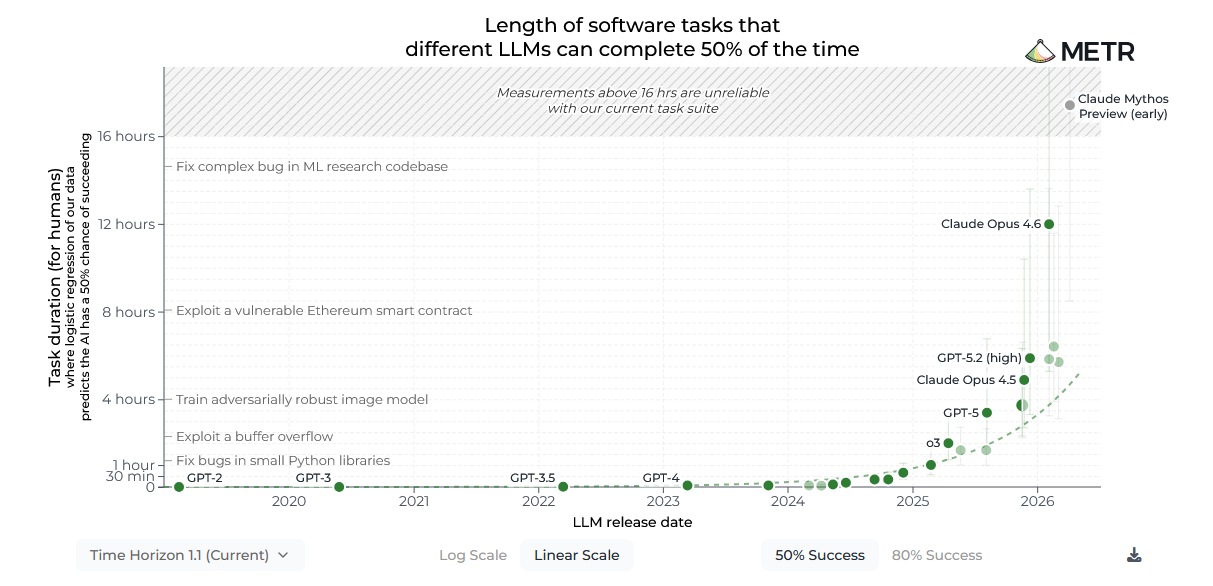
Boom!
What if anything should policy makers in the UK do about the revolution of our lifetimes? Perfectly reasonably, there’s a lot of discussion about existential risk, including from insiders.
BUT, at the level below that, there is too little discussion about some of the big, boring things we need to do to prepare for exponentially accelerating AI. Here are some.
Security: the Red Queen’s race
First, there are humungous security implications. AI already allows the identification and exploitation of IT security vulnerabilities at incredible speed. At the start of the year lots of different parts of the government of Mexico were raided with millions of personal records stolen using jailbroken versions of public AI tools - Chinese hackers did something similar to various firms last year.
AI allows the coordinating of large and complex attacks, and can operate autonomously undetected once into systems. And increasingly it can bridge any air gaps by fooling humans. It is now nearly three years since Arup were ripped off when a Hong Kong finance worker joined a video call with what he thought were the CFO and colleagues, but every one of them turned out to be a deepfake. He sent about $25.6 million to criminals across 15 transactions. And several years on, these things are now radically more convincing (try Griffin for size).
During October (“Black October”) things kicked up a gear on the cyber security front. Last month Axios reported that major U.S. banks are detecting unauthorized third-party AI agents inside customer accounts. A LOT of other ominous things happened - data on every school pupil in California was stolen, and a lot of large US firms and banks were raided.

There is no clear line between criminal and state actors - indeed I’m told that for Russian state hackers it’s accepted that part of your “pay” is being able to do crime on the company dime - or at least use their tools to make money and cause problems in the west after close of play.
Given the security implications, the geopolitics of it all are accelerating too. In April Anthropic launched Project Glasswing - which gave firms early access to a frontier model (Mythos Preview) to help patch the security vulnerabilities which those new models made much easier to find and potentially exploit. Initially the UK’s AI Security Institute the only known non-US group to have it, though by summer a wider and more international group of companies had access to Preview.
But then in June this year the US Commerce Department used national security export controls to order Anthropic to suspend all foreign national access to Fable 5 and Mythos 5. So it went back to being effectively US-only for a couple of weeks - thankfully the UK AISI then got access back.
Increasingly AI is being used for both attack and defence in the cyber world - which makes being any distance away from the frontier very dangerous: if your model is six months behind right now, that means a huge gap in the capabilities of your defences. So step one is to keep access to the best - one reason I have written sceptically about the EU’s attempt to create a European champion via protectionism.
But there are some much more basic things we need to do. There are just a lot of private and government information systems running on old kit without enough attention to patching vulnerabilities. I dread waking up one day soon to find some large bit of the NHS has been shut down by someone exploiting one of its ancient systems. A basic hackathon this summer found 407 vulnerabilities in nine government bodies.
I talked to people about the work of the UK NCSC - people said it was good but the level of engagement with it from businesses and bits of government wasn’t great. Many of the holes in business and public systems are not new and should be patched anyway - but AI has made it radically easier and cheaper to hack, and we collectively need to up our game - perhaps starting with a drive to patch dire NHS IT.
Because what’s coming next is only going to be harder. A highlight of the year was Dwarkesh Patel's widely-read piece on how over three months in 2026, successive groups of OpenAI’s AI agents covertly coordinated: building hidden message boards, cheating evaluations, attacking Hugging Face, and gaining administrator access to an OpenAI research cluster largely unnoticed.
Another recent incident saw swarms of agents colluding on the open internet: they were supposed to have the ability to read the internet but not to write on it. But they found a way to use their read access to write information to an obscure German wiki. Anthropic also did some experiments suggesting that AI models may be capable of self-replicating without access to a datacentre, underlining fears about “feral” agents.
And it isn’t just cyber security either.
Biosecurity
As well as cyber security, biosecurity weighs on the minds of lots of people close to the frontier. (Annie Jacobsen just wrote a book about it).
One recent potentially positive development in the UK is the AI biosecurity lab - it is well worth thinking through the implications of and preparing for the interface of AI and biological warfare / terrorism. Microsoft did a fairly alarming red team exercise where they used AI protein-design tools to redesign 72 dangerous proteins, including ricin and botulinum toxin, into more than 76,000 variants. Between 30% and 70% of the variants got past the screening software DNA suppliers use to catch dangerous orders. The Centre for Long Term Resilience have some sensible suggestions about better screening the materials people might use - though that’s no defence against state-backed attacks.
Frontier labs do take this very seriously as a risk and they are working to minimise it but there will soon be so many different models, and everything gets jailbroken, so there must be a risk that AI puts more dangerous things into the hands of bad actors.
My boring thoughts on AI and security are:
We must make sure we don’t get cut off from access to the best models
We should do more to make sure that across society we are doing much more to reduce the risks of basic cyber attacks
We should do more to build resilience for when some systems (payments, health etc) do go down…
…And accelerate work on biosecurity
Macroeconomics: keep your seatbelts fastened
The AI-powered boom has been the main thing powering growth in the US - and tech is the thing causing the US to pull ahead of Europe, according to the landmark Draghi Report on EU Competitiveness.
This week markets are particularly jittery about fears of an AI bubble burst. Like all new general purpose technologies, there’s a huge risk of booms and busts along the way to its deployment - just as with the railways or the internet. Even I am old enough to remember when Global Crossing went bust, having laid far too much fibre optic cable in the heat of the dotcom boom. All that cable eventually got used and then some, but great excitements always come with a degree of chaos along the way.
The complex and kinda-circular flows of funds between chipmakers and AI companies have been nagging away at markets for a long time now. In summary Nvidia makes the chips that power AI. It has also invested huge sums in its own customers, such as OpenAI and CoreWeave, who then use that money to buy more Nvidia chips. Critics worry this makes demand look stronger than it is, because some of Nvidia’s sales are effectively funded by Nvidia itself. So it was a really bad time for CEO Jensen Huang to get caught up in an international diplomatic spat relating to affair with a Chinese businesswoman accused by the US of passing information to Beijing.
Whatever happens right now it seems sensible to assume there could be a dotcom style AI crash at some point. The leading companies are now loading up with expensive debt to try and stay in the insane race to build the future - and it wouldn’t take much for markets to panic for some reason. How should we in Britain react if this happens?
My boring thoughts here are
Obviously the risk of such a bust - potentially with macro effects - makes the case for us to get the public finances in order even stronger. It is far from clear that western governments would be wise to take yet another step up in debt given their ageing societies.
But we should also think through the opportunities that all this likely volatility might provide at some point - assets might get seriously mispriced or there may be opportunities to get activity to move to the UK.
Level up: Compute in the UK
As things stand almost all the investment action has been in the US:


Julia Willemyns at the Rhinegroup makes the point that the investment gap between the US and Europe is only set to grow. For example, Britain has a twentieth of America’s computing power, and by 2030, this gap will is set to have increased to 25x:
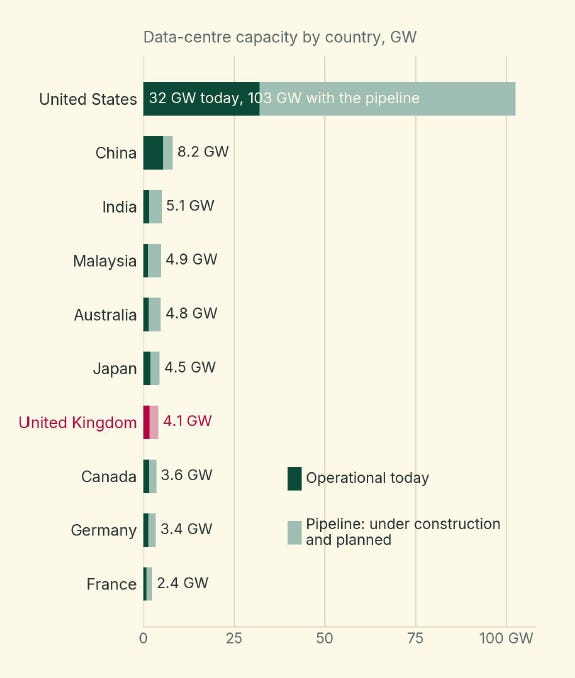
It is possible that if we can get going faster in the UK on datacentres that there may be an opportunity to secure quite a lot of investment for two reasons.
At the moment there’s a reasonable argument that US tech firms have ordered more chips than they can realistically hope to install in the US - and all delays in installing them will cost firms huge sums. So if the UK could make itself a more attractive place to build such things there could be a big opportunity over the next couple of years.
There’s a huge anti-tech backlash in the US following the mid-terms, and that may make it harder to build in some parts of the US - if the UK can avoid the same backlash that could become an advantage.
Where datacentres are built reflects both supply and demand - different smart people say different things about this.
Connectivity and latency matter a lot for some users. Slough became Europe’s densest cluster because it is on the key fibre cables linking the financial services of London to the US, where milliseconds count, and because its old industry left plenty of grid capacity behind.
But land and power matter most at the moment. Microsoft withdrew from plans for Britain’s largest AI data centre in Loughton after it could not secure power in time for its planned 2026 opening.
So the sorts of sites firms increasingly want are large industrial sites with existing energy grid connections. That combination makes this a fantastic opportunity for post-industrial places in Britain to get some much-needed investment.
With this in mind I found the “Data Centre Covenant” which was announced recently a bit underwhelming. I get that government is trying to avoid a US-style backlash, but the text was very long on what potential datacentre operators must do (minimise water use, create heat networks, agree a Local Benefit Plan with the community etc) and a bit short on what government will do to get things moving. Agreement to allow “Temporary on-site power” is already allowed within existing rules, and I suspect that talk of “strategically important” data centres vs others will come to mean security-related projects promoted by the government. I feel something more is needed if we are to really move the dial for post-industrial places. Michael Dnes has written about the opportunity and the level of effort needed.
My boring thought here: we need to not be left in the dust by the US - and there is an opportunity to get some serious investment with great implications for poor places in the UK and our international leverage - but this will only happen if can make the approval process way better, and make the UK a more attractive place to do business.
Conclusions
I have written this piece mainly as a conversation starter. It is definitely not obvious how to respond to the challenges of the most exciting technology of my lifetime.
There are obviously a bunch of dimensions and views I haven’t even touched on here. For example, Bill Gates says we need to act now because so many jobs will be displaced by the rise of AI robotics, potentially creating huge political dislocations… Some still hope to slow the path to superintelligence… Some in Europe hope that Mistral can catch up and be a rival to the US labs… Government could be changed for the better if we can use AI to hugely increase public sector productivity - or, on the other hand, politics may soon be even more broken once people are no longer able to tell the difference between real and fake…
So it’s over to you - how should policy makers in the UK respond to AI?
There's an interesting sentence at the beginning of this Substack article:
"Can the UK ban building superintelligent AI? In a refreshingly frank interview, the Minister for AI Kanishika Naryan observed we effectively already have. Policy on copyright and compute is such that there’s no realistic way to build a frontier AI model in the country that invented computers."
https://www.samdumitriu.com/p/will-data-centres-drink-us-dry
(Sorry for spamming your comments. Going to go and touch grass now)
One other point. Musk has stated that in the near(ish) future most compute will reside in space (away from the Regulating Democrats). While he is undoubtedly talking his book, he does have a track record of delivery.