

I have a nice memory of walking into the Chancellor’s Private Office at 1AM and everyone just being there, hammering away on their computers, as if that was just totally normal. And nice memories of watching the senior people in the Treasury slice through some very intractable-seeming problems. But during my time in government I also met some people who were… not so amazing.
The civil service is a weird mix. You have a bunch of people who are amazing and not paid much. And you have a bunch of people who are not good and should have been managed out ages ago. I worry that too often the good people leave not just because they are underpaid relative to their ability, but because they are sick of carrying the people who shouldn’t be there.
Other countries do better. Surely the vision has to be a civil service more like that in Singapore: a smaller number of better paid, much more effective people.
Excess people in the civil service don’t just fail to add value. They often subtract it. The devil makes work for idle hands to do, and there is a connection between regulatory bloat and having a large low-quality workforce. If you have a lean, focussed high-IQ team, you are more likely to get on with core business, rather than have people who spend their time pumping out unnecessary initiatives or EDI nonsense.
There are multiple issues with the civil service. There is incredible churn. Because you generally can’t get promoted in place, the Treasury has faster turnover than McDonald’s. Over one fifth (20.8%) of civil servants in the Treasury left the Civil Service or Department in 2024-2025.
Too often an official would just be getting good at a brief and I would turn up at their desk to find they had been replaced again with a newbie. The Fulton Report (1969) complained about the cult of the generalist but I’m afraid it is still there. Efforts to build specialist professions in finance, project management etc have light years to go. The Civil Service Commissioners act like gatekeepers and the service has far too few people coming in from outside. Where people have spent more of their career outside it makes a big difference and it’s not a coincidence that some of the best people I met in government had done that.
But in this piece I want to focus on performance management. Let’s start with recent history.
Performance art
Concerned about these issues, the Cameron government in 2012 brought in measures to strengthen performance management.
This Civil Service Reform Plan, spearheaded by Francis Maude, warned that “exceptional performance is too rarely recognised and underperformance not rigorously addressed”.
There were two bits to the plan.
For the Senior Civil Service, it brought in a system requiring each department to identify the top 25% and the bottom 10% of performers.
And for the rest of the civil service (the less senior people) it encouraged something similar - and several large departments adopted a similar arrangement for their lower (“delegated”) grades.
Unsurprisingly, this “enforced distribution” model, proved deeply unpopular with the unions who argued that it was discriminatory and harmful to staff wellbeing.
By 2017 it was already in retreat as departments began to drop formal percentage targets for delegated grades, and in 2019 forced distribution was officially abandoned for Senior Civil Servants as well.
So we now have two systems in place. Senior Civil Servants are assessed by all departments using four box ratings: ‘Exceeding’, ‘High Performing’ ‘Achieving’ and ‘Partially Met’, with a recommended “expected distribution”.
Delegated grades, meanwhile, have since 2019 operated under a “flexible Performance Management Framework” which effectively allows departments to determine their own performance management system.
The current government says that this reform “has enabled departments to adopt a Performance Management approach to best suit their organisational and cultural needs”.
Is this just fancy code for “we’ve let them give up”?
I went to investigate, by firing off a barrage of 150+ Parliamentary Questions.
I had to do this because amazingly, no department has published its current approach. The information obtained reveals just how much performance management is deteriorating.
All must have prizes
When asked how many staff achieved the top performance rating in each department, it became clear that several departments have more or less entirely abandoned efforts to track performance.
The Home Office, for instance, explained that they had “introduced a no-rating performance management system for delegated grades in 2021 in line with external good practice”. Likewise, at DEFRA, the minister noted that “end-year performance ratings were removed for most staff in April 2023”.
DCMS and MCHLG have both since adopted a “rating-less system” for performance management. The Department for Education explained that they do not “operate a performance management system that includes ratings”, and DWP say their approach “does not involve employees below the Senior Civil Service being assigned a performance rating”. You get the idea.
Others like the Department for Business and Trade were unable to answer because delegated grades in their department are assessed by just two ratings: ‘Met’ and ‘Not Met’.
Meanwhile, at the Treasury, the “high performance category,” defined as “delivering exceptional performance” has limited value, given that nearly a third (30%) of all delegated grades were awarded this rating last year.
Can 30% really be “exceptional”?
Naturally, these “rating-less” departments were unable to answer my question on the number of staff promoted according to their performance marking the previous year.
But even where departments had retained some form of rating system, these marks had apparently no bearing on promotion decisions. And that’s supposed to be the point: money and promotion should follow appraisal and performance management.
But that’s not happening. At the Department for Business and Trade for instance, having ‘Not Met’ as your rating puts you in the bottom two per cent of performers in the department. And despite this, two civil servants in that bracket were promoted up a grade the following year.
And of the 576 promotions awarded by DBT in 2024/2025, a third of recipients (194) didn’t have a performance rating in the previous year.
Similarly, at the Department for Transport there were at least six people whose performance was rated as ‘developing’ (the euphemistic bottom ranking) who were still awarded a promotion. While for 81 of the 282 who were awarded that year, there was no performance rating from the previous year on record.
No one expects… the Spanish Archer?
OK, so if we aren’t managing for high performance, are we at least managing out the real duffers?
Another question I asked was on the number of poor performance cases recorded, and the number of staff who had left as a result.
The best data is provided by the Department for Transport. Across its core department and its agencies, there were over 100,000 performance reviews conducted in 2024/25, with 822 of these leading to unsatisfactory performance ratings. A separate question on the number of concluded cases disciplinary or performance related cases, revealed that there had been 58 ‘Managing Poor Performance’ cases concluded in that year, with only 2 dismissals as a result of poor performance (0.01% of the FTE proportion).
To put this in perspective, there were 25 civil servants who died in service in the department in the same period. So you are twelve times more likely to die than be removed for poor performance.
Sadly, this pattern is replicated across departments: a tiny proportion of civil servants fall into the lowest performance category or are subject to formal performance management procedures, and very few of these cases result in dismissal.
The Department for Culture, Media and Sport, for instance, has recorded just 61 formal performance cases over the past five years. Of these, 11 employees were either dismissed or resigned, representing roughly 1 per cent of its headcount over that period.
Similarly, at the Treasury, 2,057 reviews were completed in 2024/25, with only 28 poor-performance markings recorded. The department is unable to specify precisely how many of those individuals were dismissed, on the grounds that the number is so small it would risk breaching data protection rules. We do know though, that in no year since 2020 have more than five staff been dismissed for poor performance. The Treasury generally attracts high-flyers, but still.
Neither DHSC nor DfE could provide data on the number of dismissals as a result of poor performance, though in both cases the number of staff who were flagged for poor performance was miniscule.
At DHSC there were 2,820 end-of-year ratings in 2024/25, with fewer than 10 deemed unsatisfactory or below (0.35%). This is a very small risk indeed. For statistical context for every three members of staff given a bad rating, one will die by drowning.
DfE conducted 73,035 “monthly check‑in conversations” in 2024/25, where under performance was recorded in only 516 of these (0.7%).
An honourable mention must also go to the Medicines and Healthcare products Regulation Agency (MHRA), where despite 1,272 performance reviews taking place last year, not a single staff member was dismissed for poor performance. In fact, not a single member of staff has been dismissed for poor performance in the last five years in an organisation employing 1,456 FTE staff.

From PQ 87060 - https://questions-statements.parliament.uk/written-questions/detail/2025-10-31/87060
Sacking long term staff is hard. The easiest time to move out someone who isn’t working out is when they are still on probation.
But to my questions about the number of staff who did not retain their employment following their probation - or had their probation extended - there was a similar story.
For DSIT, “dismissals in relation to probation failure since DSIT’s inception occurred during years 2023-25 and totalled 2 members of staff.” From 2023-2025, there were 1520 entrants to the Civil Service who joined this department.
The Department for Transport revealed that they recorded “fewer than five staff members who were recruited into the Civil Service and did not pass their probation, and were subsequently dismissed, since DBT was created in 2023”. The Department saw 2540 staff recruited into the Civil Service in this time.
DESNZ revealed that no-one had failed probation. There “is no evidence in the data held in the DESNZ HR Oracle system of any employee being dismissed during their probationary period.” This is despite the fact that there have been 840 entrants to the Civil Service who joined this department since its creation in 2023.
Manage your way out of this
So why are these numbers so low? In large part, it’s down to the lengthy and complex procedures that managers must navigate before anyone can be dismissed for poor performance.
Obtained via FOI, the Department for Business and Trade’s dismissal policy sets out a 10-step process, requiring a determined manager to pursue the cause through two written warnings, four formal meetings, and “regular performance discussions” during this period.
Meanwhile, the Home Office provided a flow chart of their dismissal procedure (which was shared by several other departments), illustrating the hoops managers must jump through to dismiss an underperforming colleague.
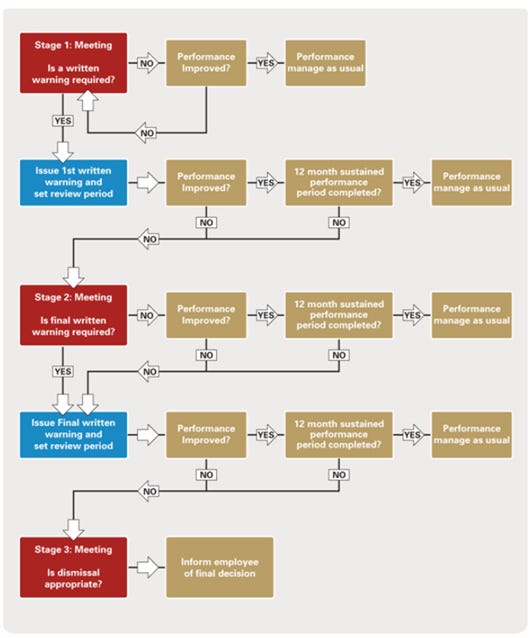
To make things harder still appeals can be lodged at pretty much every stage of the process. Guidance from DBT dictates that an employee “has a right to one appeal per stage of the procedure”, which are the first written warning, the final written warning, and the decision.
And yet despite all these opportunities to appeal a decision, DBT was subject to nine unfair dismissal claims between 2023 and 2025, while civil service statistics show that there were only 60 dismissals in total over the same period.
Given the time and workload required to navigate this process, and the risk that any decision could be overturned by an appeal or subsequent legal action, many managers conclude that it is simply not worth attempting to remove underperforming staff.
It makes you sick
I always think the amount of time people have off sick is (other things equal) quite a good proxy for morale and performance management. And when we look at the data we can see both the attempt to get a grip after 2010 and the way that petered out before the pandemic and started to backslide after it. (This data excludes the effect of Covid absences).
If we look by department, it is not obvious why the number of days lost to sickness is so much higher in some departments than others. Sure, there are differences in structure which matter - DWP and Justice have far more frontline staff included in their totals. But it is not obvious why the Home Office should be so much higher than say the Cabinet Office, or why the Welsh equivalent of Ofsted should have 50% more sick days than its equivalent in England. We can see absence is higher in lower grades, among women and older staff, but it is not obvious that composition explains away much of these differences.
There is an overlap between sickness and longer term disability. I found that among staff who have declared their disability status:
24% of DWP staff identify as disabled (based on 92% declaration rate).
19% of DEFRA staff identify as disabled (84% declaration rate)
18% of MOJ staff identify as disabled (81% declaration rate).
And there’s also a feedback loop between registering as sick and the difficulty of sacking people.
When threatened with the sack people say they are disabled and claim discrimination under the Equality Act.
Between 2020 and 2025, 607 Employment Tribunal claims were lodged against the MOJ under the Equality Act (the majority relating to disability) and 244 claims were lodged for unfair dismissal.
DWP has seen 413 claims lodged against the department between 2022 and 2025. Of these, 312 relate to the Equality Act only.
The Home Office has had 205 Employment Tribunal claims in the last 5 years (01/10/2021 to 30/09/2025). (It has refused to break this down)
The MOD has had 187 claims lodged against it since 2020, including 134 under the EA. Equality Act claims have risen consistently from 4 in 2020-2021, to 39 in the current year up to November.
Conclusion
Fourteen years on from Maude’s report, the Civil Service appears to be backsliding on the challenges he identified. The Conservatives have promised to reduce Civil Service numbers by 132,000 (back to 2016 levels) saving £8 billion. But this can only be the start of an overhaul.
Today top performers still go largely unrecognised, and promotions do not rely on performance. Meanwhile poor performance is hardly registered, and when it is, the levers to dismiss staff on this basis are effectively out of reach. The losers from this are the public, taxpayers - and the civil servants who are not getting the rewards they deserve and carrying people they shouldn’t have to.
Taxpayers have a right to expect a more efficient and better run Civil Service, and that is what we need to deliver.
I have never seen performance management done well in any large organisation, I've been in 4 corporates, 3 schools and a consultant. Ratings are usually given following some pseudo-objective process involving collecting evidence which wastes everybody's time. In some settings, e.g. a sales environment, financial bonuses can work, but in most settings effective collaboration is more important than individual brilliance, so performance-related pay can be decisive and is usually counterproductive. It's a lazy, unsophisticated way to motivate people.
From a legal rather than procedural perspective, is the civil service subject to different employment law than the private sector? Ie) Does it require ""just"" cultural, or in fact also legal changes to change outcomes?