

Reading is in decline. Instead, people spend more and more time staring at video. And more and more of that video is short-form, on-demand video like TikTok and YouTube.
We’ve moved from the “Information Age” to the “Screen Time”.
As an MP I’ve visited a lot of schools - and I often ask kids what they did the night before. Some of the answers are horrifying: “four hours on YouTube,” or “six hours on TikTok”.
You don’t often get: “I was reading.”
James Marriott has nailed down the shift to “post literate age” and set out some of the consequences. In fact he has a book out soon - The New Dark Ages (which sounds jolly).
He’s written about this better than I will, but this really isn’t just a meme, or old people complaining about “the yoof of today”.
The trends are clear in the data. In the UK the share of children who say they enjoy reading has gone from over 58% in 2016 to under a third now. Children both enjoy reading less, and are less likely to actually read - the two are obviously strongly connected:
And this is a change which is still gathering pace - the biggest declines in reading enjoyment and daily reading are among the younger children who have spent longer in the TikTok world. They are much less likely to get the reading habit.
The same trends are there in other countries - here’s data for the number of books read for pleasure in the last year by U.S. 12th graders (via Jean Twenge).
Basically, first TV came for books, and now screen time is hammering reading further:

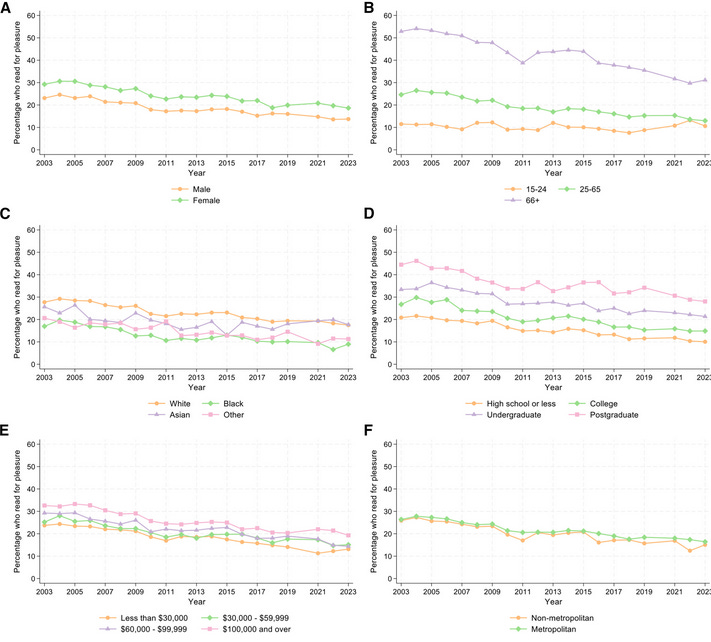
The US has a longer run of time-use data than the UK, and you can see that time spent reading for pleasure is in decline among adults too. It shows you two things which might seem surprising.
On the one hand there is individual polarisation: those who still read for pleasure read slightly more if anything, and the decline in time spent reading is all driven by fewer people reading for pleasure.
On the other hand, there seems to be no social polarisation: the decline in the share of people who read for pleasure is hitting every group: more and less educated, rich and poor, black and white, male and female, city folk and country dwellers - and most age groups1.
It isn’t just the anglophone world either.
In the FT a while back Sarah O’Connor reported that:
“This month, the OECD released the results of a vast exercise: in-person assessments of the literacy, numeracy and problem-solving skills of 160,000 adults in 31 different countries and economies. Compared with the last set of assessments a decade earlier, the trends in literacy skills were striking. Proficiency improved significantly in only two countries (Finland and Denmark), remained stable in 14, and declined significantly in 11, with the biggest deterioration in Korea, Lithuania, New Zealand and Poland.
“Thirty per cent of Americans read at a level that you would expect from a 10-year-old child,” Andreas Schleicher, director for education and skills at the OECD, told me — referring to the proportion of people in the US who scored level 1 or below in literacy. “It is actually hard to imagine — that every third person you meet on the street has difficulties reading even simple things.”
The revolution will not be televised
I introduced this piece by treating the rise of short form video and the decline in reading as two sides of the same coin. And the two are linked in multiple ways. For starters, TikTok and reading books compete for time - you can’t do both.
They are also related in the same way that junk food and marathon running are related - having more of one might hinder your ability to enjoy the other - or certainly make the other unattractive.
But the smartphone / social media debate (which I have written about before) is only partly overlapping with the reading decline debate.
For starters, the decline in reading started before smartphones turned up. And initially the “world wide web” was mainly text - the 90s web couldn’t really handle video. In fact we hoped back then that we were going to be spending more time reading interesting stuff online, and less time watching brainrot TV.
YouTube only launched in 2005, and TikTok not till 2017. It has really been since then every social media platform has been trying to turn itself into a video platform.
And then there are different types of video. Broadcast TV is tanking fast, particularly among younger people. In 2019 71% of 16-24 year olds watched broadcast TV on average each week. By 2024 only 45% did.
And of course there are different types of reading too. There is probably something different about three hours of concentrated reading of a book compared to reading fragmented snippets of articles and microblogging sites like x.com.
Teasing apart the impact of all these different changes - less reading, less TV, more short form video is likely to be very difficult.
Why it matters
There are two different theories out there about why the decline of reading and the rise of the post-literate society might matter
Worry number 1: Inability to read complex texts, and general cognitive decline. One category of worry is that people not in the habit of reading will struggle when they have to. When you are confronted with a complex text you will struggle or take things in more slowly. That might mean you learn practical things more slowly, whether you are studying engineering or reading the manual for a complex process. It might mean you can never really enjoy great literature. Connected to this is a more general concern that it might impede your general cognitive ability: that as well as being worse at reading, you might be worse at thinking as a result.
Worry number 2: Moving us from a rational / discursive culture to an emotive, oral one. This is the idea that “the medium is the message” and that reading makes you think differently about the world. That reading encourages an analytical, discursive, rational way of thinking about things, while short-form video encourages an emotional, immediate, visceral non-rational way of thinking.
Let’s try and look at both.
Brain fade?
Worry 1 certainly has some data points to support it. I don’t just mean the endless anecdotal articles from university lecturers complaining that new students can’t bear to read anything of any length - though I am struck how many such stories there have been recently. (There are examples, here, here, here, and here).
Over at the FT John Burn Murdoch has brought together some of the evidence of a decline in cognitive performance since the launch of the smartphone - reversing the improvements of the twentieth century. It’s pretty stark:
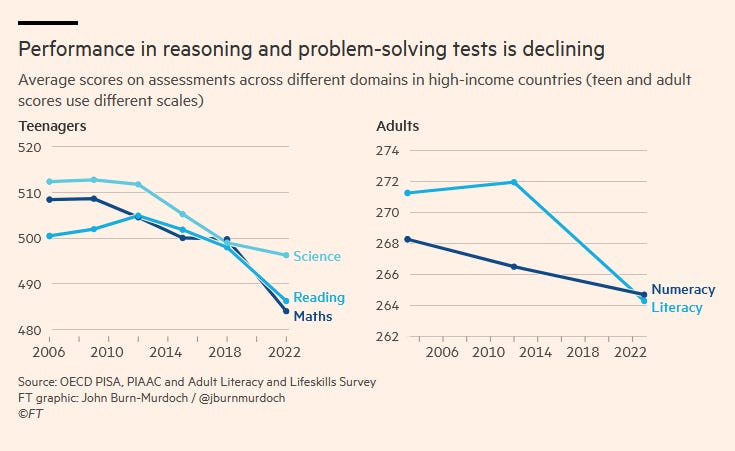
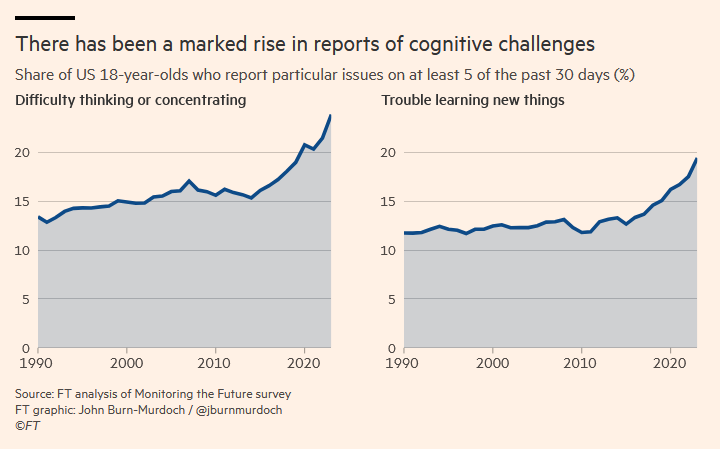
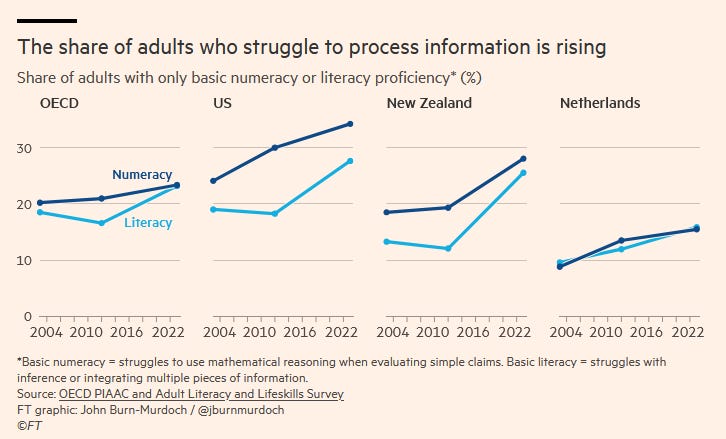
Of course, there are some things potentially muddying the picture, like the global increase in migration to developed countries and the rise of self-reported mental health challenges across the west. But the numbers above are pretty striking and it is not at all obvious that these other factors can explain the changes well, or at all.
None of this isolates the effect of reading specifically, or tells us whether it has protective effects. But the totality does seem to be hitting people’s ability to think.
Ragebait
That brings me to worry number two: that we are moving from a “cool” world of argument, careful reasoning and delayed judgement to a “hot” world of instant gratification, visceral emotion, fragmented and hysterical reaction.
These debates are not new.
In the late 1950s Richard Hoggart’s The uses of literacy worried that people had gone from reading serious, morally-improving stuff, to gorging themselves on “admass” - crappy, commercial, manipulative, Americanised, “candy-floss” rubbish.
In the 1980s Neil Postman worried further that we were “Amusing Ourselves to Death” by gorging on terrible TV, on which image and emotion dominated, and what little information there was was fragmented or superficial.
Some people will read this and say - here we go again, the oldies are in a moral panic. My view is that these previous observations were correct and the shift to short-form video on demand and even less reading is another step downward.
There’s no doubt that younger generations are getting less of their news from newspapers (including online) and more from social media - which is a lot more video heavy.
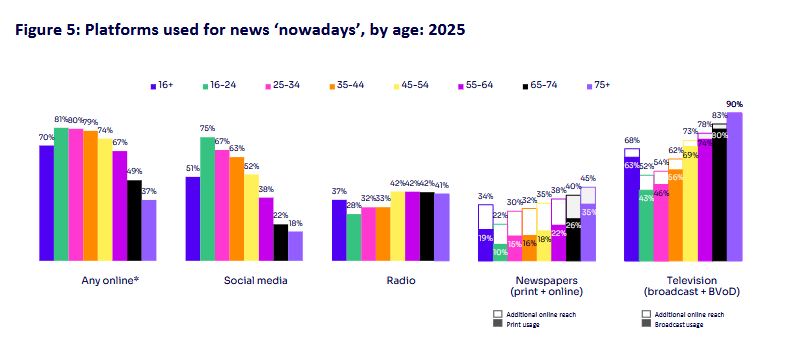
I think there is no question that the rise of new forms of media has played a role in balkanising our politics - people can get reinforcement of their views on tap and end up in algorithmic echo chambers. That could happen even in a world with only the written word. But I think that the shift from reading to video turbocharges all this.
There is a world of difference between getting your information from the six o’clock news and getting it from TikToks about Gaza, where there is no attempt at balance, no context and even greater focus on emotion. If you are interested in immigration, x.com will feed you more and more visceral content. Neil Postman argued that only in the printed word can complicated truths be rationally conveyed. I wouldn’t say only - but the printed word certainly lends itself better to “on the one hand, on the other” than a 10 second video clip does.
It is all tied up with broader cultural trends of course: TV got dumber too, and went from Civilisation to contemporary documentaries which seem to assume you have been lobotomised.
But there is something about the formula algorithm + short form video that is ruthlessly potent. And if you aren’t consuming anything offsetting - even handed, rational, concentration-requiring - that is even more so. And when I talk to young people in my constituency, the results on their world-views are stark.
Conclusion
At the moment I am helping our six year old to learn to read. It is not easy. Unlike talking, it doesn’t come naturally. It requires mental effort. I can feel it stretching and growing his brain.
One of the reasons that we (on the Conservative side) have been pushing the government so hard to ban smartphones from schools and get kids off social media is that there is enough evidence already to worry that young people are losing crucial skills, and suffering cognitively because of the decline of reading. Given how strongly the Labour government had set their face against the phone ban in schools I was really pleased we made them change their minds.
There are other positive changes. I’m glad to see that “World Book Day” in our kids’ school seems to be becoming a bit less about dressing up, and a bit more about, er, actually reading. One of the successes of the 2010 Conservative government was the introduction of Structured Synthetic Phonics (SSP) and things like the Year 1 Phonics check, which have seen English schools climbing the international league tables.
But given the cultural drift towards a post literate age, much more is going to be needed if we want to remain a literate people.
What would you do?
I’m not sure how the 15-24 line in Chart B squares with all the other data showing reading in decline in the US among young people.
I would try to reorient most university undergraduate courses around in-person reading and writing. This would not only ensure that to receive a degree one would need to have considerable experience of reading and writing at length but also help to mitigate the increasing use of AI by students to produce essays and other material. Of course this would need to come with much wider reform of undergraduate admissions and courses.
Really interesting article. Why aren't more of our MPs this sensible?