

Since the election youth unemployment in the UK has surged to levels above the eurozone for the first time in many years. And the eurozone has much higher rates of youth unemployment than the US.
This is a very bad result, but no great surprise, because of three things the government have done.
First, the government massively tightened employment regulation with the employment bill - this makes older more tested workers relatively more attractive. Why take on someone that may not work out if you won’t be able to get rid of them without huge costs?
Second, Labour have massively hiked tax, and surprisingly have done so in a way that targets low wage workers. Younger people tend to earn less, so again they have borne the brunt. Reeves now admits there is a “valid argument” this was a mistake. No kidding.
Third, Labour’s manifesto said: “Labour will also remove the discriminatory age bands, so all adults are entitled to the same minimum wage”. There have been different rates of the minimum wage for adults ever since it was set up in 1999, and for good reason. This pledge effectively told employers that wage costs for younger people would continue to rise faster than average.
Add it all up, what you get is higher youth unemployment.
U turn ahoy?
The government is now trying to execute a classic Starmer “partial U-turn”. The Treasury are briefing that they are retreating from plans to align the minimum wage, but the PM is insisting the policy hasn’t changed.
And having hiked tax across the board, Pat McFadden will announce on Monday that employers will receive a £3,000 taxpayer subsidy for hiring under-25s who have been on Universal Credit (UC) for more than six months.
One thing to note here is the difference in scale between the takeaway and the “giveaway”. The chancellor aimed to raise £25 billion from her across-the-board increase in Employers NI on low paid workers in Budget 2024. And a further £12.4 billion from her real terms increases in Income Tax at Budget 2025.
Longer term youth unemployment is certainly a growing problem. ONS say the number of 18-24 year-olds unemployed for over a year has grown from 86,000 when Starmer came to power to 121,000 now.
The offsetting action isn’t remotely on the same scale.
In total there are 274,000 people under 25 who have been unemployed for over 6 months. If 10% get a job over the next year that will cost £82 million in wage subsidies. So that’s a:
£ 37,400,000,000 tax increase versus a
£ 82,000,000 wage subsidy
We can generate different numbers if we look at UC claims, but the point remains, the tax takeaway alone is several orders of magnitude larger than this offsetting bung.1
The big squeeze
New Labour were careful to avoid setting a single rate to avoid youth unemployment. That lesson seems to have been forgotten, and is being re-learned the hard way.
Labour’s rash pledge to end different rates of the minimum wage was also really strangely timed, as differences in how much people earn per hour have been getting a lot smaller over the last 30 years, and the gaps have become particularly small among younger people.
This wage compression holds true whether we look at the gap between the top 90% and the bottom 10%, or at the gap between the top 80% and the bottom 20%, or whatever ratio you choose. This compression of earnings gaps is true at all ages.
We can look at the same data in a different way, by looking at the ratio of earnings between earning groups over time2.
An 18-21 year-old in the top quarter of earnings for his or her age group used to earn 50% more per hour than someone in the bottom quarter in 1997. Now they earn just 15% more.
Among over 50 year-olds, someone in the top 10% used to earn four times more per hour than someone in the bottom 10%. That is now more like three times as much.
Kicking the can
Torn between its rash manifesto pledge and the reality of rising youth unemployment, the government is kicking the can for now, with small bungs and delays to its policy on the minimum wage.
The Low Pay Commission Report which came out last month says:
“We have debated how to balance the Government’s ambition to lower the NLW age to 18 with its desire to avoid causing youth unemployment. In light of youth labour market conditions, we judge it better to take a cautious approach and backload the increases needed to reach alignment.”
Our proposed pathway to meeting the Government’s ambition is to reduce the NLW eligibility age to 20 in 2027. The evidence, including our consultation, suggests that the labour market treats 20 year olds differently to 18 and 19 year olds, and that around 70 per cent of 20 year olds are already paid at or above the NLW. Thereafter we also propose that 18 and 19 year olds will move together so that the NLW age will be lowered to 18 in 2028 or 2029. However, all of this will be subject to economic conditions and Government policy towards young people at the time. We will consult further with stakeholders on this approach.
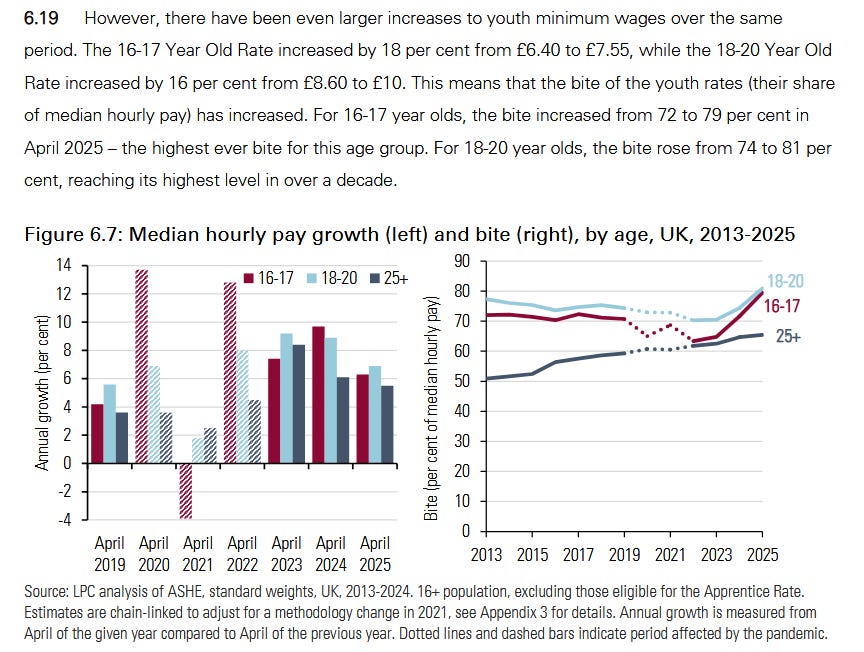
They note that for young people the minimum wage is now very close to the average wage - it is 81% of the average for 18-20 year-olds.
Conclusion
On the Conservative side we opposed the tax increases and the damaging elements of Employment Bill. We have proposed funding 100,000 more apprenticeships for 18-21 year olds by reducing the number of low quality “debt trap” degrees.
In contrast, at present the government has created a big problem but is offering only small solutions.
Employers are still being told that if they plan to take on young people they can soon expect them to be being paid the same as 40 year olds.
The triple whammy of higher tax, much more regulation and the attempt to flatten wages has clearly increased youth unemployment in the UK compared to other countries. And this was all before the war in the Middle East. If we are going to end the tragedy of youth unemployment, the government needs to stop coming out with fiddly small policies - and have a much bigger rethink.
It is not clear whether people will have to have been unemployed for 6 months or on UC for 6 months or whether the period will have to be continuous or over a period (say 6 months within a rolling year). But either way the numbers being helped by this new policy will be much smaller than the numbers harmed by the previous and ongoing policies. There are 448,000 people aged 16-24 who are not in work and have been claiming UC for over 6 months. This a larger number than the ONS unemployed number above, but the UC group are less likely to move into work, as more will not be searching / off sick not unemployed.
Thanks to Aiden Cheng for crunching the ASHE data here.
Thanks, Neil. A very clear article. Amazing the government don't think these things through.
The longer this goes on the youth are going to have another nastly realisation when they realise they’ve missed a ~decade of building a private pension. This has longer term effects.
Secondly, we should subsidise heavily degrees where a) the skills are highly valuable (STEM, etc) and/or b) we have a forecasted shortage. Gender studies etc self-funded or though loan mechanisms that actually make sense