

“This country desperately needs a strong second city… and we don’t care if it’s London or Birmingham.”
-Old joke among Manchester politicians
“This city needs more council housing like a hole in the bloody head.”
-Senior figure in Manchester local government to the author
One of the things our new Prime Minister has traded off is a sense that he has presided over a city that is going places. Shiny skyscrapers… shiny new yellow buses… and a shiny new Prime Minister. What’s not to like?
His claim is: I can do for the nation what I have done for Manchester.
But is this quite right?
How well are things really going in Greater Manchester?
Where things are going well, how did that really come about?
What was Andy Burnham’s role, after he arrived as Metro Mayor in 2017?
Is Greater Manchester doing well?
London-based Journalists head up to Manchester expecting the north to be a land of pies and prejudice. But instead of a Hovis-soundtracked landscape of industrial decline, they find instead lots of pencil thin glass towers. Many conclude that some miracle is underway.
But beyond the skyscrapers, what exactly is the evidence that Greater Manchester is doing well - or better than similar places?
Let’s run through some possible ways to measure progress.
Exhibit A: Population growth.
When I was a teenager in the 1990s we would go shopping in Manchester. It seemed like the height of sophistication and cool, but almost no-one lived in the middle of the city. Now they do. The old mills are trendy flats and pencil thin towers have shot up everywhere. And you can argue that population is a measure of success - people are voting with their feet1.
Like all our other cities, Greater Manchester has been on a turnaround curve in terms of populations - our cities shrank in the postwar years, and have filled up again since the 1990s. London shrank hardest, but rebounded first: Greater Manchester is in the middle of the pack - nothing unusual for the city as a whole.
The Manchester turnaround story is still a story about central Manchester: the area covered by the City of Manchester and Salford. Since 2011 about half of the 10 boroughs have seen their population grow faster than England as a whole, but half have grown more slowly. And for the purposes of this piece it is worth noting that the turnaround in the centre happened in the late 90s, long before Andy Burnham turned up as mayor in 2017.
Exhibit B: Building
So let’s look at the most tangible example of the Manchester turnaround: all those big tall towers. In Manchester and Salford they have built a lot - they have built faster than the England average. But the same isn’t true of the rest of the city. Roughly half of all the new building in Greater Manchester happened in just those two (out of ten) local authorities:
While the city of Manchester and Salford has built quite a lot, Greater Manchester hasn’t really built at an amazing rate. Compared to 2009 it has 10.9% more homes. England as a whole has 13.8% more. West Yorkshire has 11.1% more, the West Midlands 10.4% more, South Yorkshire 10.1 % more, and Merseyside 9.4%. So it did worse than the national average, a little better than some other urban areas, but marginally so.
And given all that population growth, arguably the real test is how well all the building has kept up.
When it comes to housing construction compared to population growth, Manchester, along with our other cities, hasn’t been doing too well - our cities stand out as red dots in the map below because their building hasn’t kept pace with population, and Manchester is no exception.
Exhibit C: Economic growth
Is Manchester experiencing an economic miracle? There was an exciting-looking uptick in productivity in the city in 2023, as measured by output per hour worked.
But city growth experts seem to think it is a statistical mirage. In a superb piece, Paul Swinney notes that there has been an implausible 21,000 jump in the number of legal and accounting jobs in one suburban neighbourhood in Trafford over a couple of years. Swinney says this “must be a data error”.
In fairness to ONS, it isn’t an ‘error’ as such: IR35 has driven lots more people to register as contractors: ONS books their output wherever their payroll is run, not where they really work. So if you have an umbrella company in Trafford that starts doing their payroll, then their output will suddenly appear in Trafford.
In the Spectator Tali Fraser notes that:
Paystream My Max Ltd, an umbrella payroll firm based there, went from 5,226 employees in 2019 to 22,213 in 2023: contractors across the country who shut their limited companies after the IR35 changes. I spoke to two of them – they work in Canary Wharf.
Paul Swinney rightly argues that to check on the headline numbers we should :
“look at data that you’d expect to move in line with productivity. Wages are a good candidate. The wages data has its own pandemic-induced sampling challenges. But if it was to corroborate this story, you’d expect there to be an increase in wages in line with productivity. As Figure 2 shows, this isn’t the case. There was no equivalent jump in pay since 2019”
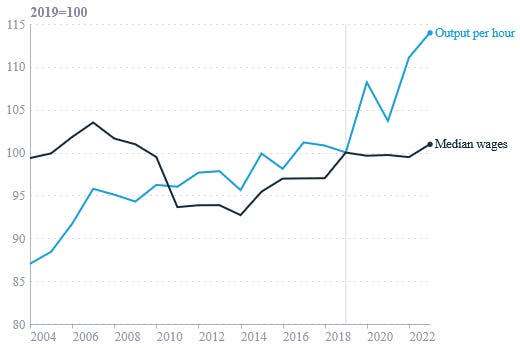
He is right - earnings are the more reliable measure here. I will come back to the earnings data in a second.
But before that, we also need to ask: can we distinguish what is happening in Manchester from other cities? Across the whole country economic growth has been higher for denser areas. We have continued to shift to a services-based, laptop-based, city-centre model of growth.
The chart below shows how, across the country, dense urban areas have grown faster, whether you cut it by job density or population density or workday density (how many people live there, plus those who work there). In fact this trend is happening across Europe and beyond2. (The chart below is cumulative, so it shows you how much the densest 1% of neighbourhoods grew, then the densest 10% taken together, the top 20% and so on.)
So generally cities have seen more growth - so how does Greater Manchester compare to our other cities? Whether we look at median or mean wages, Greater Manchester remains a bit below the England average. If anything, there’s probably more evidence of rapid catch-up growth in Merseyside, South Yorkshire and Tyneside. Manchester looks neither terrible or miraculous.
It’s a similar story with mean wages:
If we look at disposable income per head our large urban areas have fallen back from the national average since 1997 and Greater Manchester is no exception:
Looking at unemployment and welfare, again we don’t see much that is dramatic. Unemployment is a bit higher than the England average. Economic inactivity rates are higher, and actually the gap has grown a bit since 2017. In England two in ten adults are inactive, while in outer boroughs like Bolton it is three in ten. Six in ten young people in Bolton are inactive.
Most of the city sees higher-than-average levels of welfare spending, though there are big differences between Oldham on the one hand, and more affluent places like Trafford. Welfare spending is lower than Birmingham or Merseyside or North London. But it is still higher than the national average: we are spending £6.3 billion a year on working age benefits in Greater Manchester.
Half time conclusions:
So then: so far we can conclude:
The centre of Manchester has seen faster population growth and more housebuilding than the England average.
But that’s not true of the rest of greater Manchester
There is some exciting data about productivity…
…But it’s a statistical mirage.
There is no sign of wages growing significantly faster in Greater Manchester than other big cities.
Unemployment and welfare are a bit worse than average, though not the worst.
There is no obvious inflection point in any of this at the point where Burnham became Mayor.
How did Manchester get where it is?
But hey - there is more to life than counting people, buildings, GDP and so on. Even as someone from the other side of the Pennines I would admit the city has become better in various ways since I was a teenager - particularly the public transport.
So how did Manchester get where it is?
My then girlfriend was in Manchester town centre when the Provisional IRA detonated a 1,500 kg lorry bomb in 1996 - and the bomb is often written up as a turning point for the city. But though it led to the shopping centre being done up, in truth the city turnaround started long before then.
The real answer is complicated, and involves a mix of Conservative-era development corporations, sport-led regeneration, controversial housing policies, sustained cooperation between local authorities, and eventually a landmark devolution settlement. Two threads that run through the whole thing have been:
a highly pragmatic approach from long-serving local leaders (particularly Graham Stringer and Richard Leese), including a willingness to work with national governments which they were ideologically hostile to.
A very close (and sometimes controversial) relationship between local leaders and certain local property/regeneration companies
So, in no particular order, I think the big elements of the story have been as follows:
The Urban Development Corporations and links with business
In the late 1980s, despairing of obstruction from “loony left” Labour councils, and determined to regenerate the inner cities, Mrs Thatcher launched a raft of actions to try to turn things round. Spurred by the success of the Docklands Development Corporation, Michael Heseltine set up similar institutions in other cities. Labour run local governments generally hated them: they held the funding for regeneration and were set up to provide business leadership explicitly aimed at going round useless local councils.
Like many other places Manchester got two urban development corporations, which ran from the 80s to the 90s. This was an era when mental inner city Labour parties would still spit at the word business, and Manchester Labour had been gradually taken over by the left in the early 80s.
However from the late 80s on, the Manchester leadership was prepared to work with the UDCs, not just fight them: Graham Stringer joined the board of the CMDC. The city’s control of the Airport and Ship Canal also led to close working between the city and large developers - particularly Peel Holdings, Alan Cockshaw at AMEC and later Daren Whitaker of Renaker.
In the case of the CMDC, it drove developments like Bridgewater Hall, the Science and Industry Museum and the transformation of the former Manchester Central railway station into Manchester Central Convention Complex (where political parties have their party conferences). The Trafford Development Corporation catalysed the regeneration of the area around the old docks, the former steelworks at Irlam, Old Trafford and the Ship Canal. Further partnerships with developers and central government followed, including John Major-era funding through “City Challenge” to regenerate catastrophic 1960s estates in Hulme.

The Commonwealth Games and culture.
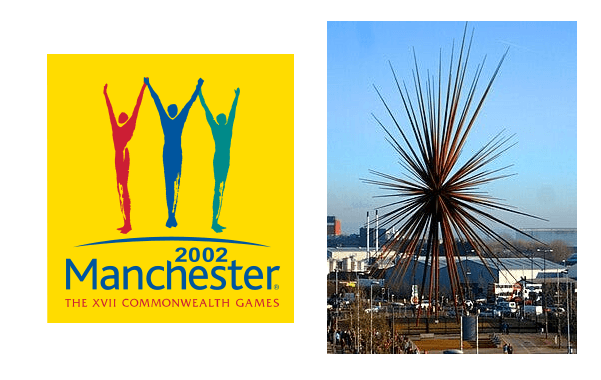
Having explored bids for the Olympics in the 80s and 90s, in 1995 it was announced that Manchester would host the 2002 Commonwealth games. The games were used to try and regenerate the east of the city in particular. Investment of about £300 million gave the city some new facilities and raised its profile. I used to enjoy seeing the monumental sculpture “The B of the Bang” on the way in from Huddersfield, but it is hard to find really crunchy economic evidence of the effects. I suppose it was one of several things that changed the vibe around the city.
And of course, the city had already become “cool” from the late 1980s, through a combination of “Madchester”, the Haçienda, Factory Records, the rise of the Northern Quarter and Ancoats and the gay village around canal street - highlighted in 1999 drama “Queer as Folk”. The BBC moved a lot of staff to Salford’s Media City in 2010-12 which also brought lots of other media suppliers to the area.
Local authority cooperation & more. In 1986 the Thatcher government abolished Metropolitan County Councils (MCCs). In the big shakeup of local government in 1974, every area had been given two tiers of government: a county council and a district or borough. The Thatcher government saw them as a pain in the arse - doing little but talk, and putting up stupid “nuclear free zone” signs. The worst offender was Ken Livingston’s GLC, but the others were seen as wasteful too. So they were (as one person wrote at the time), “zapped off the political screen like so many space invaders” (nice 80s reference).
After that, things that needed to be run in common like transport would be run by joint boards of the lower tier local authorities. In some cases relationships between councils were poor, but in Greater Manchester there was a lot of cooperation, through the Association of Greater Manchester Authorities (AGMA). The snappily-named Local Democracy, Economic Development and Construction Act 2009 allowed them to take this a step further, with the creation of a “combined authority” in 2011. Then in 2014 the leaders of the ten councils agreed to create an elected mayor for the whole city - the role Andy Burnham would go on to hold. This was a brave thing for them to do. Doing a deal with George Osborne just before an election was not welcomed by Labour in London. Even on the morning Osborne arrived to sign the deal one authority threatened to back out3.
In return the city would gain various new powers, including the ability to run London-style bus franchising and secure loan-type funding for housing and regeneration. That and the government’s idea of a “Northern Powerhouse” were helpful calling cards for the city with investors. Devolution was expanded with a series of further deals over several years covering health, fire, regeneration, rail, businesses rates, skills and homelessness. The cooperation went beyond the local authorities too - with the universities and various businesses all working hand in glove to bid for things in a way that hasn’t happened elsewhere.
Transport investment
Trams. When I first used to go over the Pennines to Manchester as a teenager, I was very jealous of their Manchester’s tram, which immediately made it feel like a much bigger city somehow. Over the period since they have built a whole network. The whole thing started in the 80s. Having dreamed up schemes including a monorail and underground tunnel, plans for a tram network were funded and legislated for under the Thatcher government. It used a mix of old railway lines and new track through the city centre. The first line opened in 1992, from Bury to Altringham. Later phases have been funded through a resourceful scraping together of money from fares, government grants, European grants, council tax supplements, and money from the airport (which the city owns). New sections opened in 1999 and every year from 2010 to 2017. The most recent section to the Trafford Centre opened in 2020 - having been given approval in 1992 (!) None of this was inevitable: contrast the horror of Leeds’ attempt to build a tram, where successive tram proposals were cancelled by central government in 2005, 2016 and 2025. There will be nothing built this parliament and opening has been delayed yet again to the “late 2030s”
Buses: In the 1980s buses were deregulated in a very different way in London compared to the rest of the country. In London, bus firms competed franchises to deliver a certain service (off road competition). In the rest of the country they competed on the road - they delivered whatever service they thought was economically profitable plus anything councils chose to explicitly subsidise. This worked fine in most places but was seen as working less well in big cities (I remember Graham Stringer bending my ear about this in about 2001). Probably the most important power in the 2014 devolution deal was the power to move to London style franchising, with the first franchises starting between 2023-25 under the banner of the “Bee network”. In 2022 the city was given over a billion pounds via the “City Region Sustainable Transport Settlement”, of which over £400 million was for buses.
Making housing affordable - not “affordable housing”
While the rest of England has 6% more social housing than in 2009, Greater Manchester has 1% less, and the city of Manchester has 5% less. How come?
The city had an explicit strategy to get more productive people to come and live in the centre. The influential 2009 Manchester Independent Economic Review (authored by the city’s in-house think tank) warned that “areas with high social housing concentrations are much less likely to improve” and that the city needed to run housing policy “to attract more skilled people from elsewhere”, with “the easing of planning restrictions which restrict availability and increase housing costs for skilled workers”.
Above all this meant not loading up new developments with massive unaffordable demands for them to contain lots of social housing - the policy which has helped drive housing starts in London to their lowest level since the second world war.
The local left have complained about this for years and argued that the city should demand that a greater share of new developments should be council housing. The Guardian and local left went into overdrive around the £1bn Manchester Life development, run in partnership with the Abu Dhabi-based owner of Manchester City football. There was also controversy about the 32-storey "Oxygen" block, with a pool and spa, built on former public land with no affordable units.
But the kind of urban regeneration that is happening in the city is more expensive than greenfield development, in a city where incomes and land values are not that high. As former local leader Richard Leese argued, many of these developments were in places where at the time no-one wanted to build anything: “If we’d tried to impose 20 per cent affordability on it, it wouldn’t have happened. We wouldn’t have got 20 per cent affordable housing, we would have got nothing.’
There have also been controversies around the Combined Authority using its funding to make loans to skyscraper developer Renaker, with other developers unsuccessfully trying to challenge these loans in court.
Under new City of Manchester leader Bev Craig and GM mayor Andy Burnham things have moved back into a more conventional left social-housing approach, with a 2022 strategy calling for 10,000 council homes, a “Manchester Living Rent” and direct building through a council-owned company called “This City”. It is possible that with the momentum that has been created this won’t make much difference, but only time will tell.
What did Burnham do as Mayor?
The metro mayors set up under the devolution deals since 2014 are not particularly powerful - the local authorities continue to make a lot of the decisions people care about and the Mayor’s most important role is to provide leadership and use the power of the pulpit to try and get people moving or working together. What was his role?
The Bee Network.
As noted above, building the tram network had happened before Burnham arrived. The agreement to go to bus franchising had also been reached earlier, and central government put in a billion quid. But Burnham helped to shepherd the process to a conclusion and that is a real thing.
Clean air zone retreat
Under pressure from Whitehall to improve air quality, Burnham announced a Greater Manchester-wide clean air charging zone in 2021. He said: “Greater Manchester were the pioneers of the industrial revolution, now we are leading a green revolution”. But as the signs for the charging zone started to go up there was a backlash and by 2022 Burnham was announcing a pause on the charging zone, which was formally dropped in 2025.
Policing - into and out of crisis
Burnham also became Police Commissioner when he became Mayor in 2017. Greater Manchester Police was placed in special measures in 2020 after it emerged the force had failed to record around 80,000 crimes in a year. Under new Chief Constable Sir Stephen Watson since 2021 the force seems to have bounced back, with arrest numbers rising. So, on the one hand the force went into crisis on his watch. On the other hand it has bounced back.
Homelessness - progress then backsliding
In 2017 Burnham promised to end rough sleeping in the city by 2020. His “A Bed Every Night” scheme aimed to provide the offer of a bed for anyone sleeping rough. In 2017 central government also announced £30 million for Manchester to pilot “Housing First”, where street homeless people can be put directly into housing, not having to go via a period in a shelter. The pandemic drove down numbers but they have rebounded since, both in Greater Manchester and across the country. Local news outlet The Mill produced this chart.
The “MBacc” - too soon to say
In 2022 Burnham first floated the idea of an “Manchester Baccalaureate”. The mayor has (limited) oversight over post-16 skills and no power over schools. The basic idea is that “the MBacc will guide students towards subjects which will maximise their chances of getting a good job”, a create a "clear line of sight" from education to good local jobs. They have created a careers website called “Beeline”.
The ambition to have as clear a pathway on the technical side as on the academic is a good one. That was the same impetus behind “T-levels”, announced by government in 2017. But whether the MBacc will make any difference at all is hard to say.
Conclusions
The city has both changed and not changed. When I went for interview at medical school in Manchester I popped out of the building for lunch, and a guy got stabbed in the buttocks right in front of me on the street. Years later I came back to the roof of the same building as a Minister, for them to show me their plans for a gleaming new innovation district. I first met Howard Bernstein in 2008 working on a think tank project which concluded the growth in the centre wasn’t reaching the rest of the city. Writing this piece 18 years later I conclude that’s sadly still true. My take is this:
The City of Manchester and Salford have been brave to embrace regeneration and have built quite a lot. But the way Manchester did this is the opposite of the approach that the left would approve of: involving very close relationships with developers and a strong focus on making housing affordable by building more, rather than the council housing the left prefers.
For all the tall buildings in the centre, there is no Greater Manchester miracle. The city has lower wages than average, higher welfare spending, and as a whole hasn’t even built more than other places.
The cooperation between the local authorities and other local leaders has been better than elsewhere for a long time.
That, plus a pragmatic approach to working with governments of all colours has helped the city land successive waves of central government investments.
Andy Burnham arrived as Mayor about 30 years into the process of turning around the city, and inherited a stronger set of institutions than most other mayors.
Though it was agreed before his time, Burnham has seen through the most recent round of transport improvements, albeit with heavy funding from the last government.
But while his other policies have not been badly intentioned, it is had to see that he has made much of a dent on the issues he has tried to tackle. This may be partly because of the powers and nature of the role, but he has also u-turned on things like the clean air zone.
There have been lots of impressive things about Greater Manchester over the last 30-40 years, and some strong leadership from Stringer, Leese and Bernstein. But sadly there has been no miracle - and Burnham is no miracle worker.
It is hardly an infallible measure though: there are plenty of poor countries with rapid population growth and and poor places that suck in more poor people.
For example, Joan Rosés and Nikolaus Wolf have found that over the last couple of decades capital cities in Europe have generally outperformed other places because of this.
The Labour leaders all went off into a room and some internal political magic happened, and then things were suddenly okay again.
Pedant alert: it's Altrincham, not Altringham, althought it is pronounced Altringham.
Hi Neil. A really thoughtful article. I’m no fan of Labour, and particularly Burnham, but I love stats more than party allegiances, so I ended up going rather further down this rabbit hole than intended.
I think you make a very strong case that Manchester’s rejuvenation began long before Burnham took the helm. I also struggled to find much evidence of a distinct Burnham effect in the broad economic measures.
But that made me wonder whether those are really the right measures on which to judge a mayor.
Looking instead at areas where metro mayors have meaningful powers, I found much clearer evidence that they can make a difference. Manchester’s bus system seems a good example: there was a genuine problem, Greater Manchester had meaningful discretion over the response, and the early evidence suggests franchising is improving the service.
That doesn’t mean mayors necessarily choose the right priorities. Greater Manchester Police deteriorated badly enough to enter special measures during Burnham’s first term, for example, before subsequently recovering.
So I’m left with a rather more modest view of mayoral power. They may struggle to change the broad economic trajectory of a city region, but they can materially affect particular services and institutions where their powers are substantial.
Perhaps the better test isn’t whether a city boomed under its mayor, but whether the mayor identified the most important problems within their control and used their limited powers and resources effectively.
Thanks for prompting a much longer investigation than I expected.