

One of the most cited facts in the higher education debate is the finding from a groundbreaking IFS report that:
“total returns [on going to university] will be negative for around 30% of both men and women.”
The IFS have recently updated this work, looking at the same cohort of students - people who did their GCSEs in 2002 and graduated in 2007.
We now have several more years of earnings data for them, and the IFS now find negative returns for 32% of those same graduates (25% women, 36% of men)1.
Not being worth it for a third of students is bad: it implies that taxpayer’s money and students’ time is being wasted.
But actually, that 32% could be an underestimate.
This piece explains why.
Preamble: choices, choices
Before we start, a key thing to know up front is that how much men or women are likely to earn after university depends mainly on three things - what subject you did, where you studied - and what your prior attainment at school was.
Graduates from some subjects see low earnings whatever their level of prior attainment. Subjects like arts, media studies and so on lead to low average earnings - even for those who did well at school.
In contrast earnings for graduates of other subjects vary massively by prior attainment.
Subjects like Computing, Economics, Law, Business etc lead on to high earnings for those with high prior attainment - but low earnings with low prior attainment. That wide variation appears as long grey bars are in the chart below:
So, it’s worth holding this in mind as we think about outcomes for the “average university student” - there is no such thing! And a lot is about your prior attainment.
With that preamble over, let’s get into it, and look at some of the reasons why I think things may be worse now even than the IFS report’s headline finding.
1) Declining graduate premiums - driven by more students with low prior attainment
The new IFS paper is looking at some pretty old students - people who were born in 1985, took their GCSEs in 2002, and graduated in 2007.
In other words, the IFS work is looking a long way back in time. Since then, graduate premiums have fallen quite a lot, driven by the expansion of higher education.
The IFS have continued to look at that older cohort because they are wary of too much extrapolation. Even with the extra data they have gained six years after the first report, that only gives them people’s actual earnings to age 37 - the rest has to be extrapolated. So it’s not unreasonable to look back in time - the business of writing such reports turns on making these trade-offs.
But the problem is that two big things have changed since 2007.
The gap between graduate and non-graduate earnings has narrowed a lot. (we often call this the “graduate premium” - though how much of it is actually just a “smart person premium” is a key debate)
While the share of kids going to university has not changed so much at the top of the distribution - the share has been transformed in the bottom half.
And it turns out the rising number going to university with low prior attainment and the falling “graduate premium” appear to be linked.
Let’s put some numbers on both those changes. For a girl right in the middle of the achievement distribution at GCSE, between 2002 and 2018 the probability of them going to university by age 21 went from less than 20% to about 50%. And of course, even that is old data - the share going to uni has gone up further since then.
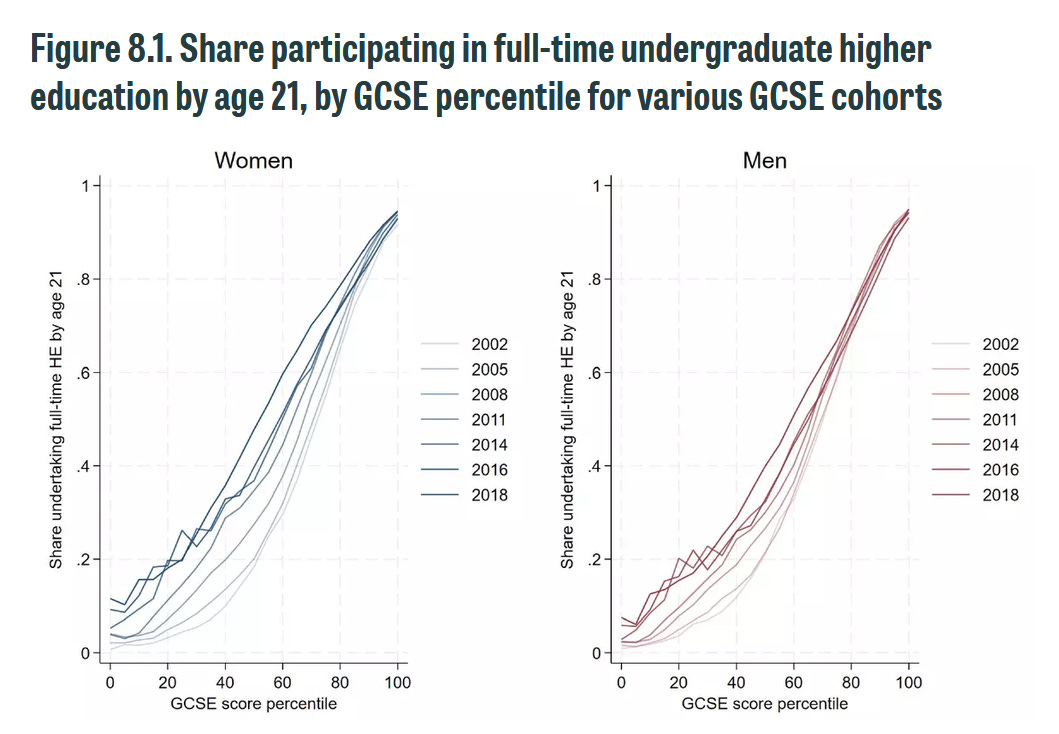
As more and more have gone to university, the gap between graduate and non-graduate earnings has declined.
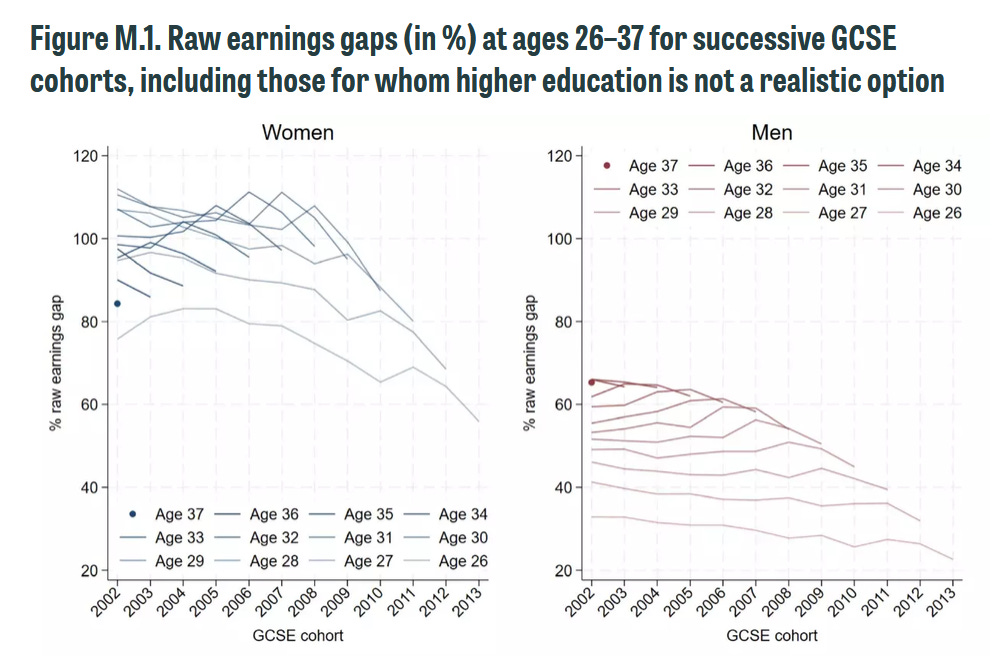
There are different ways to measure this. The chart below (M.1.) compares all people of the same age who did and didn’t go to university. The IFS describe this as “including those for whom higher education is not a realistic option” - though as noted above, increasing shares with low prior attainment are in fact going.
As you can see, the earnings of the graduates are higher. That is unsurprising, as they typically did much better at school.
But the earnings gap between the graduates and non-graduates is falling over time.
At age 26 the raw premium for women declined from c 80% for those doing their GCSEs in the early 2000s to under 60% for those doing their GCSEs in 2013, and there is no reason to think this trend stopped or slowed down in 2013.
This is a key reason why, when IFS find that university wasn’t worth it for 32% of those who did their GCSEs in 2002, that share may be much higher by now.
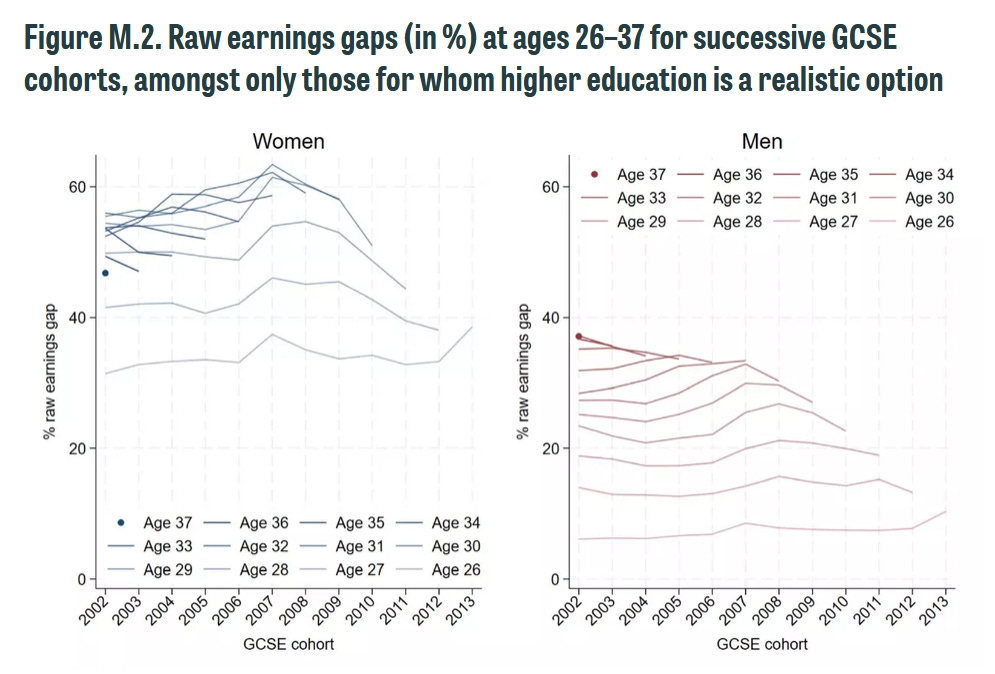
If you re-plot the charts above, but exclude those with lower prior attainment, you don’t see the same clear decline in graduate premiums - so the decline appears to be all about sending more people with low prior attainment to university:
Low prior attainment
And what about those people with lower attainment? The IFS paper makes a crucial choice. They look only at about 40% of pupils - the top of the prior attainment distribution.
They also screen out various others, including those with a SEN statement or EHCP at age 16, which is obviously a rapidly growing share of pupils - currently around 5% of young people have an EHCP.
For the 2002 cohort they only look at those who achieved at least the points equivalent of five C grades in their top eight GCSE exams. Here is what that does to their sample:
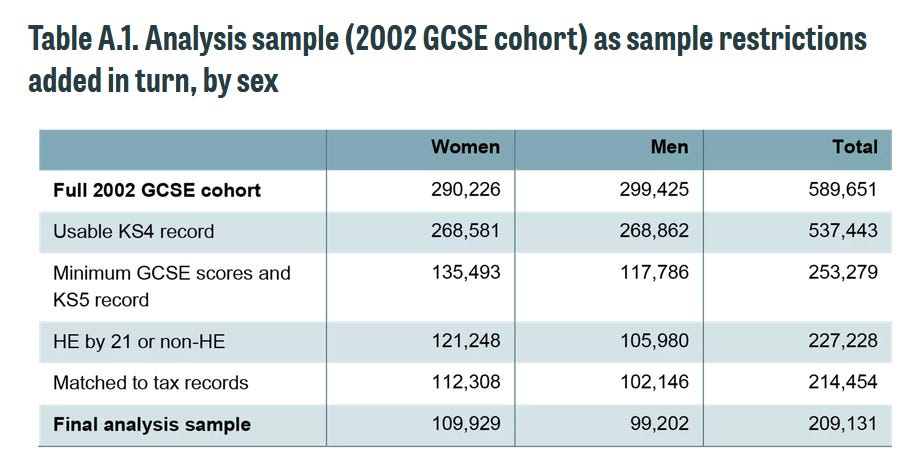
What they are trying to do is screen out data problems - people who go to university who apparently had low GCSE results may have actually be unrepresentative in some way, or data glitches. Including SEND students might distort things. I totally get why they have done it.
But that exclusion gives you a new problem: once you cut off the bottom half you have fewer people in the sample not going to university. And they too might be unrepresentative in some way, or data glitches.
All this must be born in mind when we look at graphs like the below from the IFS - this is in fact not the bottom 35% but the bottom 35% of the top 40%.
We can directly observe these graduates’ outcomes up to age 37 - I have drawn that point in as a red vertical line. After that is a projection - IFS read across from higher attaining cohorts and assume their future earnings will shoot up in a similar way later in their careers. But the key question is: will they really?
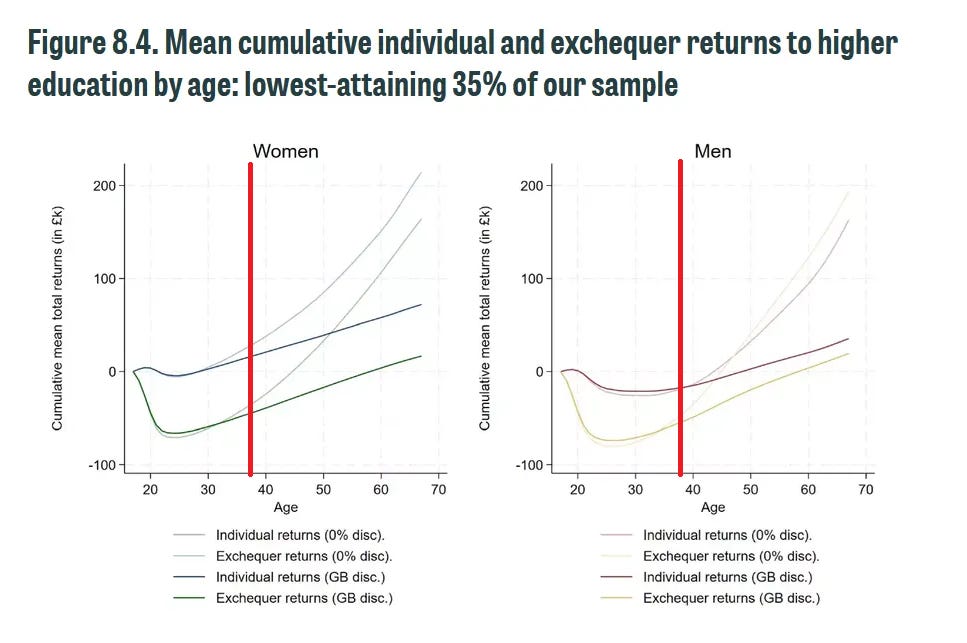
Looking at the period we can directly observe, (to the left of the red lines) we see that the average woman in this group saw an individual positive return by 37, but a negative return once you include the costs to taxpayers. We see that the men in the group have seen a negative return as individuals as well as a negative return for taxpayers. A lot turns on the hope that things will turn round for them later as they do for historic graduates with higher attainment.
And what would the numbers look like if the IFS work was updated to stop screening out those with lower prior attainment - and we could bring the figures up to date?
The share with negative returns would surely be much higher in those groups, and that 32% figure would be higher.
Accounting for hours worked - and kids
In the above I have talked casually about “graduate premiums” and whether university is “economically worth it”.
In reality it is very very hard to work out the impact that university has, compared to other unobserved facts about graduates. The IFS are trying to control for prior attainment - and as noted above, even that is very tricky. Attempts to prize apart the impact of university on “human capital” from “signalling” effects more broadly are nigh on impossible.
The IFS work just looks at overall earnings - they dataset they are using doesn’t contain hours worked. But a recent paper from a team lead from UCL suggests that is a big part of the story:
Recent evidence using administrative earnings data from England suggests a zero return to graduation for men and positive returns to graduation for women in annual earnings at age 26. We show that once hours worked are taken into account – typically not available in administrative tax data – returns to graduation in hourly wages are considerably smaller for women than returns in annual wages at this age. Graduate women work more hours than comparable non-graduate women; thus, not taking hours worked into account leads to overestimating returns to graduation for women by more than two-fold.
Higher per-hour productivity is (other things equal) an unambiguously good thing.
But working more is more ambiguous: is working more hours something we should consider as a benefit of graduating - or is it a variable that we should be controlling for to work out the benefit?
There is a wider issue here. We know that for women, the point at which they have do or don’t have children has a huge impact on their earnings:
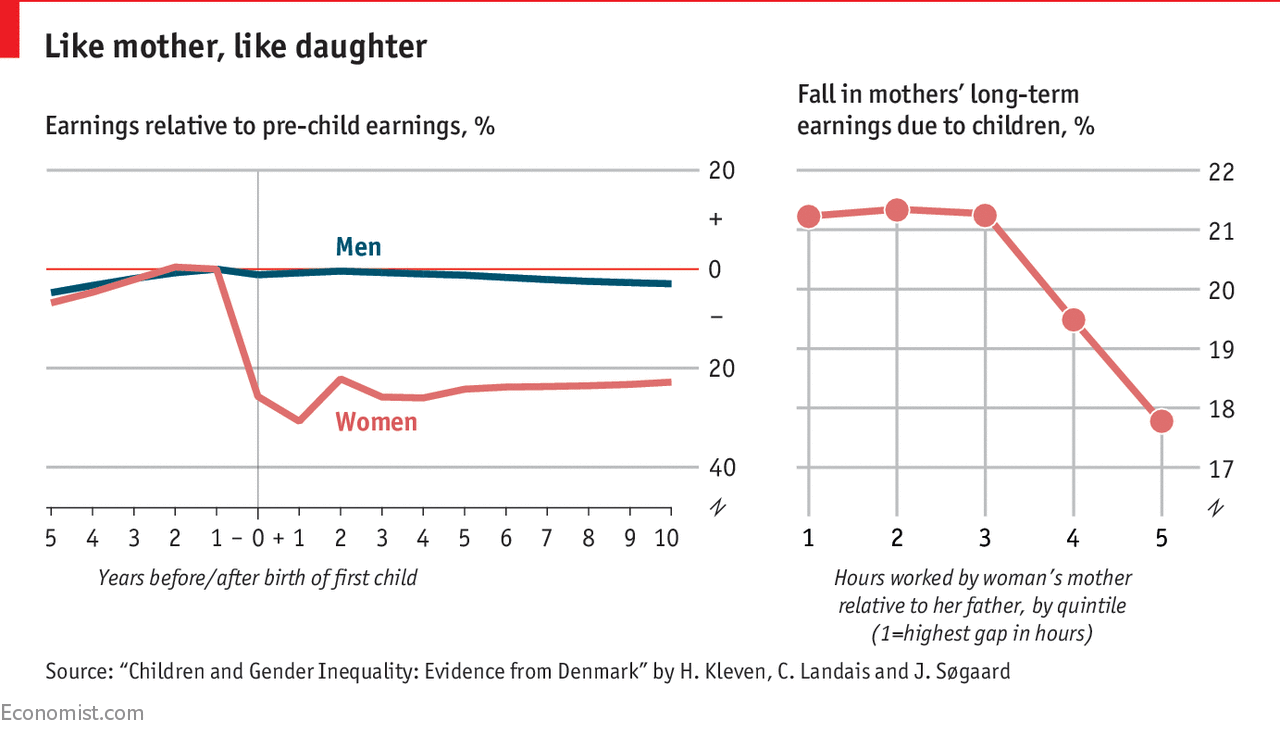
And higher education correlates with both later childbearing and lower rates of childbearing. Even older cohort studies found that average age of entry to motherhood was five years later for women with higher qualifications than for those without. A study of women born in 1970 found that first-in-family graduates were 40% more likely to be childless at 46 than their university-educated peers.
So how much of the “graduate premium” for women reflects later / lower childbearing - and how should we regard that in the analysis? This would be a great extension to the dataset that IFS are working on.
Conclusions
The series of papers on graduate returns which the IFS have produced are superb - and hats off to them for their work. The finding that university was not worth it from an economic point of view for nearly a third of 2007 graduates is very striking. It should lead to a change in policy. In fact, it has already influenced the Conservative pledge to re-introduce number controls on higher education, and use the savings to fund more high quality apprenticeships and the abolition of of real interest rates on Plan 2 student loans.
But there are good reasons to think this may be an underestimate of the problem. The graduate premium had continued to decline since 2007, and as the IFS turn to later cohorts, they will need to figure out what to do with people with lower prior attainment who are now going to university. We can see that some of the apparent earnings premium is not higher hourly productivity, but more hours being worked - and that female graduates are more likely to be working more hours due to lower/later childbearing.
The further dramatic expansion of mass higher education in the 2010s was justified by analysis of average graduate earnings premiums which now look very crude and misleading. As the analysis gets better we see more nuance - but overall, the picture is looking worse and worse.
Table D.1.
I always find your work stimulating and informative. Please keep it up. I am pledging.
Neil,
I run the University Watch campaign. I am extremely interested in your work and I hope that you have seen mine at my website universitywatch.org. I was most recently attributed as a contributor to Iain Mansfield's report Tarnished Towers from the Policy Exchange. I currently have an on-going case at the Office for Statistics Regulation regarding the recent Graduate Labour Market Outcomes report which is misleading and is continuing to hide the truth. ie. That once you control for Prior Academic Attainment, then there is no Graduate Premium. This is consistent with the findings of a report from the team lead at UCL that you refer to in your sub-stack which I hadn't come across before, but it is excellent and very useful to my campaign. I think that it would be very interesting if I was to meet up with you to discuss my current case at the OSR, as the outcome is absolutely fundamental to Govt policy making. Official Statistics are supposed to tell the truth and not obscure it, which has been the case for the last 20 years and has led to the unfettered growth of the HE sector.
Paul Wiltshire
paulw4567@hotmail.co.uk
07768 915446