

Up to one quarter of UK growth this year is because of AI. I’ve written before about how rapidly progress is accelerating, and how economically transformative it could be.
But for that to happen, UK companies will need access to compute, and lots of it. Now data centres aren’t really a bottleneck to AI adoption right now - but the UK is an island with highly vulnerable submarine data cables. We are currently becoming more and more reliant on models running in other countries which we could be cut off from. In some cases latency matters. And just generally, we are going to need a lot more capacity. There is a good argument that investment in data centres could be a boon for post industrial areas - something picked up in the FT this week.
The current government has set a target of 6GW of data centre capacity by 2030.
There’s just one problem: a government-commissioned economic report published last week estimates that demand in 2030 will actually be 11-21GW. That means that the British economy could demand up to 3.5x more compute than the government is planning for.
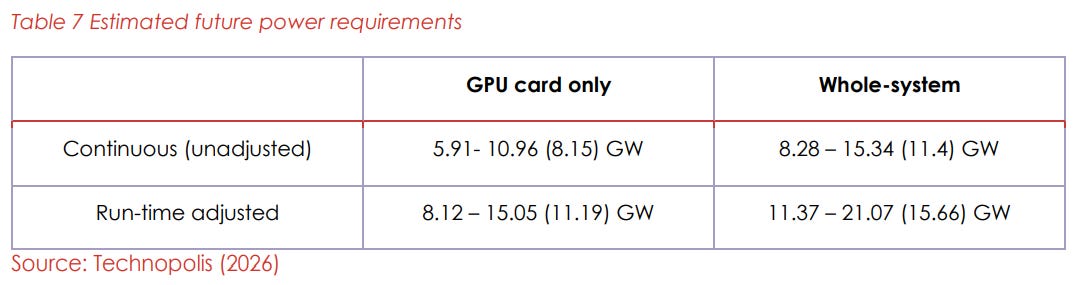
Scaling up data centre deployment first and foremost means reforming access to the grid. Firms seeking new grid connections can wait more than a decade for the power to come on.
Despite saying “accelerating grid connections… is central to unblocking private investment… [in] data centres” as early as Budget 2024, the government’s action to fix this is both wrong headed and too slow1.
We are now half-way through the parliament and the Connections Accelerator Service - a proposed grid prioritisation mechanism for “strategic demand” - is not yet running, with no proposed date for delivering pre-2030 grid connections.
Bizarrely, the government has also suggested that it will end up capping data centre development. This will be implemented through “regional infrastructure targets, which will act as a limit on connection volumes.”
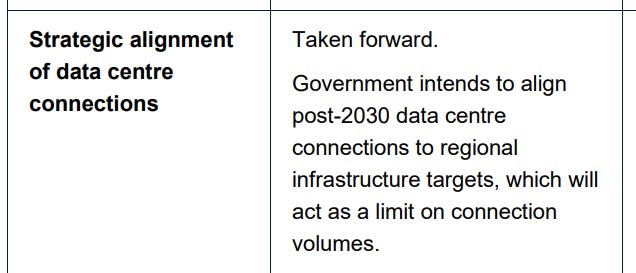
Combining a far-too-low national target with strict regional limits would force the UK economy into under-capacity on compute. In the short term, this could mean ~£700bn in missing capex from the up to 15GW of data centres that simply aren’t built.2
But in the long term, the real costs would be more geopolitical risk and less available and more expensive compute. This would mean worse growth, fewer jobs and more reliance on access to the US. The government needs to increase its ambition.
The main problem is grid connections, but it’s also worth noting that the government has launched another consultation on planning reform for data centres, meaning we won’t have a framework for large data centres until Spring 2027 at the earliest. This is despite starting work within days of winning power!
Taking industry estimates that it costs up to ~£45bn to build a 1GW data centre