

Against the assault of laughter, nothing can stand.
-Mark Twain
He’s finally resigned. But the Arday scandal revealed the rot in higher education in several ways, and involved:
Cambridge University giving a professorship to a fraudster and fantasist, based purely on his skin colour and absurd stories
A large number of academics coming out to defend him - even after it became totally clear he was a fraud.
The University first saying the complaints were bogus and a “vile campaign” - then being utterly paralysed and unable to respond, even as their reputation went up in smoke
Arday being empowered to use lawyers (and the police!) to intimidate journalists
Even more people becoming aware of the utterly worthless nature of too much of the “output” of the non-STEM parts of our universities.
Tom Wolfe couldn’t have invented Arday. Nor could the late David Lodge have written a more on-the-nose satire of contemporary universities.
While the intimidation of journalists, the waste of public money and the reputational disaster for Cambridge are all very serious, one of the things that makes it so disastrous is… it made them all look monumentally stupid and gullible.
And nothing can withstand a gale of laughter.
Here is Arday’s boss Hilary Cremin gushing to him: “We are so lucky to have you… you are the best in the world”.
Watching this display of fawning stupidity kills me. I love universities. I am naturally a universitophile. My parents didn’t go to university, so my siblings and I were the first generation. When I went to Oxford I loved it.
And lots of wonderful things still happen in our universities - particularly on the STEM side. There are scientists and other real scholars in our universities who we should revere. There are bits of HE I think we ought to expand.
But, but but… there is just so much garbage now. Watching Cambridge (failing to) grapple with the Arday case was like watching one of your best friends end up on heroin and living in a skip. Its tragic. You still love them, but you know you have to help them get off the smack.
And let’s face it, the Arday case is hardly the first spectacular disaster in higher education:
In 2022 we learned about the Manchester PHD involving masturbating to Japanese child porn.
We had Prof David Millar at Bristol, who who denied the Assad regime’s use of chemical weapons in Syria, disputed Russian responsibility for the 2018 Skripal poisonings and said jewish students were “pawns” in a zionist conspiracy.
We had a Sunday Times investigation found millions being fraudulently claimed by people with no intention at all of studying, prompting the Education Secretary to refer it to the Public Sector Fraud Authority.
The University of Liverpool agreed to rename Gladstone Hall - instead of the great Liberal Liverpudlian statesman, it now celebrates Dorothy Kuya… a lifelong member of the Communist Party of Britain.
We had the Grievance Studies Affair, where academics deliberately published absurd papers in journals, including, “"Human Reactions to Rape Culture and Queer Performativity at Urban Dog Parks in Portland, Oregon” (in Gender, Place & Culture) and "An Ethnography of Breastaurant Masculinity: Themes of Objectification, Sexual Conquest, Male Control, and Masculine Toughness in a Sexually Objectifying Restaurant" (in Sex Roles)
I could go on. But the spectacular disasters don’t really explain the problem. The problem is the vast flood tide of badly written zero-value guff.
Stuff that would be described as “woke” is part of it, but there is just much that is pointless - read by no one, and of use to no one.
In government and in Parliament I would often go looking for academic evidence and find that stuff just wasn’t being produced on things that would actually be useful. A handful of academics produced must of the useful stuff.
Meanwhile academia produces reams and reams of work on its own obsessions - particularly the increasingly monomaniacal obsession with issues around race, gender and sexuality.
Let’s be clear. The stuff Arday produced is utter garbage. But it isn’t unusual garbage. Here is one of his. He produced loads of this sort of stuff:
“Dismantling Power and Privilege through Reflexivity: Negotiating Normative Whiteness, the Eurocentric Curriculum and Racial Micro-aggressions within the Academy,” Whiteness and Education (2018)
This paper employs a Critical Race Theory (CRT) a storytelling [sic] method, which operates as a counter-narrative in attempting to conceptualise my own professional experiences of negotiating normative Whiteness, diversifying Eurocentric curricula and conceptualising the racial mirco-aggression [sic]. The narratives proffered demonstrate the subtle but powerful ways in racism unfolds [sic] within in [sic] the Academy and the nuanced, everyday forms of racism that persist against a backdrop of Whiteness. (p. 141)
This is purest word salad. But in contemporary academia that’s not unusual.
Charlotte Gill runs a whole website cataloguing the nonsense. And a brief search of thesis titles reveals how much of this there is. In the space of five minutes scrolling I noted theses including:
“The unladylike ladies of roller derby? : how spectators, players and derby wives do and redo gender and heteronormativity in all-female roller derby” (University of York)
All that glitters is gold : queering waste through campy craft (Loughborough University)
“The politics and aesthetics of decolonial queering in Palestine” (Durham University)
“Lifescapes of a pipedream : a decolonial mixtape of structural violence & resistance along the Chad-Cameroon oil pipeline” (Oxford University)
“Transgender gaze, neoliberal haze : the impact of neoliberalism on trans female bodies in the Anglophone Global North” (University of Edinburgh")
Decolonizing the camera : photography in racial time (Durham University)
“Coloniality, (body-)territory and migration : decolonial feminist geographies of violence and resistance among Latin American women in England” (King’s College London)
Boyish aesthetics : images of the boy from ‘Peter Pan’ to contemporary female-to-male transgenderism (University of Manchester)
“Awaken dreams : decolonising participatory art through communal friendship” (Goldsmiths College)
I could go on and on…
How did we get here?
If this blog has any theme, it’s about putting numbers on things. So lets look at the following questions.
Have universities really become more focused on DEI stuff, or is that a myth?
If so, when exactly did things change?
Are we “past peak woke” in our universities as some claim?
I’m going to use a simple metric to look at this, and just look at the number of (mainly doctoral) thesis papers each year which contain terms in the title which people would describe as DEI or critical theory-related (see annex for the full list of terms).
We can use two different data sources to put numbers on this.
EThOS, the British Library's e-theses service. EThOS was the British Library's national database of UK doctoral theses: a single catalogue that recorded every PhD awarded by a UK university, gathered from the universities themselves. The British Library published periodic snapshots of the whole thing as a downloadable spreadsheet. The sample size averages around 14,000 theses a year across the 1990s to 2010s, rising to roughly 19,000 by 2022. Its weakness is that it stopped: a cyberattack in October 2023 ended collection, so the data only reliably runs to 2022.
Individual university repositories. Via a protocol called OAI-PMH, we can get more up to date data from individual repositories and aggregate them. Here I have drawn from Oxford, Cambridge, Durham, Birmingham, Glasgow, Leeds, Sheffield, York, LSE, UCL, Warwick, Southampton, and the Open University. The sample size is smaller - about 8,200 a year over the last three years - but the advantage is that we can go nearly up to the present day.
What do they tell us?
The rise of EDI and critical theory in British academia
We obviously need to control for the growing total number of theses being published and look at a the rate of EDI-related titles as a share of all theses. I haven’t excluded fields like physics or maths where you are unlikely to find such terms, so the share is obviously quite small.
Here I have just looked at titles not abstracts or papers - this is intended as a simple proxy for wider trends.
Of course a thesis may be a load of DEI garbage and not have one of my search terms in the actual title. So while the numbers are not huge - this is the tip of a much larger iceberg.
As you can see - a strongly growing share of theses contain EDI/critical theory terms in the actual title.
The larger sample size on EThOS explains the less choppy line. But the trends are more or less the same in the two datasets. Screening for only doctoral theses makes little difference:
My 13 chosen repositories come from more elite / more research intensive universities which I suspect are more STEM heavy - I suspect this is why the rate is about 20% higher on the wider EThOS dataset. If we had EThOS data for the last couple of years I suspect the rate will have risen to about 270 ish by 2025 in the chart above. The data for 2026 showed a huge spike - but I have not included it here because the data for this year is only partial so far - and there may be some selection bias driving that spike.
It is worth noting that there’s a timelag here - people publishing their thesis in 2025 probably started in 2021 or 2022 - so, a bit like in astronomy, we are looking into the past.
Which particular ideas and terms are driving this EDI growth? Well, if you are still talking about “feminism” and “the patriarchy” those are still big on campus, but you are probably an old-timer. Hotter EDI terms now are things like “intersectional” “queer” and “autoethnography”. “Transgender”, “decolonising” and “whiteness” are very big too.
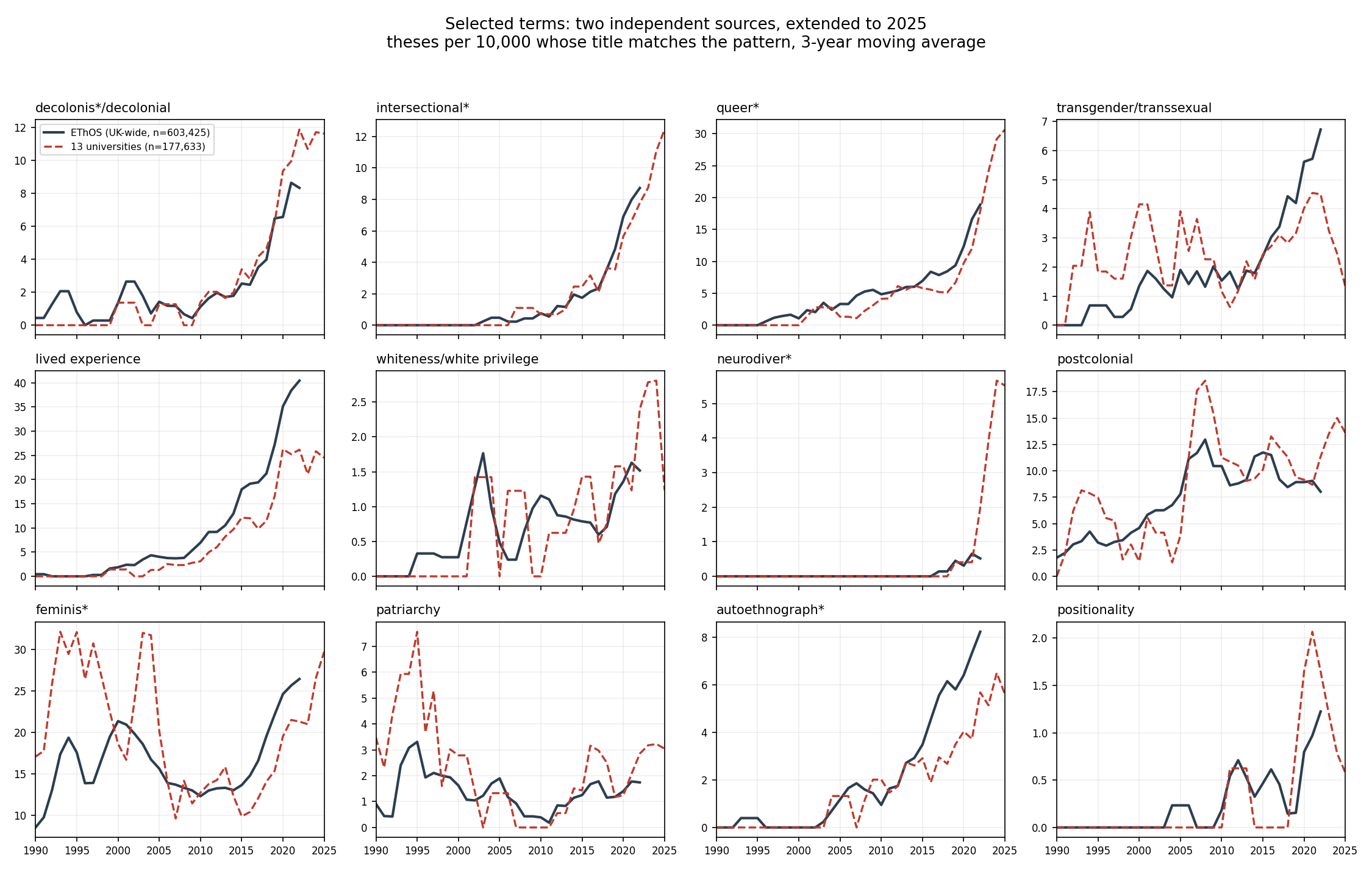
Projecting the EThOS data forward to 2025, UK universities are now probably publishing about 400 theses a year with these terms in the actual title. Generally a doctorate takes about 3-4 years to write, so that is a huge amount of life-years being spent on writing these things. Many multiples more will be on similar themes, even if my search-words aren’t in the actual title.
And think of the zillions of journal articles and research projects in HE which are similar. Is this all a good use of taxpayers money? Is it a good use of people’s lives?
Conclusions
Academics have studied somewhat pointless stuff for a long time. Even in Lucky Jim (1954) Dixon's article, “The Economic Influence of the Developments in Shipbuilding Techniques, 1450 to 1485” satirises the narrow and pointless quality of much academia. And it is true that sometimes you don’t know what might be useful.
But it is often clear what will definitely not be useful. And the charts above show there is proportionately a lot more EDI / critical theory rubbish than ever before in academia.
People like Jonathan Haidt and Eric Kaufmann have done a good job of explaining the purity spirals which have gradually taken the norms of the university world further and further from the rest of society.
We are in an ageing society with nothing but hard fiscal choices ahead of us for the rest of my life. People can see that a lot of garbage is being produced - that the HE emperor has no clothes.
And unsurprisingly, taxpayers’ don’t want to waste their money on this rubbish any more.
Annex: the terms searched:
Variations of each were searched - a * indicates wildcards
BAME
EDI/DEI phrase
LGBT*
X justice
ableism/ableist
allyship
anti-racism
autoethnograph*
cisgender/non-binary
coloniality
critical race theory
decolonis*/decolonial
epistemic injustice/violence
eurocentri*
feminis*
gender identity
gender-based violence
global south
hegemon*
heteronormative etc
inclusive education/practice
indigenous
intersectional*
islamophobia
lived experience
marginalis*/marginaliz*
microaggression
minoritis*/minoritiz*
misogyny/sexism
neoliberal*
neurodiver*
othering/otherness
patriarchy
positionality
postcolonial
precarity
privilege (social)
queer*
racialis*/racializ*
reflexivity
safe space
settler colonial*
social justice
subaltern
toxic masculinity
transgender/transsexual
unconscious/implicit bias
whiteness/white privilege
As an academic insider, I can also tell you that this language has poisoned much theological study, and this is not unconnected with the intellectual collapse of the Church of England.
Far be it from me to gainsay any theory about the intellectual collapse of the progressive classes, but they also respond to incentives like everyone else. If the money - and the institutional credit - comes via this stuff then it's no surprise efforts will cluster there, any more than it's a surprise that this system should self-rationalise whilst doing so. It would be tempting to turn this into a hearts and minds issue, about how we need to either win the argument with these people or remove/replace them, but the trickle down effects of a tweak to the incentive structure would achieve more