This was a can-kicking, fiddly, and underwhelming Budget. It is difficult to disagree with the verdict of the IFS:
“This Budget has a raft of fiddly measures but very little that will move the dial on growth. But on many other big areas – disability benefits, support for young people, plans for social care, and the path for defence spending – we are still waiting."
Today’s Budget had a record number of measures - but the average size of each measure is the smallest ever.
But the boring, fiddly quality of it does NOT mean it is a “do no harm” Budget.
Borrowing
For starters, borrowing will higher in every year compared to March – even the Resolution Foundation have been critical of the decision to reduce headroom, noting that after this decision: “he doesn’t have enough to survive one bad roll of the dice.”
It is a bit mad for the government to be briefing that is OK to borrow more because of looming further conflict in Iran - it’s a bit like saying there is a storm coming so no point in fixing the roof.
It is easy for your eyes to glaze over at such 70 billion of extra debt interestpayments over the forecast even compared to March. That increase in debt servicing costs alone could buy or forces a lot of kit or allow us to do seriously pro-growth things.
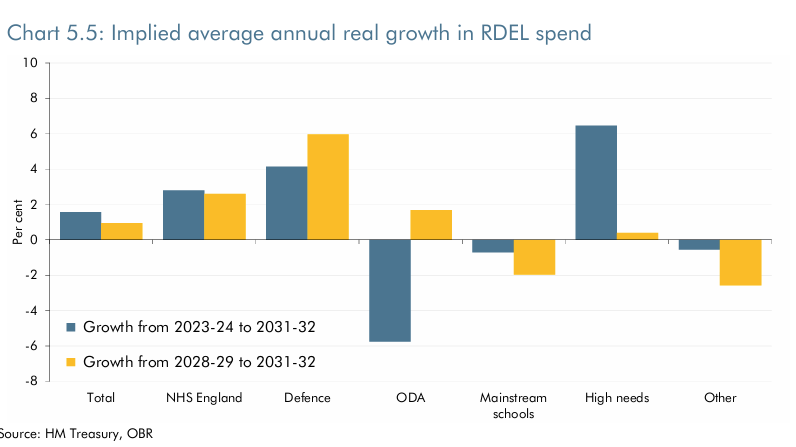
And it is worse than it looks, because even this turns on highly unrealistic assumptions about real terms cuts to most departments which the Parliamentary Labour Party seem unlikely to approve. As Paul Johnson notes:
Here's the real story of this Budget, the can being kicked down the road. This Labour government is apparently planning spending cuts on most areas of public service spending of 2.6% per year between 2028-29 and 2031-32. Pull the other one. It's got bells on.
Welfare and jobs
Meanwhile the explosion in welfare spend continues unabated - with a £55+ billion a year increase in spending. In fact the government are going to breach the “welfare cap” on overall spending. The OBR note that the deterioration “results in the welfare cap being on course not to be met by £3 billion once the margin is included.”
Healey claimed he would “bring down” welfare spending. This is the opposite of the truth.
Compared to 2023/4 by the end of the Parliament in 2029/30 we will spending an extra £17.4 bn a year on Universal Credit and its equivalents, plus an extra £37.4 bn a year on non-pensioner sickness and disability benefits - so £55bn more on just those benefits.
And the forecast keeps getting worse - £13 billion higher in 2029/30 than even Rachel Reeves thought it would be:
One problem with fixing the welfare problem is that the tax increases Labour already pushed through are costing jobs - the OBR says their Income Tax and National Insurance threshold freezes now cost 215,000 jobs. (4.14 of EFO)
Taxing investment in the future
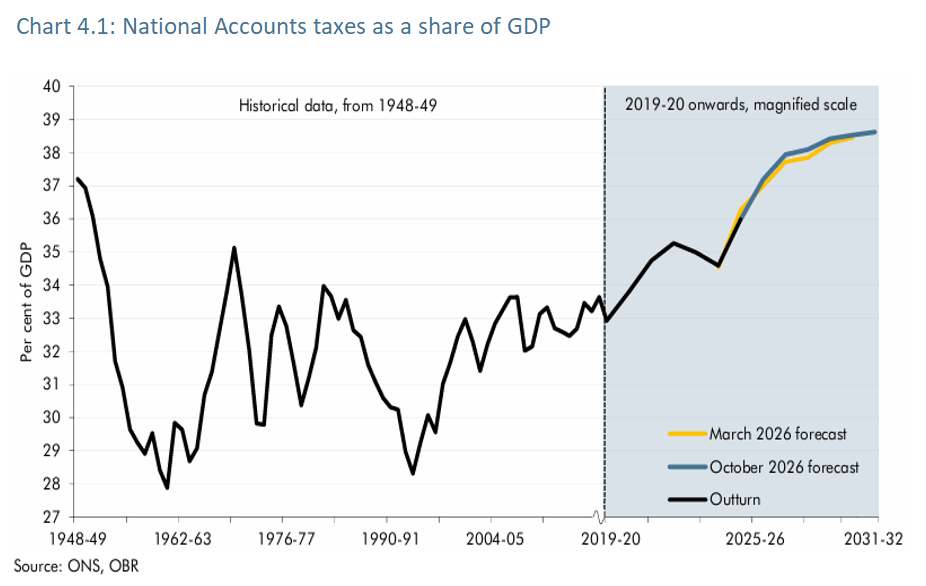
Meanwhile the tax burden as a share of GDP is forecast to increase in every year of the forecast – and reach a record high in 2027/8:
In this budget as well as the bank tax (which is ultimately paid by savers and borrowers) we had some big tax increases on the future. These include:
Increased tax on business investment (raising £5.2bn over the forecast)
Increased tax on savings (£2.4bn)
Increased tax on inward investment (£2.6bn)
(Red Book scorecard, lines 58, 62, 68).
This is essentially a raft of taxes on growth and the future! The sorts of investments that can get our economy moving will now be harder to fund and more expensive to make. Thanks a bunch!
There is also an increase in tax “on landlords” - but unsurprisingly the OBR says rents will go up as a result and that landlords will just pass the cost on to tenants. The OBR say that; “These measures collectively risk leading to a steady rise in rents” - so perhaps we should just call this a tenant tax.
The supply side: Housing
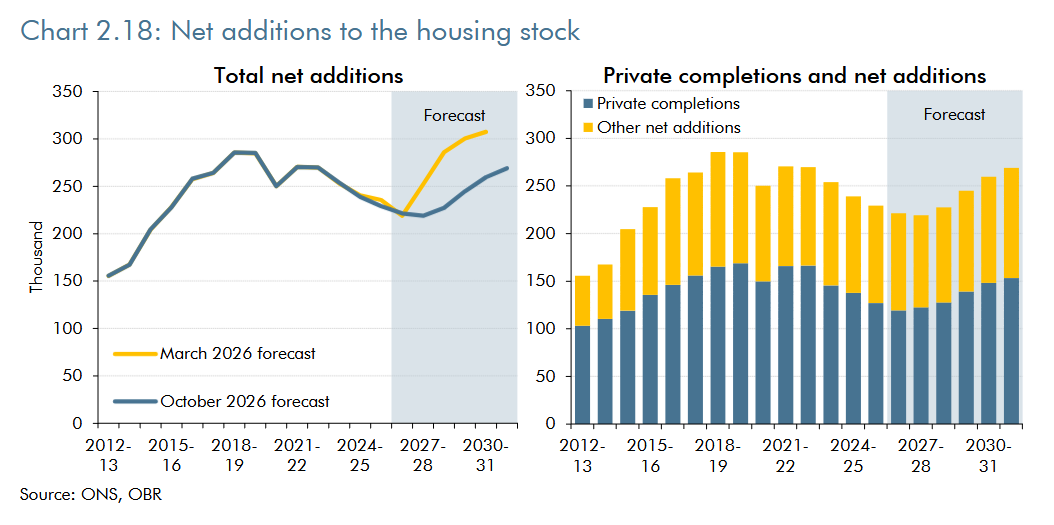
The outlook on housing is dire - Labour are set to miss their manifesto commitment to build 1.5 million new homes by 500,000. The OBR say even “compared to the March forecast, we expect 190,000 fewer cumulative net additions over the forecast period” They add: “We expect the ’Your First Home‘ equity loan scheme to only have a marginal impact on housing supply given its limited overall size.”
It is amazing that we managed to build more homes during a global pandemic than Labour will manage in any year of this Parliament.
Living standards
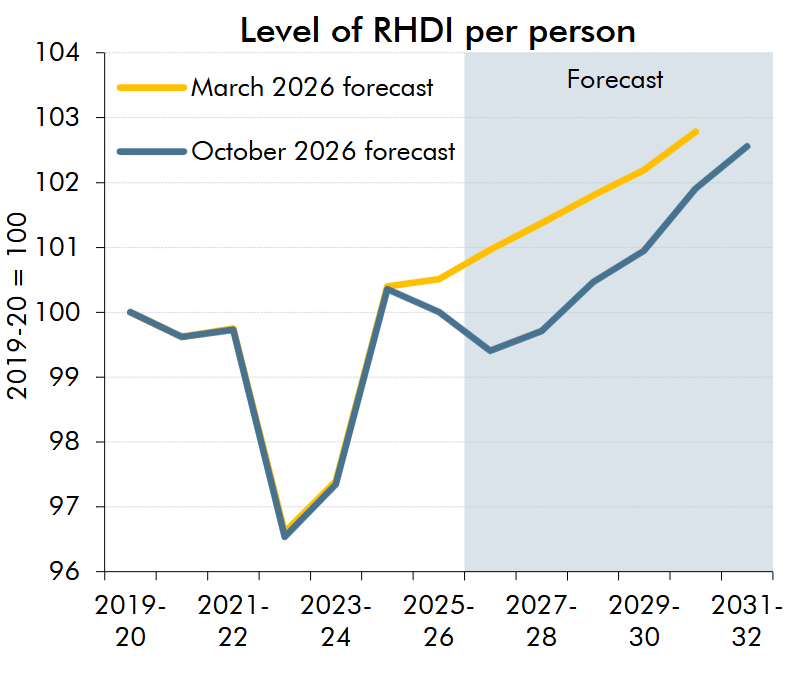
Meanwhile living standards are getting battered – when increasing them used to be described as one of Labour’s 5 main “missions”. Real Household Disposable Income (RHDI) per head is falling 0.8% this year and is lower every year of the forecast. In total it will end up being nearly £1,500 lower than forecast by the OBR under the last Conservative government.
Or to put that in actual cash:
Questions, questions
The Budget leaves a whole bunch of unanswered questions too.
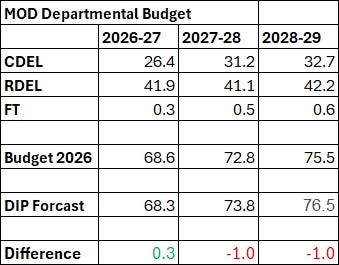
Defence. Compared to the Defence Investment Plan the government appear to have taken a billion out of MOD in 2027/8 and 2028/9 by banking changes to pensions? Page 145 of the Red Book suggests a gap of 1.5bn but this seems only partly unwound by changes to Financial Transactions and the like, so MOD ends up being a billion lower than at DIP. If you really regard defence as a super-urgent priority this seems like an odd thing to do? Torsten Bell has said this is a “technical change”.
Triple lock. The OBR note that triple lock changes are expected to save literally nothing over the forecast (out to 2031/32). “it does not currently affect state pension costs over the forecast period”. So that means there is nothing for the “National Care Service” till at least 2032. So where is the money coming from?
CBAM and fuel prices. The government also today published a separate consultation on joining the EU Carbon Border Adjustment Mechanism for refinery products – this will add a new tax on imported petrol and diesel. The government gives no figure but accepts there will be increase in prices: CBAM could affect prices paid by importers, distributors and end-users of CBAM goods – and in this case, for fuel products widely used throughout the economy, including supply chains and households. The scale and distribution of any impacts would depend on several policy decisions, such as specific product scope, which are still to be determined, but also including the extent to which additional costs are absorbed versus passed through supply chains.” As a diesel driver I don’t love the idea of them making fuel even more expensive.
Student loans. The Starmer government promised it would sort out the problem of above-inflation interest rates on Plan 2 student loans earlier in the year. The new Education Secretary described it as her top priority - and yet they seem to have given up trying to fix this - there is a continuation of a 6% cap on interest rates but this is a micro-sop basically and Plan 2 graduates will remain stuck on the hamster wheel, working hard, making lots of repayments but watching their debts go up, not down.
Conclusion
Healey’s excruciating delivery and the zillions of tiny micro measures may lead some to conclude this is a “boring, sensible” budget. In reality it is anything but. It takes us deeper into the doom loop of higher welfare spending leading to higher tax, leading to slower growth and then back around to get more tax and welfare spending.
The only sensible course of action is to cut spending and tax, and break the vicious circle.
Thanks for reading Neil O'Brien's Substack! Subscribe for free to receive new posts and support my work.