

In her Spring Statement this week Rachel Reeves said:
“Real wages have risen by more in the first 18 months of this Labour Government than in the first 10 years of the Tory Government.”
Keen observers will immediately spot what is going on here.
Ten years on from 2010 is… 2020, and the depths of a global pandemic.
So if we do a point to point comparison then… well, you can tell exactly what she is up to here.
Let’s look at the chart. Reeves “ten years” comparison (in pink below) neatly coincides with the mid-pandemic low point. If you compared just a few more months on into the recovery (say “eleven” years) the story would be totally different. As would rolling on to 2024 (in grey). Hence her selection of “ten years”.
In reality neither 2010 or 2020 mark turning points in the wages data.
The coalition government came to power about halfway through the big fall in earnings that followed the massive recession. Following bubbly financial sector growth from 2000-2008, real wages were falling fast way before Cameron and Clegg ever set foot in the rose garden. The economic turning points were March 2008 and 2013-14 ish, but then those don’t fit the political narrative Reeves wants to weave.
On this data, the trend between 2014 and 2024 and the trend between 2024 and 2026 are basically indistinguishable.
But it’s also worth also understanding what this measure she is quoting actually is. “Average Weekly Earnings” sounds like the wages of the average Joe. Nope!
It is an economic concept measuring all earnings divided by all employees. Its main merit for economists is that it can be produced quickly.
But it tells you little about what is happening to most people. If a few bankers make out like bandits, but your average person sees no increase, it will still go up.
And if unemployment falls and there are more employees, what tends to happen is that the people joining the workforce (from welfare or because they are young) tend to have lower earnings and drag the average down (the so-called “batting average” effect). It doesn’t distinguish part and full time jobs. If more part time women enter work (say because of welfare reform) that will drag down the average.
So, let’s look at some other measures of earnings that actually try to get at the experiences of normal people. The Annual Survey of Hours and Earnings is the flagship ONS measure, with a huge sample size. It lets you look at different people, not just an economic variable.
I have given index values below so you can see the relative trends. You can see that it was lower earners who took a bigger hit in the period from 2008-2010, and that people in the lower half of the income distribution saw stronger growth after that - something that Reeves didn’t mention for some reason.
And of course, what really matters is how much you actually have after tax. While Reeves is clobbering lower earners with large tax increases, the previous government oversaw an unprecedented increase in the personal tax allowance from £6,500 to over £12,000, further boosting the take home pay of lower earners on top of the increase shown above.
And the statistics above still don’t capture the batting average effect.
Before the election we had seen real wages growing since 2014 - and there has relatively been little difference since.
The difference was that wages were rising even as we brought more and more people into the labour market, but now that is over, with HMRC data (which starts in 2014) suggesting employment is now falling.
For all of Reeves dishonest attempt to pretend there has been some great acceleration in wage growth, her statistic ignores the fact that for many people, their wage growth is now zero, because they don’t have a job.
This is particularly true for young people.
The wage growth we saw under the last government was happening even as lots of young people (who have lower wages) left unemployment and joined the workforce.
They almost certainly dragged “average” wage growth down through a batting-average effect, but in the real world them getting a job was a good thing/
Now the reverse is true, and we should remember that wage growth is currently being flattered by the fact that lots of young people are no longer in the data because they can’t get a job. Amazingly, youth unemployment in the UK is now higher than in the eurozone, where rigid labour markets have long led to high youth unemployment.
Why? We all know. By targeting her biggest tax increase on low paid workers and jacking up labour market regulation at the same time, Reeves has brought Europe’s youth unemployment disaster across the Channel.
Conclusion
This is a nonsense stat from Reeves, and most people will immediately understand why.
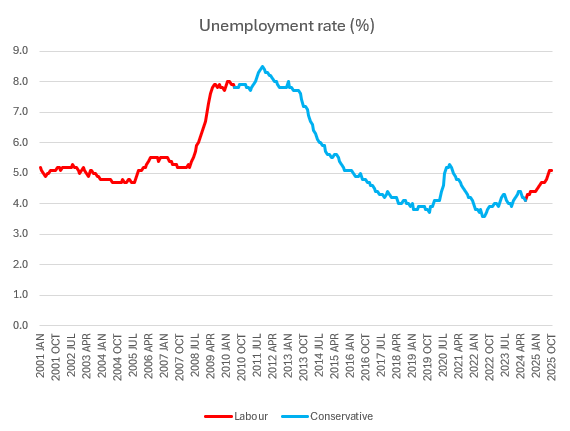
It is a bit like when Labour MP Tris Osborne says ‘unemployment was higher on average under the Conservatives’. It is technically true, but extraordinarily misleading.
Wages took a massive hammer blow from the 2008 recession, and that went on for a long time - but Reeves wants to count that as a failure of the coalition government.
Of course we would like wages to grow faster, but there has been ongoing real growth since 2013-14 ish, which is all the more surprising given the massive blows from the 2020 global pandemic and 2022 Ukraine/energy crisis.
And there are a lot of things about the recent history of earnings growth that are not widely understood, and really don’t fit Reeves’ political narrative.
If I were Reeves I would be doing less boasting about the UK labour market right now - and more to fix the unemployment problem.
Postscript - HMT have messed up.
The government didn’t publish the usual Red Book alongside the Spring Statement but they did publish a web page giving sources for some of the things she said.
Confusingly, this says the Chancellor said something different to what she actually said, something which is not correct on any reading. (If you work at the Treasury and are reading this you need to change your website.)
I don’t know whether officials have been arguing the toss with the Chancellor or whether there was a last-minute change of plan but the Treasury website says the Chancellor said thirteen years. I checked the video back, and she definitely said ten.
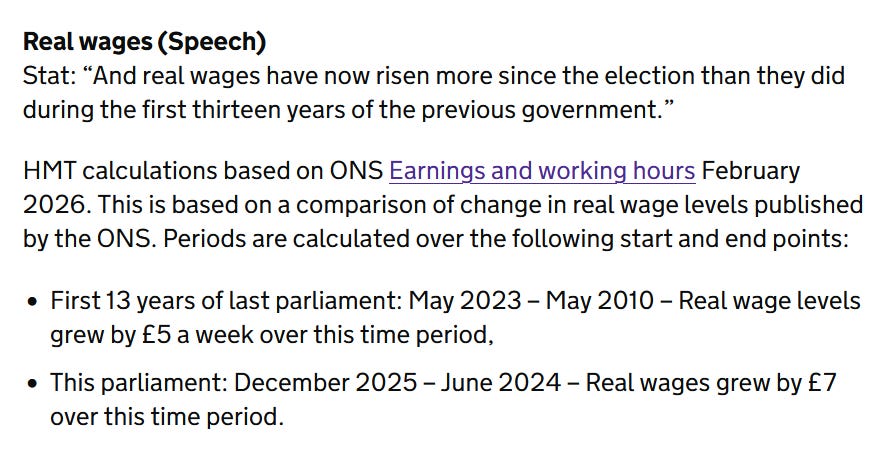
If we go into the dataset that the Treasury have linked to it is not the case that real wages only grew £5 over thirteen years. That’s just wrong.
Whoops. HMT, please correct!
This is interesting to those (like me) who are fascinated by the use and abuse of abstruse statistics but I doubt it will mean anything to the more than 95% of the population who neither know nor care what the statistics say - and as we know statistics have been manipulated since either Mark Twain or Benjamin Disraeli (or probably someone else) originated the concept of lies, damned lies and statistics.
What matters to the wo(man) on the Clapham omnibus is whether or not they feel better off - something this government (despite its obsession with "lived experience") just doesn't seem to get.
For those who are interested here's a quick guide to the three most common statistical abuses,, especially as regards public spending and economics:
- If a politician or civil servant compares one series of data with another (as in Neil's example here) check the respective start and end points for cherry picking;
- If they quote an absolute number (e.g. we are spending £Xbn on Y, or we are spending Z% of GDP on Y) check how that absolute spend compares to spend previously - it will almost certainly be lower, sometimes precipitously so (see for example current Defence spending);
- If they quote a percentage increase in spending (we have increased spend by X%), check the base number from which the percentage change is calculated - it is likely to be paltry.
But let's be encouraged that there appears to be at least one MP who has the competence to understand and analyse statistics in this way!
«And of course, what really matters is how much you actually have after tax»
That claim works only under the assumption that government spending is worth nothing to "you" so any tax paid is completely wasted. That is indeed somewhat right when "you" is a billionaire.
What really matters to most people is not their earnings before or after tax but the ratio between hours worked and their standard of living and the latter is made of both private and public services and goods
So for example property-owning "Middle England" voters are obsessed with their property gains because they require no hours of work from them (they are entirely redistributed from the work of someone else).