

“We sit on our hands and they cave in the end, same as always.”
- EU Official quoted in the FT, following Burnham’s EU deal
So, the conclusions of the UK-EU summit are up. The deal will cost taxpayers a lot. We will have less control, and it will be bad for our economy and living standards. Let’s walk through it.
100,000 a year more low wage / no wage migrants
Amazingly, despite rocketing youth unemployment - and falling numbers of young British people in jobs over the last year - Burnham has agreed to accept 100,000 young people a year who won’t earn enough to get a normal work visa - in addition to the large numbers coming from the EU visa existing and not-too-demanding visa routes:
Para 39: We welcome the conclusion of negotiations on a Youth Experience Scheme (YES). The scheme will allow 100 000 young people from the EU and the UK respectively to reside for up to three years to engage in activities such as work, studies, au-pairing, volunteering, or simply travelling, in accordance with our respective legal frameworks. We aim to apply this agreement no later than 2028 and endeavour to ensure that opportunities under the scheme will be available to our young people no later than January 2030.
As the FT noted: “The UK government, which had originally ruled out doing any deal on youth mobility, originally offered just 30,000 places a year, then 50,000, then 80,000 but — after a late-night haggle — conceded 100,000 places.”
The government’s own analysis of the deal (which we can assume to on the rosy side) suggests only 65% of those who come will get jobs. The UK government analysis notes that:
The policy increases both GDP and the population (through higher net migration) by similar proportions, so the impact on GDP per capita is 0.0% at one decimal place.
Wow! 0.0%!
Remember, these visas are in addition to the various routes like work visas and student visas which EU citizens will still be able to access. So by definition this will be a route for people who don’t earn enough to meet even the modest requirements of a work visa.
That means that those who are working will be by definition competing at the bottom end of the labour market with young British people who can’t get jobs. Yes, in the long run of course there is no “lump of labour” - but equally the real economy doesn’t just instantly clear like it does in a textbook. If you bring in a lot of extra people to work in low wage jobs you will absolutely make things harder for the existing young unemployed to get jobs.
The government says that places will be “allocated in proportion to each Member State’s population”. It says that “The YES entitles participants to stay for two years, with the possibility to extend for a further year.”. But they also note that once people are here they are more likely to stay on leading to a permanent increase in immigration. They say they assume that “Net migration remains positive beyond the third year because some participants stay in the UK after their three-year YES visa expires. These participants move onto other immigration routes, such as the Skilled Worker or Family routes, which they would not have used without the YES.”
So to summarise - no productivity boost at all, but more net immigration, meaning more pressure on infrastructure, public services and housing. And a compounding of our problems with youth unemployment.
This means it will be a net negative for living standards.
Higher Energy Costs
The agreement says that the UK will link to the EU Emissions Trading System on 1 January 2028.
This means higher energy prices. For years, the EU carbon price (a traded tax) has consistently been ~25% higher than the UK - though it has narrowed a bit recently on the prospect that the UK will join the EU ETS.
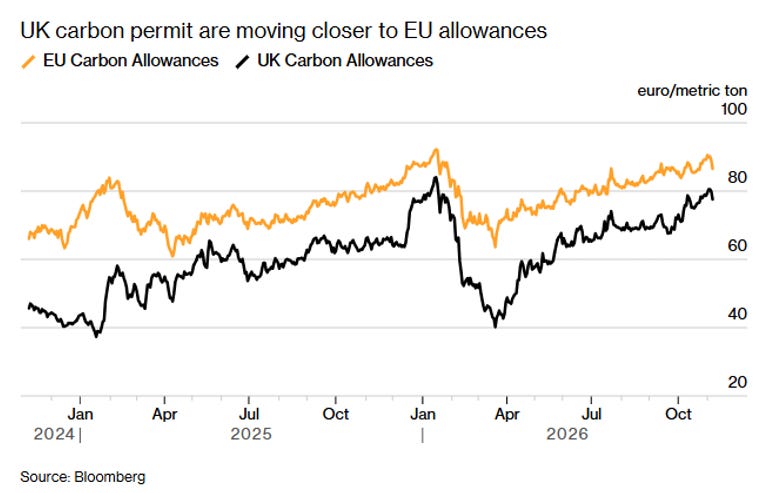
So joining will increase energy costs in a very obvious way - UK energy bills will go up as the higher tax kicks in.
The notional gain from this is that those who export things to the EU which are covered by the EU Carbon Border Adjustment Mechanism will be exempted, so won’t pay that tax.
But this is like the American soldier in Vietnam who said that it was “necessary to destroy the town to save it.”
These firms will avoid a higher tax on some of their exports. But they will face a higher tax on all of their activities instead. And all the other firms who don’t have exports facing the CBAM will be paying more too.
Andy Burnham talked about avoiding higher taxes on £6.5 billion of exports. But in return for placing higher taxes on all £3,000 billion of our economy.
In a report for the Prosperity Institute David Turver notes that
if the [UK-EU carbon price] gap persists at £13/t, British business would be better off to the tune of £3.5bn in avoidable ETS taxes; if the gap widens to £31/t, the amount would be £8bn. Both these savings to the whole economy far exceed the alleged cost to exporters of £0.2–£0.8bn. This demonstrates that the claimed benefits of UK-EU ETS alignment are illusory.
And aligning with the EU’s ETS isn’t the end of it - we will also have to follow their rules. The UK government explainer says that,
“From 2028, the UK will dynamically align with the EU rules”. For example it notes that “the UK will align with key EU rules on free allocation.” This will allow the Eu to tell firms in the UK what to do.
For example, the EU recently proposed that, from 2031, ETS free allowances should be made conditional on recipients spending at least as much as the allowances are worth on “decarbonisation investments” - to be decided by the EU.
How will this affect British businesses? We don’t know. And what certainty can they have that the British government can protect them from rules made elsewhere? None.
From 1 January 2028 the EU is about to put a carbon price on petrol, diesel and home heating through ETS2, which expands the ETS to fuel used in buildings, road transport and additional sectors. Will ministers rule out linking us to it?
As the UK fuels industry has noted:
“The expected agreement to adopt the EU’s more expensive Emissions Trading Scheme is already costing UK fuel producers. We need to ensure that UK industry remains globally competitive and that any future deal preserves the UK’s economy and energy security. UK refineries are already unable to compete on a level playing field with carbon costs, not paid by many oversees producers, set to triple by 2030.”
As Gareth Wiltshire recently noted that even within the EU there is alarm about the policies we are now joining:
It is not as if the EU industrial base is thriving under the EU ETS. The EU trade associations covering every major energy intensive industry have repeatedly called for a more realistic ETS policy, especially in the as yet to be defined post 2030 time frame. This includes the most recent joint letter of the 3rd of November, signed by groups such as metals, chemicals, fertilisers, glass, ceramics and fuel producers. The open letter highlights the politically targeted rate of local emission reduction as unachievable while maintaining EU manufacturing. Every EU proposal to speed up decarbonisation, such as the proposed “conditionality for free allowances”, is more likely to deliver deindustrialisation than decarbonisation.
Paying into the EU budget
Before the EU summit the government put out a very carefully drafted statement designed to mislead people into thinking we would not be paying into the EU budget:
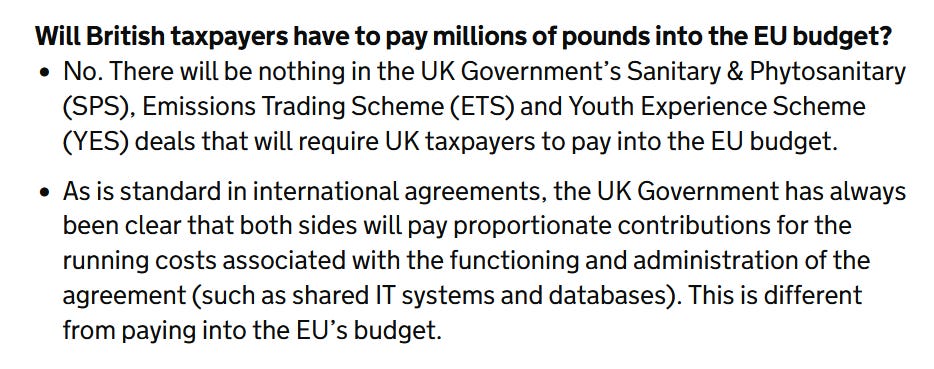
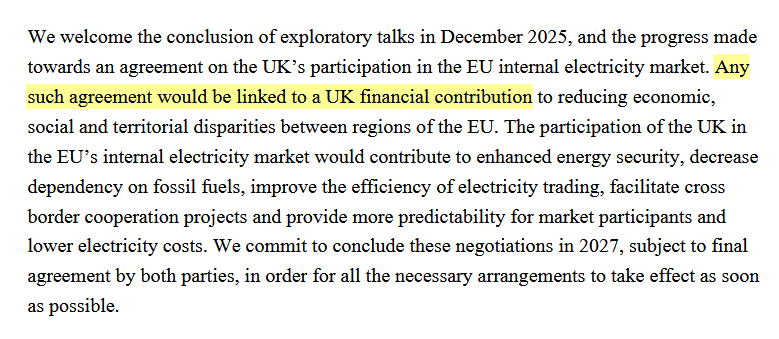
Now that the summit text is published, we can see this was a lie - a classic Foreign Office attempt to treat people like fools. As part of joining the ETS, the government is aiming to agree to be a rule taker as part of the EU Internal Energy Market. Paragraph 52 notes that
“Any such agreement would be linked to a UK financial contribution”:
They have also ignored the payments we will have to make as part of the Labour government’s decision to replace the Turing scheme with participation in Erasmus+.
Sure, the Foreign Office are welcome to try argue that paying to fund the EU’s regional policy is completely different to paying into the EU budget. Good luck with that. They are treating people like morons here. No one is fooled.
Paying to cut fees for EU students.
Labour promised they would sort of the incredibly high and unfair interest rates faced by those on Plan 2 student loans. The Education Secretary said it “was at the top of her in-tray”. They have not fixed this problem for British graduates, but somehow have found loads of money for overseas students.
The agreement states that:
“The EU and UK will therefore work towards a supplementing agreement to the Trade and Cooperation Agreement on tuition fees for EU students in the UK and for UK students in the EU. The Agreement will apply to all students from the other Party irrespective of the immigration pathway. The aim is to increase opportunities for students to study in each other’s territories. We will conclude the negotiations within six months from the date of the summit.”
As the FT noted: “Ultimately, both sides believe the UK will offer “home fees” to European students”.
This will cost taxpayers around half a billion a year according to the Russell Group of universities. Another piece in the FT noted that:
Britain appears to have retreated from an argument that only undergraduates would be covered after a deal text said agreement would “apply to all students”.
The PM has tried to argue that this huge British taxpayer bung to EU students is “separate” to the deal, but EU leaders couldn’t have made it any clearer that it is one of the “prices” the UK is being made to pay.
EU Commission vice-president Maroš Šefčovič, has said that “To come to an agreement on the youth experience scheme, we will need a solution of tuition fees.”
“The Council agrees that adoption of the Council Decisions on signing of the ETS, SPS and YES agreements will not precede the conclusion of the negotiations on the supplementing Agreement providing for equal treatment on tuition fees,” a draft of an EU statement seen by POLITICO says.
As well as the cost of giving EU students home sees, the government is going to continue in Erasmus, at great expense, already having paid for one year of the programme.
The UK’s first-year cost to rejoin the Erasmus+ programme in 2027 (covering the 2027/28 academic year) is approximately £570 million, reflecting a negotiated 30% discount on the default fee of roughly £810 million. We don’t yet know how much money the government will pay for each year from here on it, but again, the cost will be really substantial, with no advantages over the more globally focussed and cheaper “Turing” Scheme which the UK has run since Brexit.
Becoming a rule-taker on agriculture
The normal thing in trade policy deals is for each partner to recognise each other’s standards, not a one-sided deal for one side to agree to become a rule taker from the other.
For example, the EU has a veterinary agreement with New Zealand for example, where they recognise each other’s standards. Only 1% of New Zealand meat imports into the EU are now subject to physical checks. Neither of them has had to sign away control over their laws.
So, why will the EU give New Zealand something it won’t give us?
It’s because they knew that Andy Burnham would sign Britain up to be a rule taker from the EU instead, which is just what he has done.
The government have claimed the deal “could add up to £5.1 billion a year to the UK economy by 2040.” But because there are no meaningful workings or assumptions behind this (and no sense they have accounted for any of the downsides) this is meaningless at best.
Britain will follow whatever rules on food and agriculture the EU chooses to pass. Disputes go to the (EU’s) European Court of Justice. So the rules on what British farmers grow and how, what you can buy in the supermarket will be written in a room we aren’t in.
Conclusion
Ultimately the EU deal will do nothing good for the UK economy. In the absence of any plan or even understanding of what it would take to get the UK growing, Burnham has alighted on a vibes-based hope that “getting closer to Europe” will somehow do the trick.
Whatever you think of EU membership, this is a bad deal which means higher tax, more immigration and less control.
Yes, but the continuity Remain campaign will be able to convince themselves that in the long term they will defeat those nasty Leavers. And that is all that they actually care about. The details in a very real sense do not matter. Putting the Leave voters back in their box is what matters.
I fail to see why you guys would do any of these? What are they really hoping to accomplish? Am I missing something? (American here).