

The Burnham government is now doing eight different things which will increase immigration. And as well as increasing immigration, it is doing so in ways that make the immigration mix less selective and worse from an economic point of view.
(1-3) Three new legal routes
First up, the government has launched three new “safe and legal routes”. These were offered primarily as a way to placate Labour MPs who were unhappy with plans to reform Indefinite Leave to Remain (ILR) - of which more below.
The Prime Minister has argued these new routes will cut illegal immigration. He said: “we also need to build a system that offers safe routes for people as well, because that also takes away the selling point of the gangs.”
I have written before about why you can’t end illegal immigration by making it legal.
Demand to move to developed countries like the UK is near unlimited compared to our capacity to absorb it. Unless you are prepared to have totally open borders (which few advocates admit openly to supporting), then any “safe and legal” routes will have either a limit, or there will be countries to which they do not apply, at which point the people not included will still seek to come illegally.
The government has described the three new routes as follows
“A new community sponsorship scheme will allow communities to sponsor refugees to resettle in their area, taking responsibility for housing, integration and supporting them into work… The named community sponsorship model will sit outside the UKRS and operate at a much higher capacity once established” (these will arrive from Autumn 2027)
“trusted universities will be able to directly sponsor refugees through a study route. Applications will open this autumn for organisations to sponsor refugees, with the first arrivals in autumn 2027.”
Applications for sponsors for a work sponsorship route, which will see companies host refugees, will open in spring 2027. First arrivals will follow later that year.
My worries about these routes are that:
The community scheme will see diaspora groups encouraging chain migration in a way that is likely to be very balkanising - people will be brought over by and into a migrant community. As Canada has discovered, the dynamics of “community sponsorship” tend to lead to a degree of balkanisation as ethnic enclaves are deepened, and different groups bring over more members of their own community.
The university route will be a new way for lower quality HE institutions to put bums on seats at taxpayers’ expense (people on such schemes get taxpayer funded loans)
The employer route will be another way for dodgy employers to get in people who will be beholden to them - and potentially circumvent the already lax rules of the work visa routes.
In every case while there is rhetoric about people being supported by “the community”, once people are here they can claim asylum - and one way or another will become a large burden on taxpayers.
(4) The reopening of the UK Resettlement Scheme (UKRS)
On 28 September “in addition” to the three routes above the government announced that the reopening of the UK Resettlement Scheme (UKRS) for new referrals. They say that “Working in partnership with local authorities, referrals will reopen immediately, with first arrivals expected before the end of the year.” The announcement states that:
“The government expects the total arrivals across UK Resettlement and the 3 new community sponsorship routes to number in the hundreds at first, but this will grow into the low thousands as levels of illegal migration fall. A cap will be set each year. Those who come to Britain on these routes will be placed on a 5 year path to permanent settlement.”
It says that this will give:
“genuine refugees a safe and legal route to the UK. Around 1 in 4 referrals will be for Afghan women and girls and Palestinian refugees, fleeing war and persecution.”
There are no details yet about how we find out what that “cap” is or how it will be set. In this case there isn’t even the pretence of community sponsorship - this is a pure taxpayer-funded stream.
(5) Lowering the threshold for work visas
While the routes above are likely to be the most expensive for taxpayers per arrival, the further lowering of the requirements to get a work visa are likely to have a bigger impact on the numbers.
Buried in the Budget was a battery of changes to work and post study work visas some of them quite big. They are listed on page 118 and 119 of the red book:
6.94 Implementing Migration Advisory Committee (MAC) recommendations on visa salary requirements – The government is implementing MAC recommendations on visa salary requirements from spring 2027. These comprise: reducing occupation-specific minimum salary thresholds from the median to the 25th percentile of wages; uprating the general threshold based on 2026 wage data; annually updating salary thresholds using the latest ONS wage inflation data (ASHE); levelling new entrant discounts into a single figure for those studying, recently graduated, or in professional training; removing the PhD discount.
6.95 Extending visa curtailment to six months – The government will allow the highest skilled workers to access a visa curtailment period of up to six months. This will give highly skilled workers longer to find a new job, with the duration varying depending on how long they have worked in their previous, highly-paid job, with implementation in 2027.
6.96 Expanding the High Potential Individual visa – The government is expanding the High Potential Individual visa route to the top 150 global institutions. There will be a proportional increase to the cap under this scheme.
6.97 Extending the graduate visa from 18 months to two years for eligible universities – The graduate visa duration will be set at two years for individuals who graduate from high-compliance universities where there are strong labour market outcomes.
I think the most interesting is the announcement on cutting the occupation-specific salary threshold (the 'going rate') - which will fall from the 50th to the 25th percentile. The way the system works is that there is a national minimum rate, and then occupational rates designed to stop undercutting within a particular profession. It is this latter that is being changed. In practice this will mean more people come.
I am doing some more work on the “skilled worker” route at the moment - and I think a large proportion of the “skilled worker” route is a scam - increasingly I don’t believe any of the earnings data associated with it. Why?
Instead of NASA-trained rocket scientists the “skilled worker” sponsors are actually masses of kebab shops and pizza places;
you can import people and then simply have them pay you back some or all of the wages you pay them one way or another;
a licence to import people to the UK makes such companies much more valuable.
As a reminder, when you look at the names of companies with a licence to sponsor visas what do we see? Here are the number of sponsoring firms whose name includes the following words:
Curry / Kebab / Pizza / Chicken / Restaurant = 2,466
Shop / store / market / retail / news = 3,142
Kitchen / food / taste / flavour = 1,658
Pub / Bar / Cafe / Coffee = 695
Taxi / car / cabs = 253
Mosque / Temple / Muslim / Hindu / Sikh = 598
Hair / Afro / Turkish = 198
Vape = 79
Off licence = 81
Given all this, any further changes to liberalise and weaken controls on this route are very unwelcome.
(6 and 7) EU free movement for workers and students
The next change, with the potential to significantly move the numbers is the reopening of (capped) free movement with the EU in the form of a) a “youth mobility deal” and b) an agreement to give EU students access to British taxpayer-subsidised student loans, which will of course increase student migration.
The Burnham government is currently negotiating how far to go, and there is no doubt a degree of expectation management going on so that they can end up with a “lower than expected” number and then claim “victory”.
So taking the reporting with a truckload of salt, the Times has reported that “Between 75,000 and 80,000 18 to 30-year-olds a year will be able to travel to the UK for up to three years under a proposed youth mobility scheme with the European Union… The proposed annual cap is significantly higher than the figure of 50,000 previously offered by the UK’s negotiators” (31 October)
The Times also reported that “EU negotiators are demanding “home fees” for their students studying in Britain. EU students have paid international tuition fees of at least £38,000 a year since Brexit, rather than the £9,790 for domestic students. British negotiators expect that before November 20 they will agree the wording promising a significant reduction in tuition fees for EU students, to be formalised within six months.”
The Guardian (1 November) reported that
“Ministers are prepared to spend as much as £450m a year to give students from the EU discounted university fees, the Guardian has learned, but only if Brussels allows the UK access to its Made in Europe industrial programme… One person with knowledge of the talks said: “We are willing to give the Europeans what they want on fees, but we will have to get something significant in return. The biggest prize we are pushing for right now is access to Made in Europe, so there is a deal to be done there.”
On both, we will see what happens. But these negotiations are in sharp contrast to the things Andy Burnham has said over the years. In 2016 he said that “Free movement was being used to undermine skilled wages and we did not do enough about it.”
In 2019 he argued that:
"Free movement had allowed, in my view, the undercutting of wages. Some people debate this, but I saw evidence of it. Where people were brought in by agencies from other European countries and it was used to bring wages down"

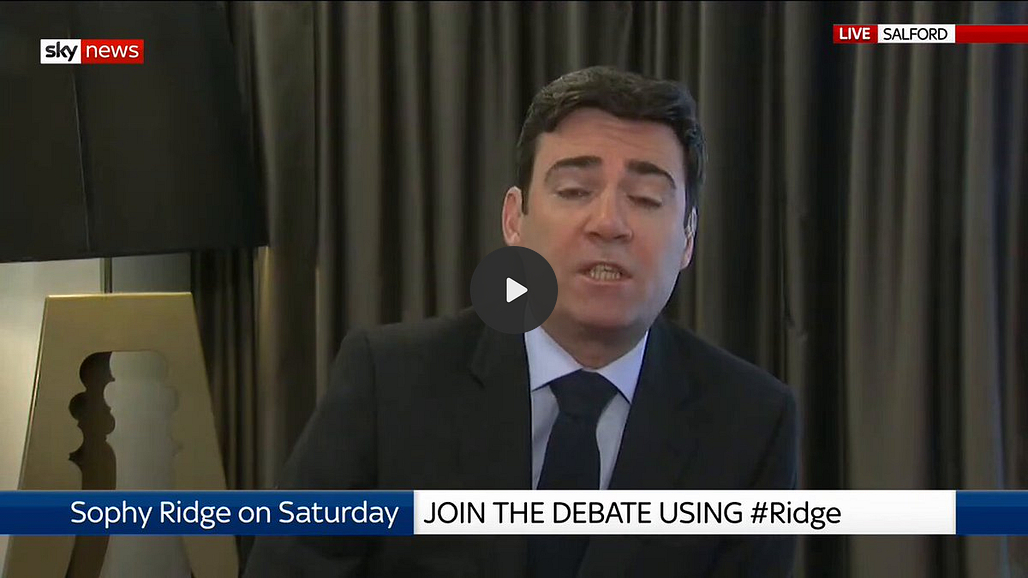
As so often with Mr Burnham, he just says what he thinks is popular in the moment, but is now doing quite the opposite by signing up to free movement, from those who are likely to have lower wages.
8 Caving in on ILR
As noted at the top, the government set up some of these new migration routes in as a political sop to buy off Labour MP’s opposition to reform of Indefinite Leave to Remain (ILR). It has not worked - Labour MPs just swallowed the concession and have now forced a retreat on ILR.
To recap the story, in May 2025 a white paper said new arrivals would only be able to apply for indefinite leave to remain after 10 years, not five. In a Times interview on 1 March this year, Mahmood confirmed the changes would apply to people already in the UK without ILR, but implementation was pushed to autumn 2026.
However, is now being reported that Mahmood will carve “care workers” out of the changes.
We will have to see what this means. The government knows how many people came on care visas but doesn’t really know how many of those people are working in care.
I will not rehash her my years of critiques of the care visa, but suffice to say it was basically the easiest visa to get for several years and a huge loophole into low wage work. Nearly half of all international students switching to “skilled worker” visas went into care.
As Alan Manning, former head of the MAC, has noted:
Those who came on a care worker visa and worked in social care for five years may have another 50 years in the UK, during which there is no obligation to work in social care or even to work at all. And their partner may also be in the UK for 50 years and never work in social care. So of the 100 years the couple will live in the UK only five can be guaranteed to be working in social care. A visa designed to supply labour to the social care sector is a very ineffective way to provide care workers and may mostly supply workers to other sectors… a study of a similar visa in Canada found that after 10 years only 15 per cent were still working as care-givers.
We will have to see what the climbdown looks like. One key question will be what happens to the dependents of those who arrived on care visas. Between January 2022 and September 2026 there were 292,800 main applicants who came on a Health and Care Worker visa as the main applicant - but they also brought with them a further 470,800 dependents - one reason it was such a bad policy. The bulk of people who came on this visa will start to be eligible for ILR and benefits from next year if the government backtrack.
But why is this cave-in in my list of measures that increase immigration? Simply put people are less likely to leave, therefore more likely to bring over relatives. And then there is the impact of the wider signal this sends - that there is an easy path to permanent residence and access to the UK welfare state. Both are hard to quantify - but the effect is clearly pro-immigration.
Conclusion
The Burnham government is now doing - or about to do - a large number of things which will increase immigration. After the extraordinary levels of immigration over recent years, I find this pretty incredible. But here we are.
It’s not incredible at all when you reflect on the fact that these are all likely future Labour voters. Is it anything more complicated than that?