

On 23 June 2016 I headed off to the polling station uncertain how I would vote, for the first time ever. And even once I was in the voting booth, I continued to ponder which box to tick for about five minutes. And it wasn’t hard to choose because I hadn’t thought about it. In fact it was hard to choose exactly because I had spent about 16 years thinking about it.
In the end I voted to leave. But even so, I can completely understand all the different reasons - both emotional and rational - why 48% people voted the other way - and I felt the pull of those arguments too.
But we voted to leave, and - after years of parliamentary argument - we finally left.
Until recently we seemed to be finding a new and stable relationship with the countries who remain in it - not least Britain has been working closely with friends in Europe to help the brave people of Ukraine.
It seemed the issues were more or less settled and we could now work on the million other issues that need our urgent attention - from the small boats crisis to the state of the NHS and the cost of living.
Andy Burnham said as much when campaigning to become PM. He said he didn’t want to re-run Brexit arguments. He said Britain would be stuck in “a permanent rut if we’re just constantly arguing”.
He promised a “relentless domestic focus”. His promises were unsurprising - after all, Makerfield voted 65% to leave.
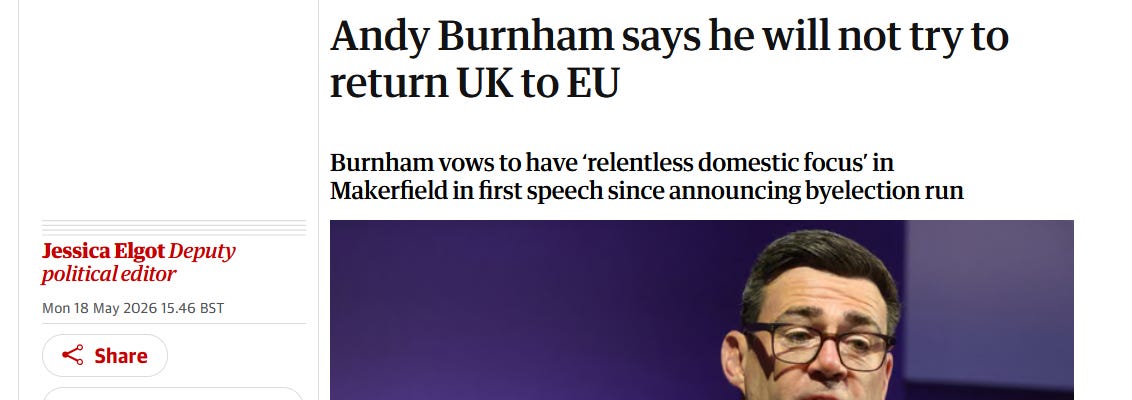
Why Burnham is reopening the Brexit rows & handing over your money to the EU
But… as so often with Burnham, that was then, and this is now. What changed?
The PM is struggling to enunciate any clear economic strategy - or any strategy full stop. This is a bit embarrassing, as his pitch to bump off Keir Starmer was that had a much clearer vision and would end the muddle and drift of the Keir era. And yet… he has been reduced to hiring expensive consultants to tell him what his own 10 year vision is. It turns out Chat GPT is no substitute for a plan. On the economy Burnham has become simply the latest Labour figure to discover that there is no magic money tree, so we are stuck in doom loop of tax increases, slow growth and rising youth unemployment. But all the things Burnham might sensibly do to get the economy moving would run into a brick wall of opposition from Labour MPs (e.g. welfare reform) or contradict the last Labour Manifesto (e.g. no new drilling in the north sea). In the absence of a real plan, “Get close to the EU” makes it sound like he has some kind of vague plan.
Building the sunset coalition. The PM’s political strategy is not to compete with the right (as Morgan McSweeney wanted to) but to consolidate the left. Striking a pro-EU stance is part of his strategy to build ties with (and borrow votes from) the Lib Dems and SNP.
So, for these reasons, at the end of the week on on 20th November, at an EU summit, Burnham will be bringing back all those Brexit rows: signing up to increase the cost of energy yet further; increase immigration despite high youth unemployment; and above all - agreeing that that British taxpayers will be paying a lot of money for the privilege of this agreement.
What will Burnham sign up to?
We already have a fair sense of the likely agreements from press reports and the fact that the draft conclusions have already been leaked on 4th November. Here’s what Burnham is about to agree.
Paying into the EU budget. The UK would be allowed to participate in the student exchange scheme Erasmus+ - but only in return for the UK going back to making financial contributions to the EU budget. Erasmus is about five times more expensive than the UK “Turing” scheme which it replaced. And to make matters worse, the draft conclusions say UK taxpayers will be asked to fund the EU’s regional spending in return for joining, though it describes this rather opaquely as “participation of the UK in Interreg programmes under a new Multiannual Financial Framework from 2028”. And there are two or three other elements of the proposed agreement where payments into the EU budget are proposed.
Our large net contribution to the EU budget was one of the major issues of the EU referendum and ending those payments was one of the key things the UK secured while leaving. One of the key things the EU wants out of the “reset” is for us to gradually start paying in again. The Czech PM put it bluntly: “we need more money”. In Burnham they see a man who will give it to them.
 Tom Harwood@tomhfhWow - listen to what Czech PM Andrej Babiš says to Sky’s Alistair Bunkall when he’s asked ‘Will you support Britain re-joining the EU?’ "Yes, of course. We need more money.”
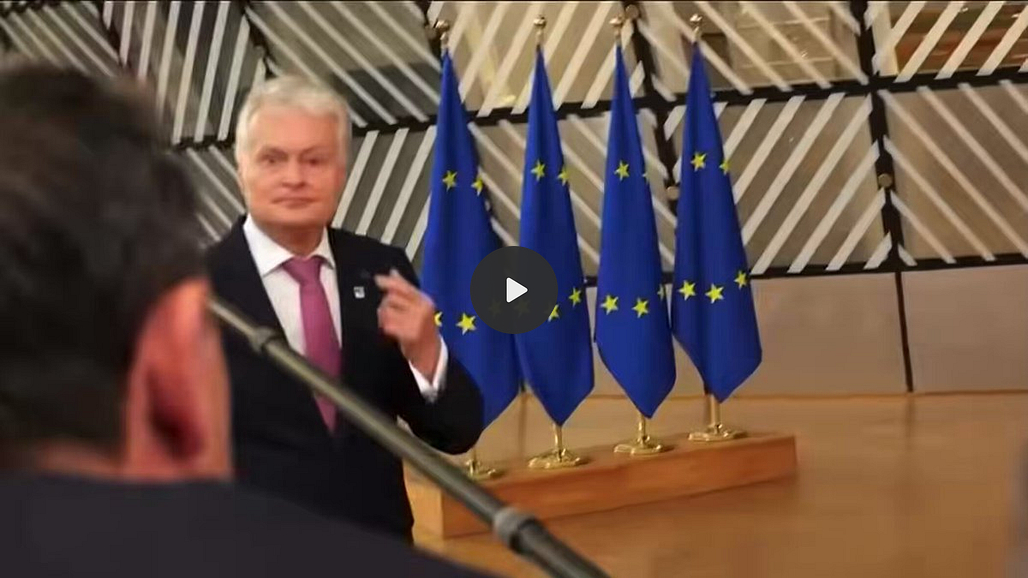 12:45 PM · Oct 16, 2026 · 178K Views206 Replies · 1.27K Reposts · 3.61K Likes

More low wage / no wage immigration, despite high unemployment. The other big issue of the referendum was free movement. The PM is set to agree to allow three years of work, study and travel without even the minimum salary limits of our current lax immigration rules. This is described as the “Youth Experience scheme” (YES). The UK government has promised there will be some “cap” on numbers under this scheme - though how meaningful that will be - or how it will even be enforced - remains to be seen. Presumably it will be on top of access to the many existing routes through which citizens of EU member states can already come here. This is a pretty amazing thing for Burham have to agreed in the context of rapidly rising youth unemployment. The number of jobs held by young British people in Britain has gone down in the last year - this agreement may well compound that.
Offering students from the EU lower fees - the same as UK students. Another cost to UK taxpayers: the Russell Group of top universities have said this will cost half a billion pounds a year to cut fees for EU students at UK universities. Because the costs are so great, the summit on 20 November will defer the final bill to save the PM’s blushes, with the draft conclusions currently stating that, “We aim to conclude the negotiations within six months.” Despite this deliberate obfuscation of the costs, graduates trapped on unfair “Plan 2” student loans will be watching in amazement. After all, Labour promised to fix these unfair loans. The Education Secretary said it was “top of her in tray”. And yet, they did not do so at Budget. And yet huge sums somehow can be found to make things cheaper for students from overseas. If you are a UK graduate you might feel quite hard done by right now.
Becoming a rule-taker in agriculture. This is known as “Dynamic alignment” on Sanitary and Phytosanitary (SPS) rules. We would get rid of some paperwork on what we export to the EU (a minority of our production), but only in return for applying a mass of EU red tape to our entire agricultural industry. Farmers in the UK will lose access to lot of fertilisers, pesticides and fungicides they need. When I have met with local farmers they are extremely worried about this. There is a lot of detail here: one report for CropLife found that “a badly negotiated new Sanitary & Phytosanitary (SPS) Agreement with the EU could wipe out 10% of farm income” because of the loss of access to essential crop protection tools.
“Dynamic alignment” will require the UK to follow all current and future EU rules in the covered areas, including SPS, food safety, agri-food consumer protection, live animals, pesticides, organics and certain marketing standards. In a normal trade deal you agree mutual recognition - this is one-way regulatory subordination
Higher energy costs - and becoming a rule taker on energy. The UK would join up to the higher carbon prices of the EU emissions trading scheme (EU ETS). The UK carbon tax / price is cheaper than the EU one, and linking would close the gap upwards. In fact just the prospect of joining up has caused the price in the UK ETS to increase - UK prices jumped about 6% on 26 May alone on suggestions that the two would link and the spring saw the big gap close a bit on speculation the UK would join. Energy Aspects calculate that if the UK were to break off talks about joining the UK price would settle at nearly half the EU level. If Burnham does sign us up to the EU ETS, a future government serious about cutting energy costs will need to leave this agreement to cut bills.
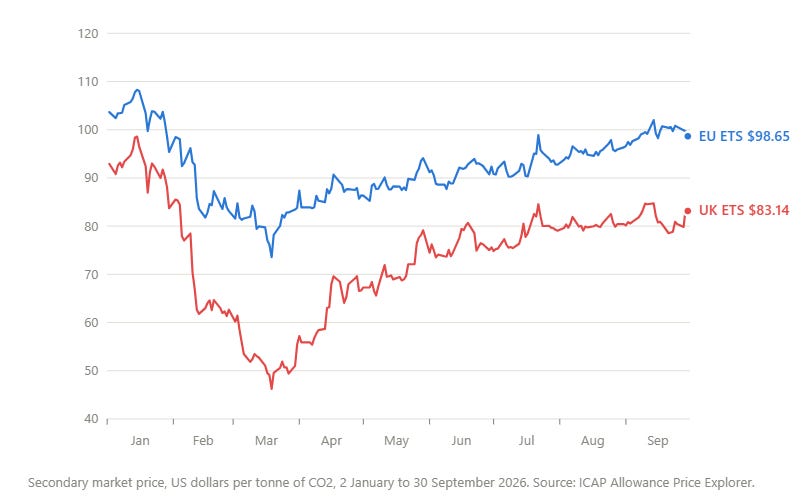
ETS prices in the UK and EU The UK already has non-discriminatory access to EU energy networks and interconnections to the continent. But Burnham is also about to agree to join the EU’s “Internal Energy Market”. What’s the difference? We will have to abide by a bunch of EU rules on renewables and to accept their court (the ECJ) as the arbiter of disputes. And we will have to pay for the privilege! The draft states that: “We agree that the UK’s participation in parts of the EU’s internal market requires an appropriate level of financial contribution” - so it’s yet another shakedown.
Since the Government have agreed to dynamic alignment and to maintain equivalent decarbonisation targets, this will also mean joining the EU’s new Carbon Tax regime called ETS 2, which will impose punitive new taxes on petrol, diesel, jet fuel, and gas used in boilers. Nobody voted for new taxes on their cars and heating.
Further cuts for UK fishermen. The government’s whole approach to negotiating on fish has been disastrous. In May last year they agreed to give the EU 12 years of access to UK fishing waters in return for… effectively nothing but a promise of talks. The draft agreement references this and says chirpily: “We welcome the decisions on full reciprocal access to waters to fish until 30 June 2038”
But British Fishermen didn’t “welcome” it. In fact they described it as a “horror show”. The draft conclusions now say that having given way on fish and allowed in EU vessels, we will now have to cut what UK fishermen catch. “We agree to work together to give a perspective to our joint fisheries in the Celtic Sea, which are currently suffering from a drastic downward trend negatively impacting fishers and coastal communities in the UK and the EU. We agree to put in place measures to reverse that trend.” Step one to reverse that trend could have been not allowing in vast trawlers from EU nations. But now Labour have - and the consequence will be tough on UK fishing.
Foreign criminals not deported. The draft test of the agreement says, “The UK recognises the concerns of the EU with the early removal and deportation of foreign national offenders from the UK to the EU Member States in particular under the Sentencing Act 2026. The UK commits not to proceed with such removals and deportations in the future.”
EU member states are alarmed by the Labour government’s early release scheme will let criminals from their count. As an article in Politico explains:
Britain is preparing to release thousands of prisoners early to free up space in its overcrowded prisons. Its European neighbours are getting worried.
Five EU diplomats told POLITICO that their countries are particularly concerned about this change, with some saying they fear their nationals could be returned with little or no advance warning or communication.
“It’s very risky sending back criminals without any prior information,” said one EU diplomat […]
Britain is on course to release over 2,500 offenders by the end of the year under the scheme, with a further 700 due to be freed on Oct. 1.
But from January 2027, the government will also remove the requirement for foreign offenders to serve a minimum period in a British prison before being deported. […]
The problem with this is that the government is still planning to release these people. It’s just agreeing not to deport them. So they will be loose in the community here.
Conclusions
During the bitter Brexit wars of 2017-2020 we discussed and voted on various options where we would tether ourselves to the EU without a say.
But these options never commanded a majority - until now, it seems.
Again and again we have been promised that integration with Europe will yield economic miracles. Again and again this hope has been dashed. Some said that Brexit would be catastrophic for the economy, some said it would be brilliant. Both were wrong - the UK’s performance since the referendum has been mid table1. All of Europe has been left in the dust by the US.
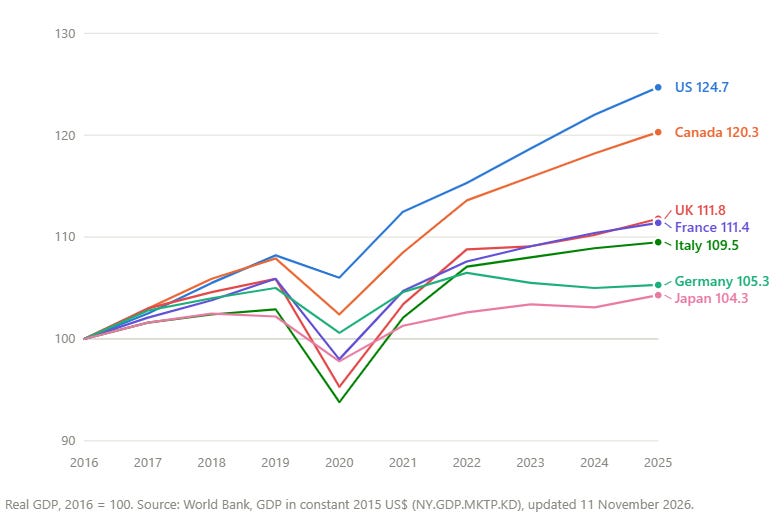
The truth is that other things matter more - tax policy, welfare reform, energy, getting stuff built, innovation policy, regulation… all the things Burnham is going nowhere on - or even backwards.
Because he has no plan to fix the economy, and because he is in search of votes, the Prime Minister is about to sign us up to a deal which means a big bill for UK taxpayers; more immigration (even as unemployment increases); higher energy bills, fewer foreign criminals deported - and agreeing to be a rule taker with no say.
This is a terrible “deal”.
People signing it on the EU side need to know that we will not be bound by it - and we will will leave it.
Claims that the UK has “lost 8% of GDP” from leaving are based on assuming totally absurd counterfactuals where it is assumed we would have blown away everyone else, were it not for Brexit.
This is crazy politics.
Is Burnham planning to find a new constituency as I'd imagine the Brexit supporters in Makerfield will be furious at being conned. Does anything sting more than betrayal? It's a shame that the 10% rule doesn't apply when a politician has made fundamental promises to get elected and then reneges on them.